From Wonder to Work: The Unified Picture and an Honest Ledger
Energy, vacuum models and actuation: connecting calculations to experiments.
This chapter brings together the energy sources, vacuum models and actuation experiments explored in the book. Puthoff's proposed synthesis connects these research programmes; testing it requires measurements of how the parts work together.
Before you move anything — what do you expect?
Optional, and there is no score. The instrument below works exactly the same whether you answer or not.
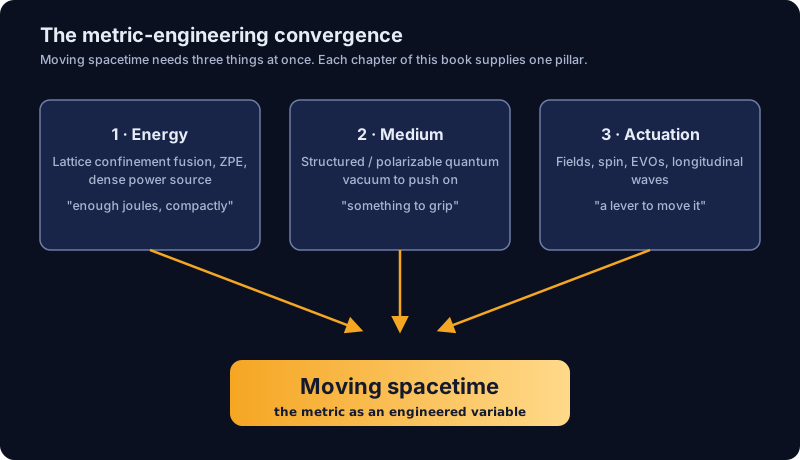
The convergence thesis
The unifying idea comes from Harold Puthoff's 2010 DIA reference document. Three ingredients, each explored in this book, might one day combine into propulsion that moves spacetime instead of throwing propellant:
- Energy — a compact, high-density source (Chapter 12's lattice fusion is the best candidate).
- Medium — a vacuum that is real, structured, and possibly a superfluid condensate (Chapters 2, 5).
- Actuation — some way to drive that medium: high-frequency resonance, spin, phase conjugation, or coherent charge (Chapters 8, 10, 11).
It is a genuinely elegant synthesis. It is also not a working technology yet, and the reason is arithmetic rather than attitude.
Formula 13.1 is the stack at the top of this chapter, written in symbols: the three layers enter as a product, not a sum, which is why one factor at zero leaves nothing however strong the other two are.
Before the ledger, the one idea the rest of this book hangs on. A warp geometry does not push the craft through space faster. It changes how much distance sits between the craft and where it is going, and it leaves the craft's own neighbourhood flat while it does so. Chapter 4 walks that idea frame by frame at one fixed shell; here the shaping is a dial you turn. The instrument below draws both rails at once — the coordinate marks, which never move, and the same marks placed by the distance a ruler would actually measure — and the amplitude you choose is what sets how far apart the two readings drift.
The distance is what changed
You do not move the ship. You engineer the distance. On the upper rail the coordinate marks never move and the craft crosses them at an ordinary local speed. On the lower rail the same marks are placed by proper distance — the distance a ruler would actually measure. Ahead of the craft they crowd together, behind it they spread apart, and inside the craft's own neighbourhood the spacing is untouched. Raise the shaping amplitude and watch which quantity changes.
- The craft's own neighbourhood
- The craft
What is happening: The distance still ahead has contracted and the distance already behind has expanded by the matching amount. The craft's own neighbourhood measures exactly what it measured before, so the traveller's frame is flat and unremarkable, and the local speed across it is ordinary.
- Proper distance still ahead — as a fraction of the flat distance
- 87.1%
- Proper distance already behind — as a fraction of the flat distance
- 117.4%
- The craft's neighbourhood, compared with flat
- 100%
Nothing here moves through local space any faster than it otherwise would. Inside the flat neighbourhood the craft's speed is an ordinary local speed at every frame. The distance is the engineered quantity.
What is taken from ahead is given to behind: the profile is odd about the craft, so the two changes cancel and the line as a whole is neither created nor destroyed. The proper distance is redistributed, not manufactured.
Published warp metrics are mathematical geometries in general relativity, not demonstrations of a working craft. This one-dimensional teaching profile uses scaled axes: flat at the craft, contracted ahead, expanded behind and conserved overall. The drawing itself is not a solution of the field equations.
The source sheet: Alcubierre 1994, The warp drive — hyper-fast travel within general relativity
The table below connects each research question to its source and the measurement needed to test it.
Experiments and sources
Read the results and proposals alongside their sources and next measurements. Choose a unit to follow its connections.
Claims shown: 13
| What the source reports or proposes | Next measurement or calculation |
|---|---|
| Mohideen and Roy measured attraction between a metal-coated sphere and plate at submicrometre separations, comparing it with corrected Casimir-force calculations.Unit 4 · The source | Compare different shapes while controlling separation, surface roughness and material properties. |
| Wilson's team detected microwave photons by driving the electrical boundary of a superconducting circuit. The drive supplies the energy.Unit 5 · The source | Compare electronic boundary modulation with a mechanically moving boundary, measuring the drive input and emitted photons. |
| Hotta's protocol uses a distant measurement and classical communication to extract energy locally from an entangled system, with measurement energy included.Unit 5 · The source | Measure the extracted energy and all measurement and control inputs as the separation changes. |
| Saldanha and Batelaan calculate interference-phase changes for particles shielded from electromagnetic fields, with the phase depending on the field configuration in spacetime.Unit 15 · The source | Test the predicted dependence of the interference phase on the connecting wire's winding around the solenoid. |
| Ford and Roman bound time-averaged negative energy for free fields in flat spacetime; the four-dimensional massless-field bound scales as inverse sampling time to the fourth power.Unit 14 · The source | Calculate bounds for the chosen field, spacetime and sampling procedure before applying them to a proposed geometry. |
| NASA's experiments irradiated deuterium-loaded metals with energetic photons and measured fusion neutrons; the trigger accelerates individual deuterons within the lattice.Unit 9 · The source | An independent laboratory reproducing the rate with the full isotopic and neutron scorecard published. |
| Bobrick and Martire construct mathematical models of subluminal, spherically symmetric warp shells with positive energy. Their shells still require propulsion.Unit 14 · The source | Independently reproduce the metric and its full stress-energy tensor, then specify the material and propulsion requirements. |
| Santiago, Schuster and Visser derive null-energy-condition violations for the physically reasonable warp-drive geometries they analyze in general relativity.Unit 14 · The source | Check each proposed metric against the theorem's assumptions and calculate where its energy-condition violations occur. |
| Moddel reports electrical output from metal–insulator–metal diodes adjoining Casimir cavities and investigates possible measurement artifacts. He proposes a vacuum-energy mechanism.Unit 5 · The source | Output power per unit area from cavity-bearing and cavity-free devices on one wafer, measured in a second laboratory, with the difference surviving the artefact list. |
| Thibado's group measured current associated with moving freestanding graphene in a diode circuit under an applied voltage. Their model includes thermal fluctuations.Unit 5 · The source | Scale the circuit while measuring the applied-bias contribution, thermal exchange and load power at a stated temperature. |
| Haisch and Moddel's patent proposes collecting radiation as gas atoms traverse Casimir cavities, with energy exchange attributed to a modified vacuum environment.Unit 10 · The source | Nanopores of consistent size and shape, the radiation imaged to locate its source, and its spectrum measured to see whether it is thermal and at what temperature. |
| Millis and colleagues compare warp drives and other propulsion concepts using explicit energy and mission requirements.Unit 17 · The source | One independent measurement of any actuation mechanism with its energy ledger closed. |
| DESI DR2 distance measurements, combined with other datasets, favor an evolving dark-energy model; the preference depends on the datasets and cosmological assumptions.Unit 6 · The source | Compare future releases and independently calibrated supernova samples to test whether the preference for evolving dark energy persists. |
Open the unit for its explanation and the source for its methods and results. The next steps are questions to investigate, not reported outcomes.
One row of that ledger has a whole programme standing behind it. Exodus Propulsion Technologies reads a steady force from a sealed article that expels nothing, and its numbers now arrive on three different kinds of record: a granted patent, a livestream, and one builder working from outside. The instrument below sorts them by which, places every reading that is a force on a single axis beside the best balance floors in the field, and names the two measurements that would settle it.
The Exodus ledger: what was measured, and on what record
Exodus Propulsion Technologies reads a steady force from a sealed article with nothing expelled. Some of those numbers sit in a granted patent; some were stated aloud on a show; one came from someone outside the programme. This ledger sorts them by which, places every reading that is a force on one magnitude axis beside the best balance floors in the field, and names the measurement that comes next.
The published record, in its own numbers
- Nine-blade article at 25 kV
- 237 µN
- With the ground electrode widened
- 421 µN
- Ground electrode, before and after
- 8 → 15 in²
- Increase computed, then measured
- ×1.8 → ×1.77
- In the patent — 5
- Stated on a show — 4
- From outside the programme — 1
- Still to come — 2
- 2019 Dresden balance floor · 2021 rebuild floor
- The nine-blade law at the chosen voltage
- Force predicted for the nine-blade article:
- 237.0 µN
- times the 2019 balance floor:
- 21,545×
- Mass that force lifts at thrust-to-weight 1:
- 24.17 mg
- Mass at the advertised thrust-to-weight of 0.5:
- 48.33 mg
Force predicted for the nine-blade article: 237.0 µN. Mass that force lifts at thrust-to-weight 1: 24.17 mg. 21,545 times the 2019 balance floor.
Rows shown: 12
| The row | What kind of record | Where it is stated |
|---|---|---|
| Nine-blade article: 237 micronewtons at 25 kilovoltsQuarter-inch blades four inches long, potted in high-voltage epoxy and hung as a pendulum against a force meter. This is the programme's published reading, and it is the number every other figure on this ledger should be read against.237 µN · 21,545× times the 2019 balance floor | In the patent | The patent |
| Ground electrode widened from 8 to 15 square inches: 421 micronewtonsThe increase was computed as 1.8 before the run and measured as 1.77 after it. A prediction made in advance and met to within two per cent is the strongest single item in the published record.421 µN · 38,273× times the 2019 balance floor | In the patent | The patent |
| The force rises with the square of the applied voltageReported repeatedly across a variety of shapes, dielectrics, coatings and geometries. A force law you can compute straight from a drawing is what lets another laboratory build the same article and know in advance what it should read.Not a force reading | In the patent | The patent |
| The controls the inventors name: grounded enclosure, plastic bag, 180-degree flip, direct-current driveRun inside a grounded enclosure coated with conductive film and inside a plastic bag to nullify ion wind, flipped end for end to read in both tension and compression, and driven with direct current so that no magnetic component, no field momentum and no hidden momentum is left on the table.Not a force reading | In the patent | The patent |
| Changing the dielectric reverses the direction of the forceThe continuation adds a second, volumetric term, the DIV-E force, which appears wherever the field in the gap has a divergence. Swapping the dielectric can turn the force around, which is what the theory says should happen, and the filing reports hundreds of further test articles built to test both terms.Not a force reading | In the patent | The patent |
| A sixteen-hour run at 6 kilovolts in about four millionths of a torrStated on air as 255 milligrams of upward force and glossed in the same breath as about 250 micronewtons. One milligram of weight is 9.81 micronewtons, so the two figures as spoken stand a factor of ten apart; this ledger records both rather than choosing, and publication of the logged data, 250 samples a second across about forty channels, is what would fix which one the run carries.250 µN · 22,727× times the 2019 balance floor | Stated on a show | Alternative Propulsion Engineering Conference, 29 August 2026, on the Alt Propulsion channel |
| About 220 micronewtons still reading an hour after shutdownThe team explains this one conventionally themselves, as charge trapped in the dielectric rather than as an exotic persistence. Offering the ordinary explanation for your own most striking number is the habit this chapter asks of everybody.220 µN · 20,000× times the 2019 balance floor | Stated on a show | Alternative Propulsion Engineering Conference, 29 August 2026, on the Alt Propulsion channel |
| How many experiments there are, as stated on two different showsCharles Buhler gives roughly 2,000 in-house results accumulated over about ten years, and says in the same session that they are unpublished. Douglas Miller, on another show ten days later, says 3,000. Both are spoken figures, and the site holds them as spoken figures until a paper carries one.Not a force reading | Stated on a show | Alternative Propulsion Engineering Conference, 29 August 2026, on the Alt Propulsion channel |
| Thrust-to-weight: 0.5 advertised, 1.8 measured once, 1.5 given as the ceilingThis is the claim at its full strength, and it is what the flight is meant to demonstrate. The voltage control above turns a bench reading into the mass it would lift, which is the bridge between the two.Not a force reading | Stated on a show | Alternative Propulsion Engineering Conference, 29 August 2026, on the Alt Propulsion channel |
| An unaffiliated builder, working from the patent and the build videoAbout 20 micronewtons at first and about 100 micronewtons at around 6 kilovolts from a five-tier T-blade device, read on his own scale in open air. The design, the method and the expected result all came from the programme, and the vacuum that motivated the original work was not part of it, so this is a demonstration that someone outside can get a reading. The independent repeat is still ahead.100 µN · 9,091× times the 2019 balance floor | From outside the programme | Alternative Propulsion Engineering Conference, 29 August 2026, on the Alt Propulsion channel |
| A flight in space, stated on air as within a yearA dated, pre-registered falsifier named by the people making the claim, which is exactly what this chapter asks for. A craft that changes its orbit carrying no propellant would settle it, and so would a null.Not a force reading | Still to come | Alternative Propulsion Engineering Conference, 29 August 2026, on the Alt Propulsion channel |
| The vacuum-chamber dataset in the peer-reviewed literatureThe patents are the published record today. The run itself, with pressure, temperature, drive and balance on one time axis, is what another group needs in order to model it, and a torsion balance or an interferometric readout beside the capacitive scale is the reading that would close the instrument question.Not a force reading | Still to come | Not a force reading |
The measurement that would settle it
Two things, and the programme named the second one first. A second laboratory measuring one of these articles on a torsion balance or an interferometric readout, in vacuum, with a symmetric null article of the same mass beside it. And the flight itself: a craft in orbit that changes that orbit carrying no propellant. Each outcome is decisive.
A patent and a livestream are both usable, and they are not the same record. Published rows carry the sheet that states them. Spoken rows carry the show, the date and the timestamp, and nothing else.
A funded programme with hardware, a granted patent and a dated next measurement. Every figure here comes from the patent sheets or from the show named on its row; nothing on this ledger is a re-plot of anyone's raw data.
Measurements and models
Casimir experiments measure forces between boundaries; the dynamical Casimir effect measures photon production. General relativity supplies mathematical warp and wormhole geometries. Santiago, Schuster and Visser (2021) examine the null-energy-condition violation in moving warp geometries, while Bobrick and Martire (2021) derive subluminal shells with positive energy.
Emergent-gravity and superfluid-vacuum models explore how large-scale behaviour could arise from an underlying medium. Lattice-confinement fusion experiments measure nuclear reactions; a power source also needs a complete input-output energy balance. Pais's proposals, conditioned fields and rotating-superconductor experiments address actuation through different mechanisms and apparatus. Connecting these strands into a vehicle requires an independently measured force together with its energy balance.
The institutional record
This is not a lone-inventor field. NASA chartered the Breakthrough Propulsion Physics programme (1996–2002) under Marc Millis to ask exactly these questions. The AIAA published Frontiers of Propulsion Science (Millis & Davis, 2009) as a credentialed survey. Their summary is the one we land on: the questions are legitimate, and the answers are not in yet. Institutional interest is real and documented. A working device is what the next experiments are for.
The worked example, one last time
Chapter 9 follows Ashton Forbes's interpretation of the MH370 recordings: three luminous objects around an aircraft and a proposed connection to plasma and metric engineering. Plasma measurements and three-emitter models provide physical questions to investigate. Original sensor files, a documented chain of custody and government records address the recordings' origin and history.
Your own research programme
The real payoff is a habit you can carry into any big claim, in this field or any other:
- State the claim precisely enough to be tested.
- Read the source and distinguish its measurement, calculation or proposed experiment.
- Name the measurement that would move it, in advance.
- Count the independent measurements behind it. Three unrelated groups is a different thing from one result told ten times.
- Follow the next experiment, and update when it lands.
- Follow the measurement wherever it goes. Tajmar improved his own experiment until his exciting signal shrank into the noise, and he published that. His bound is now the number to beat.
“Which experiments would connect these results to propulsion?”
Casimir forces, dynamical Casimir photons, gravitomagnetism and lattice-fusion reactions each have their own measurements. Connecting them to propulsion requires an actuation measurement with a complete energy balance. Chapters 8, 10 and 11 examine an orbital thrust test, a conditioned-beam inertia measurement and a spin-up run with its ramp rate stated; Chapter 12 examines proton–boron yield. Each experiment tests a particular link in the proposed system.
What the field added — July to September 2026
The convergence case gained on every front. A peer-reviewed vacuum effect on a superconductor (Chapter 2). Federal feasibility money for a vacuum-energy generator, and three chip programmes with named physicists (Chapter 6). A published bench experiment on spacetime distortion, with a funded thrust test on the calendar, and a fully specified gravitational-wave emitter (Chapter 4). A propellantless drive with an orbital test within a year (Chapter 8). An active aneutronic fusion programme with a dated plan (Chapter 12). An official "unresolved" gunship report of cold orbs (Chapter 8).
The institutional spine got longer, and every item on it is verified. The DIA commissioned 38 reference documents; all 38 are accounted for — the last one surfaced in 2019 and turned out to be a conventional laser-weapons review. The Air Force funded plasmoid and ball-lightning studies. NASA published the conditioned-field proposal in its own proceedings. The State Department hosted a future-energy conference in 1999. The Space Force funded a vacuum-energy generator in 2026. A Nobel laureate wrote to a charge-cluster inventor to say the observation might be real. There are 6,543 patent secrecy orders in force. A congressional witness spoke of "sentient plasmoid life" on the Capitol steps. Northrop founder John K. Northrop said in 1974 that UFO reports imply a power source we do not have, probably fusion. On the worked example, the channel organised its MH370 case into one provenance account with tests attached and a plasma mechanism that matches the new gunship report. The picture this chapter has always argued for is sharper than it was in July: real physics, real institutional interest, and real experiments under way. Research log. The site is named for the metric; its drill-down course, from rulers and clocks to the warp-bubble energy budget, is at /courses/metric-tensor-warp-bubbles.
The honest ledger gained an entry on 8 September 2026, and it is the good kind. Douglas Miller gave this field the phrase vacuum-catalysed fusion. He restated it in a narrower, more testable form, and disclaimed the stronger version out loud. He also named the constraint he works inside. It is the one Charles Chase states from the other side of the field: "I'm a conservationist… I believe in the conservation of matter and energy." The vacuum, Miller says, is "a cycle, just like an electric circuit — you have one electrode, you got to have a second electrode to close the loop." Finding that return path is the first thing his company means to do. Two builders, working apart, drew the same line under their own work. That is what a field looks like when it is being done properly.
The closing note of that conversation is the one this book has argued for thirteen chapters. Miller says his aim is "to create a generation of ZPE engineers." He thinks we should tell a ten-year-old, truthfully, that they can be a warp drive engineer. Every page here is written on that assumption. The reader is a future contributor, not a spectator.
Experiments to follow
An independent actuation measurement needs a complete energy balance. The proposed tests discussed here include orbital thrust, conditioned-beam inertia, a spin-up run with its ramp rate recorded and proton–boron yield. Their results would address different parts of the energy and propulsion programme.
Sources
A synthesis chapter - its sources are the load-bearing anchors of the pillars it weighs, plus the institutional record that the questions are legitimate.
The convergence thesis, stated in the corpus's own terms
- H. Puthoff (2010), "Advanced Space Propulsion Based on Vacuum (Spacetime Metric) Engineering," JBIS 63, 82 (arXiv:1204.2184). (Downloaded.)
The institutional record - the questions are legitimate (beyond the source corpus)
- M. Millis (1998), "Breakthrough Propulsion Physics Program," NASA NTRS 19980201240 - NASA chartered exactly these questions, 1996-2002. (Downloaded.)
- M. Millis & E. Davis (eds.), Frontiers of Propulsion Science (AIAA Progress in Astronautics 227, 2009) - the credentialed survey volume.
The current peer-reviewed frontier (from Ch. 4)
- A. Bobrick & G. Martire (2021), arXiv:2102.06824; S. Santiago, J. Schuster & M. Visser (2021), arXiv:2105.03079 - subluminal warp shells may be physical; moving warp drives still break the NEC.
Where the physics is worked out
- US DoD/AARO (2024), Historical Record Report, Vol. 1 - the government's public review, which sits beside the released DIRDs and the funded programmes above as two halves of one record.
- MH370 provenance (full detail in Ch. 9): Skeptical Inquirer (2024); Metabunk 13104 - the objections Chapter 9 answers, and the two named tests that would settle them.
- D. Miller, ZPE All Stars interview, Hard Truths Podcast (8 September 2026; YouTube
5MIGis0S8Fc, @1:29:30, @33:07-@35:03, @1:43:38-@1:46:15) - a second builder stating the conservation constraint and the vacuum as a circuit needing a return electrode, the narrowed form of vacuum-catalysed fusion, and the stated aim of creating a generation of engineers for it.
The convergence rule: a chain closes when its last link is measured. That link is actuation, and the experiments that would close it are named in Chapters 8, 10 and 11 - all of them on the calendar.