Lattice Confinement Fusion: The Energy Substrate
NASA Glenn's peer-reviewed fusion in deuterated metals, the screening physics that makes it work, and the milestones ahead.
This is the chapter with peer-reviewed NASA papers behind it. Every scheme in this book needs the same thing first: a small source of huge energy. Lattice confinement fusion is the best candidate on the table, and the work is public. Here is the physics, the result, and what comes next.
Why energy is the real bottleneck
Chapter 4 showed that warping the metric takes staggering energy. Even the mildest inertia- or field-based schemes need far more power than a rocket. So the first question is not which exotic drive to build. It is where the energy comes from. A breakthrough in small, dense energy is the quiet first step, and every propulsion story has to clear it.
Any metric-engineering drive needs a small, high-density energy source. That is a simple energy argument, not a guess.
The mainstream kernel: screening and stripping
"Cold fusion" is a loaded phrase. So be exact about the real nuclear physics NASA uses. Two pieces are textbook.
- Electron screening: pack a metal lattice with deuterium. The cloud of loose electrons partly cancels the push between deuterons. That lowers the effective barrier they have to tunnel through.
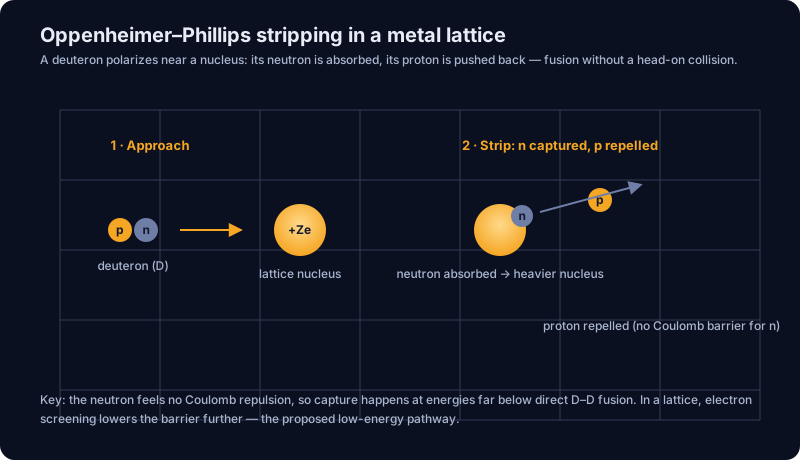
- The Oppenheimer–Phillips process (1935): a deuteron can react with a nucleus at lower energy than a bare proton needs.

- Geometry computed from
- A two-by-two-by-two face-centred-cubic block of beta-phase palladium deuteride built from the published lattice constant, with one quarter of it removed so the interior can be seen, deuterium placed in the octahedral and tetrahedral interstitial sites at the published loading and occupancy, and the coordination of one octahedral and one tetrahedral deuteron drawn as rods whose lengths are the crystallography: a half of the lattice constant, 2.013 ångström, to each of the six palladium atoms around the octahedral one, and 1.743 ångström to each of the four around the tetrahedral one, with the pair spacing the crystal sets, 2.847 ångström, spanned by its own bar inside a cubic cell frame one lattice constant on a side
- Numbers from
- Lattice constant 4.026 ångström from the Letts and Cravens sheet, loading 0.64 deuterium per palladium and roughly thirty percent occupation of the smaller tetrahedral sites from the Hubler sheet; palladium's 313 electron-volt screening energy is recorded with the model
- Schematic parts
- The cut-away quarter is a drawing device — a real crystal has no such face; it removes material only and moves nothing. Atom sphere sizes and the rod thicknesses are drawing conventions, so only the positions, and therefore the rod lengths, are physical. Which particular sites are filled is a fixed-seed arrangement at the published occupancy, not a measured filling, because no paper lists one. The screening length and the classical turning point are not drawn: at a few kiloelectronvolts the turning point is about a hundred thousand times smaller than this scene, and the site does that arithmetic in its screening instrument instead. Vacancies, dislocations, grain boundaries and the free surface are left out rather than guessed.

The screening energy is not a metaphor and not a fitted convenience. It is a measured quantity, in electronvolts, with an error bar, and it differs from one host metal to the next. Set a collision energy and a host below, and watch what the measurement buys: the bare Coulomb law holds still while the tunnelling rate climbs by orders of magnitude.
Electron screening, and what it really changes
Two deuterons approaching each other push apart by the bare Coulomb law, and they fuse only by tunnelling through that repulsion. Pack the deuterium into a metal and the metal's own conduction electrons crowd around each nucleus, cancelling part of its charge over the screening length. The pair then behaves exactly as a bare pair would if it had arrived with a little more energy — a few hundred electronvolts more, measured host by host. Because tunnelling is exponential, that small shift multiplies the rate by orders of magnitude. Choose a host, move the collision energy, and read what moves and what does not.
- Bare Coulomb barrier
- Effective barrier inside the host
- The barrier still to be tunnelled
What the screening does at this energy: The pair inside the host tunnels as though it had arrived with the screening energy added to its own. The bare Coulomb law, Planck's constant and the fine-structure constant are unchanged; the rate is not.
- Tunnelling rate, screened divided by bare:
- 19
- Orders of magnitude gained:
- 1.3
- Turning point moves inward from
- 1,152 to 921 femtometres
- Deuterium gas (reference): 0.1
- Titanium: 0.1
- Aluminium: 0.8
- Zirconium: 1.2
- Palladium: 1.3
- Tantalum: 1.3
- Palladium oxide: 2.2
The tunnelling factor. Barrier penetration follows the Gamow factor, the exponential of minus the square root of the Gamow energy divided by the collision energy. For two deuterons the Gamow energy is about 986 kiloelectronvolts, fixed by the charges and the reduced mass. A screened pair at one energy is arithmetically a bare pair at a slightly higher one, which is why a few hundred electronvolts is worth so much.
The precision point: this is an increased tunnelling rate, not a lowered bare Coulomb barrier. Douglas Miller, who coined the phrase vacuum-catalysed fusion, states the same limit himself — the idea does not require or establish any change in Planck's constant, the fine-structure constant or the bare Coulomb law.
Scope: this instrument draws the barrier-penetration factor and its ratio. The nuclear physics inside the barrier is held fixed, so every number here is a ratio of tunnelling rates — not a cross-section, not a heat measurement and not a power output. The energy balance of a lattice reactor is a separate measurement that has not been made.
The measured screening energies come from these source sheets
What NASA measured
In 2020, NASA Glenn scientists published two peer-reviewed papers in Physical Review C. That is a mainstream nuclear-physics journal. The team was Pines, Steinetz, Benyo, Forsley and colleagues. They loaded erbium and titanium with deuterium. Then they hit the metal with high-energy gamma rays. The gammas knocked deuterons loose with enough energy to fuse. The screened lattice let the reactions run. They reported novel nuclear reaction products, neutrons among them.
Two peer-reviewed papers report real nuclear reactions in gamma-hit, deuterium-loaded metals.
The chain from a loaded vial to a neutron on a detector is short, and it is worth walking rather than summarising. Take it one step at a time: what is loaded, what the metal's electrons do, what the beam does, what fuses, and what comes back out.
The Glenn run, one step at a time
This is the experiment behind the two Physical Review C papers, in the order it actually happens. Load a metal with deuterium until the nuclei sit in the gaps of the crystal. Let the metal's own electrons screen the charge between them. Trigger it with a photon beam. Then read the neutrons that come back out of fuel which never moved. Walk the five steps and watch the chain close.
Settled physics
Deuterium is packed into titanium or erbium until the nuclei sit in the gaps of the crystal itself, at solid-state density and at room temperature. There is no plasma here and no magnet: the metal atoms hold the fuel where they are.
What this step carries
- Deuterium held in the lattice
- 1E22–1E23 per cubic centimetre
What these papers report is reactions, and the energy went in as gamma rays. Net energy gain is a different measurement and it has not been made. A reactor that returns more than it draws would be burning fuel, which is a separate sentence and a separate milestone.
Scope: this instrument draws the published chain of the 2020 campaign and the energies attached to it. It computes no cross-section, no heat and no power output.
Every number on this instrument comes from these source sheets
- Steinetz, Benyo, Chait and colleagues 2020: novel nuclear reactions in bremsstrahlung-irradiated deuterated metals
- Pines, Steinetz, Forsley and colleagues 2020: the screening theory published alongside it
- NASA Glenn 2020: the lattice confinement fusion programme overview and its review panel
- The measured screening energies, host by host
From reactions to power — and how this differs from 1989
Now the part that keeps this honest, and keeps it interesting. NASA's papers report reactions. They do not report net energy gain. Those are two different measurements. Only the first has been made.
History is why people hear the second. In 1989 Fleischmann and Pons announced tabletop fusion, and the replications did not follow. Google funded a careful re-test across several labs, published in Nature in 2019. It found no excess heat at the classic levels. It also picked out screening physics in metal hydrides as worth study. That is the very physics NASA built on.
The difference is where the energy comes from. NASA never asks the lattice to make energy from nothing. Energy goes in as gamma rays, and the screened lattice lets the reactions run. The claim is narrow, tied to a mechanism, and published in a mainstream journal.
Two companies are running the same idea. Clean Planet in Japan works with Tohoku University and is jointly developing industrial boilers with the boiler maker Miura. Astral Systems is a newer entrant. Both report results from loaded lattices: Clean Planet excess heat, Astral Systems a fusion-neutron output at least fifty times that of its commercial predecessor. These are separate company reports, not independent replications of NASA’s experiment. An outside heat measurement is needed to evaluate the heat result.
Open question: what is the energy balance? What to watch next: another lab seeing the same reaction products under the same beam conditions, and a metered heat run on a loaded lattice.
The nuclear reaction products have been measured; a lattice-fusion source delivering net energy still requires a complete measured energy balance.
“Isn't this cold fusion rebranded? 1989 did not replicate, and Google's 2019 Nature programme found no excess heat.”
It is the right question, and the specifics answer it. NASA's claim is much narrower than Fleischmann and Pons. Not "net energy from a jar," but "new nuclear reaction products when we irradiate a deuterated lattice." It ran in Physical Review C, with measured signatures. The energy goes in as gamma rays, so no conservation law has to bend. The mechanisms are textbook: electron screening, and the Oppenheimer–Phillips process. The 2019 Nature work helps here. It looked hard, found no excess heat at the classic levels, and pointed at screening physics as the part worth study. The nuclear reaction products have been measured; a lattice-fusion source delivering net energy still requires a complete measured energy balance. Watch for another lab seeing the same reaction products under the same beam conditions.
What the field added — July to September 2026
A second energy line now sits beside NASA Glenn's lattice-confinement work. Eric Lerner's LPPFusion aims at aneutronic hydrogen–boron fusion in a dense plasma focus. An axial-field coil spins the pinched plasma. The spin holds the dense knot in the narrow window where it is stable. The fuel is decaborane, and the plan was published in a peer-reviewed journal in 2024. The channel taught the device's four stages in detail. The milestone to watch is the first proton–boron yield. LPPFusion projects about 25 joules from deuterium once the plasmoid shrinks as its filament work is designed to make it, and nearly a hundred times that again on proton–boron.
Froning and Bussard's 1993 paper on fusion-electric propulsion closes the loop from fusion to flight. The Air Force's own studies from 1992 and 2003 show the same plasma physics being taken seriously in government. FOGBANK is a classified material in the W76 warhead, and what is public about it comes from the NNSA and Y-12's own statements rather than from any paper: the United States lost the process for making it and re-established it in 2008. What the material actually is stays classified, and the aerogel description that circulates outside that record is an inference drawn from the outside, not a disclosure. The history is real and remarkable, and the library holds no sheet on it, because there is no publication to hold. The channel's idea that an aerogel could template a plasma is a hypothesis to keep an eye on. Research log.
The phrase vacuum-catalysed fusion belongs to Douglas Miller, and on 8 September 2026 he made it narrower and much more useful. The hypothesis is that a driven, out-of-balance electromagnetic vacuum raises the chance that two nuclei tunnel together. It does that by changing the screening around them, their polarisation, their relative motion, or simply how often they meet. The nuclear energy release does not change, and the conservation laws do not bend. Asked to put it plainly, Miller chose "increased tunnelling rates as opposed to a lower Coulomb barrier." He added the limit himself: the idea "does not presently require or establish a literal change in ħ, the fine-structure constant, or the bare Coulomb law." That is a claim a laboratory can go after. Hold temperature and density fixed, drive the environment, and the measured reaction rate either moves or it does not. What to watch: the coiner of the phrase has narrowed it to something a bench can test.
That is the shape of the experiment, and it is worth laying out as hardware before anyone builds it. Two runs on one loaded target at the same delivered power, the counter untouched in between, and a third run with the conditioning reversed. Set the bench below, and read what a difference between those counts would be entitled to claim — and what it would leave exactly where it was.
The paired run: conditioned beam against unconditioned
Here is the experiment that would settle a field-conditioning claim, laid out as a bench. One loaded target, one neutron counter, two runs in the same session at the same delivered beam power — the conditioning hardware driven in one, off in the other — and a third run with the conditioning reversed. Nobody touches the counter or the target in between. Set the beam energy, the host metal and the shift you want to test, and read what a difference on that counter would be entitled to claim.
- Run one: conditioning off
- Run two: conditioning driven
- Run three: conditioning reversed
Run two: conditioning driven
What this run would read: At the same delivered power, on the same target, through the same counter, the only quantity that moves is the rate at which pairs tunnel. The bare Coulomb law, Planck's constant and the fine-structure constant are the same in all three runs, and the panel beside the bars reads them back unchanged.
- Rate, this run divided by run one:
- 9
- Orders of magnitude against run one:
- 1.0
- Effective shift applied in this run:
- 313 electronvolts
- Collision energy in the centre of mass:
- 1,250 electronvolts
Reversal control. Run three lands back on run one exactly. A bench that does not do this has not measured the conditioning.
Held fixed across all three runs. Delivered beam power, target loading, counter and geometry, chamber and session. One thing differs between run one and run two, and it is the form of the field.
What a difference on that counter would assert
- That the tunnelling rate depends on the form of the field the nuclei sit in, and not only on the energy delivered to them.
- That the effect is large enough to read at a stated beam energy, in a stated host, at a stated delivered power.
- That it reverses when the conditioning reverses, which separates it from drift in the bench.
What it would not assert
- Nothing about the bare Coulomb law, Planck's constant or the fine-structure constant, which the panel above reads back unchanged in every run.
- Nothing about net energy: the ratio of two counter readings is not a cross-section, not a heat measurement and not a power output.
- Nothing about the mechanism. A rate difference says the form of the field matters; which gauge structure does it is a separate argument.
The settling measurement. The deuterium-deuterium neutron yield at fixed target loading and fixed delivered power, conditioned against unconditioned, with the difference reversing when the conditioning is reversed.
Scope: this bench draws a ratio of tunnelling factors between two runs of the same apparatus. The nuclear physics inside the barrier is held fixed, so the numbers are rates against rates — not a cross-section, not a heat measurement and not a power output. The energy balance of such a machine is a separate measurement that has not been made.
The sheets this bench is built from
- Froning, Barrett and Miley 2012: specially conditioned electromagnetic fields to reduce fusion input energy needs
- Fontana and Baker 2007: high-frequency gravitational-wave induced nuclear fusion, the far more extreme version of the same logic
- Carpinteri and colleagues 2012: neutron production from the fracture of piezoelectric rocks, the cheap companion experiment
- Kasagi: the measured screening energies that set the scale of this bench, palladium oxide highest at 600 electronvolts
Measurements to make next
Another laboratory should test for the same reaction products under the same beam conditions. A separate, metered heat run should close the full energy balance, whether it shows net output or not.
Sources
The most mainstream-validated node in the book - real NASA papers, real commercial partners - with the gap between "reactions measured" and "net power" kept in plain view.
Primary - peer-reviewed
- P. Pines, B. Steinetz, L. Forsley et al. (2020), "Nuclear fusion reactions in deuterated metals," Phys. Rev. C 101, 044609. DOI 10.1103/PhysRevC.101.044609 - theory: electron screening + Oppenheimer-Phillips.
- B. Steinetz, T. Benyo, A. Chait, L. Forsley et al. (2020), "Novel nuclear reactions observed in bremsstrahlung-irradiated deuterated metals," Phys. Rev. C 101, 044610. DOI 10.1103/PhysRevC.101.044610 - the experimental companion.
- NASA Glenn LCF program page and NTRS white papers (NTRS 20210026340; 20240013692; 20205006546). (Downloaded.) grc.nasa.gov.
- J. R. Oppenheimer & M. Phillips (1935), Phys. Rev. 48, 500 - the established stripping reaction LCF invokes.
Independent commercial lineages (beyond the source corpus)
- Clean Planet Inc. (Japan) + Tohoku University (Iwamura et al.) - quantum-hydrogen-energy heat; a distinct lineage, so genuine independent support for anomalous heat in loaded lattices.
- Astral Systems (UK) - "multi-state fusion"; a 2024-25 entrant to track.
Where the physics is worked out
- C. Berlinguette et al. (2019), "Revisiting the cold case of cold fusion," Nature 570, 45 - the most rigorous modern re-examination. No excess heat at the classic claimed levels, and screening physics singled out as worth studying.
- D. Miller, ZPE All Stars interview, Hard Truths Podcast (8 September 2026; YouTube
5MIGis0S8Fc, @1:29:30-@1:30:40) - the coiner of vacuum-catalysed fusion restating it as an increased tunnelling rate, with any change in Planck's constant, the fine-structure constant or the bare Coulomb law explicitly disclaimed. - The gap to keep in view: NASA measured reaction products, not net energy gain. The energy balance is the next milestone, not a result already in hand.