The Zero-Point Field, Inertia, and Gravity
What if mass, inertia, and gravity are not built into matter — but are things the vacuum does to matter?
Push a shopping cart and it resists. Push harder to speed it up and it resists more. That resistance is inertia — and every physics student learns it as simply a property matter has, measured by mass, full stop.
Before any theory, look at what that resistance answers to. Push the body below, then let it coast: the response rises and falls with the push, and reads zero the whole time the body is simply moving.
Before you move anything — what do you expect?
Optional, and there is no score. The instrument below works exactly the same whether you answer or not.
Accelerate, and feel the field push back
Two controls, and only one of them does anything. Set the body moving at any steady speed you like and the vacuum looks exactly the same to it — the zero-point spectrum is the same in every frame moving at constant velocity, so the response is zero, not small. Then add acceleration. Now the field the body meets is lopsided, and the proposal this chapter is built on says that lopsidedness is what we have always called inertia.
- Coasting at a steady speed
- Given a push, then coasting again
- The pushed body's speed
- Response to the steady speed:
- exactly zero, at any speed
- Davies-Unruh temperature:
- 3.98E-20 K
- Reaction force opposing the acceleration:
- 9.81E0 N
- The coasting body's response, at every moment:
- exactly zero, throughout
- The pushed body's response at the peak of the push:
- 9.81E0 N
- The pushed body's response once the push has stopped:
- 0E0 N
At this setting: Nothing you do with the speed control changes anything, and that is the physics rather than a limitation of the drawing. The zero-point spectrum is the same in every frame moving at constant velocity, so a body coasting at any speed meets a field that looks isotropic to it.
The acceleration control is the one that does the work. The temperature rises in exact proportion to it, and the reaction force rises with it too — which is the law this proposal is trying to explain rather than replace.
Where the marks come from
- Everyday gravity at the Earth's surface, 9.80665 metres per second squared by definition — a Davies-Unruh temperature of about four hundredths of a billionth of a billionth of a kelvin
- The classical Bohr electron, whose centripetal acceleration gives about 367 kelvin — the number the zero-point-field inertia literature quotes to show the effect is not always tiny
- One kelvin of Davies-Unruh temperature needs an acceleration of about two and a half times ten to the twentieth metres per second squared, which is why nobody has read this thermometer directly
What an engineered change would have to beat
MICROSCOPE finds inertial and gravitational mass tracking each other to about one part in ten to the fifteenth. That makes engineered inertia a small, sharply defined target rather than a large loose one, and it tells you how good the apparatus would have to be.
The Davies-Unruh temperature is settled physics, and the proposal that this asymmetry IS inertia is peer-reviewed and still open: later work by the authors and by others found the original derivation incomplete, and no measurement has yet shown inertia changing this way. The correlation function underneath the derivation is exactly the open question the frontier programme names. What to watch is a suspended-mass inertia measurement inside a conditioned electromagnetic field, with the field configuration published.
But why does matter resist speeding up? "Because it has mass" is a label, not a reason. In the 1990s a few credentialed physicists asked the deeper question. What if inertia is not built into matter at all? What if it is a force the vacuum exerts on matter that tries to accelerate? This chapter is about that question. Here the book moves from settled physics into a live research programme.
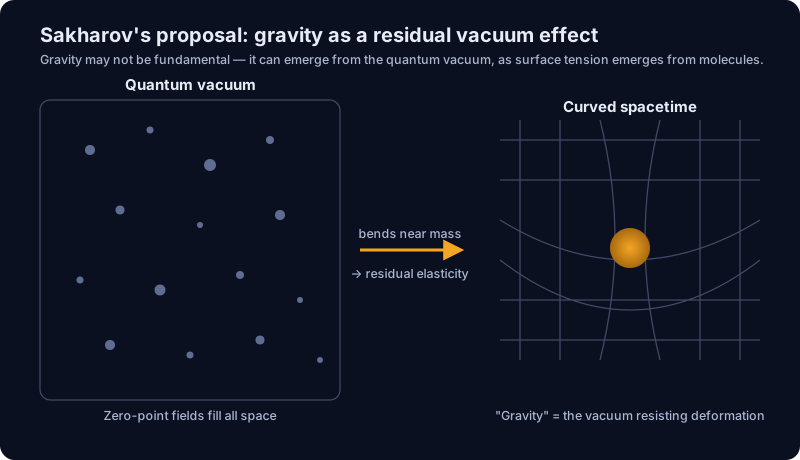
Sakharov's bold idea: gravity might not be fundamental
In 1967 the Soviet physicist Andrei Sakharov made a bold proposal. Sakharov built the hydrogen bomb and later won the Nobel Peace Prize. He suggested that gravity may not be a basic force at all. Instead it could be an emergent effect — a kind of springiness of the vacuum. It appears when the quantum fields that fill space are disturbed by matter. In this view, space bends the way a crowded room builds up pressure: not because bending is built in, but as a side effect of all the vacuum activity underneath.
Sakharov's induced-gravity idea is respectable, published physics. Mainstream researchers still work on it today. It does not prove gravity is "just" vacuum mechanics. It does make the idea a fair one to explore, and it puts the rest of this chapter on solid ground.
The ZPF-inertia hypothesis
Building on this, Bernard Haisch, Alfonso Rueda, and Harold Puthoff published a striking idea (Physical Review A, 1994). They proposed that inertia is a reaction force from the zero-point field. Picture accelerating a charged particle through the vacuum's restless jitter (Chapter 2). The field pushes back. That push-back, added up over all matter, is what we have always called inertial mass.

This is a well-posed proposal with its experiment still to run. The mechanism has a real anchor in accepted physics: Unruh showed in 1976 that an accelerating observer sees a warm bath in the vacuum, which is the effect the 1994 paper reaches for. Later work, by the authors and by others, found the original derivation incomplete, and refined versions followed. No measurement has yet shown inertia changing this way.
Puthoff's Polarizable Vacuum: gravity as a change in the "thickness" of space
Harold Puthoff went further. He restated general relativity as the Polarizable Vacuum (PV) model. The standard view pictures gravity as curved spacetime. PV instead pictures the vacuum as an optical medium — like glass that gets denser near mass. Light and matter slow and bend near a star. In this picture that is not because the "shape" of space changed. It is because the vacuum there became optically "thicker."
A denser vacuum is a slower one
In the polarizable-vacuum picture the vacuum is an optical medium, and one number carries the whole of gravity: K, its thickness, equal to one far from any mass and rising near one. Turn it up. Light slows, clocks run slow, rulers shrink, effective mass grows — all from the same K, and all in step, which is why an observer inside never catches the medium at it and always measures the speed of light as exactly c.
- Clock rate:
- 1.00
- Ruler length:
- 1.00
- Effective mass:
- 1.00
- What a local observer measures for the speed of light:
- exactly c, at every thickness
- Deflection (seconds of arc):
- 1.75
At this thickness: The rod and the clock are distorted by the same K as the light being timed, so the locally measured speed of light renormalizes from c divided by K back to exactly c. That is the point of the picture: the thickness is real, and it is invisible from inside. You can only see it by comparing one place with another.
Near a mass the thickness takes an exponential form, and the three classical tests come out at their accepted values: the gravitational redshift, one and three quarter seconds of arc of starlight deflection at the sun's edge, and Mercury's perihelion advancing by 43 seconds of arc per century.
This is a restatement of weak-field general relativity in a different language, not a rival prediction inside it — and it reaches the accepted answers for the classical tests. What to watch is the strong field: the paper states that there the two formalisms diverge, and names that divergence as the ground for laboratory and astrophysical tests that would tell them apart. The engineering interest follows from the same sentence — if the thickness is a field with sources, then electromagnetic energy density is one of them.
The PV approach reproduces the classic tests of general relativity — light bending, time dilation, the slow drift of Mercury's orbit — in the weak-field regime. That is why it is taken seriously as a restatement. Open question: is it only an equal restatement, or a deeper description you could engineer? That exact question is what the U.S. defense document in the next chapter is built on.
Why this chapter matters for everything after
Suppose inertia and gravity are things the vacuum does to matter, not fixed properties of matter. Then in principle they are settings you could change, not constants you are stuck with. That "in principle" is doing enormous work, and this book will not let it hide. But you cannot see why credible people chase inertia-reduction craft (Chapter 8) without one fact. The idea has a respectable, published lineage. It runs back to Sakharov and into the pages of Physical Review.
“These are reinterpretations that make no new tested predictions — so they are philosophy, not physics.”
These proposals connect their mechanisms to measurable quantities. PV says the vacuum's optical thickness is the handle: change it in a region and clocks, rulers and light paths change with it. ZPF-inertia says resistance to acceleration should shift when the local field spectrum shifts. Neither effect has been measured yet, and the standing precision test sets the scale: MICROSCOPE finds inertial and gravitational mass tracking each other to about one part in 10¹⁵. So the target is a small, sharply defined effect rather than a large loose one, which is useful — it tells you how good the apparatus has to be. The test to watch is a bench one: measure the inertia of a suspended mass inside a conditioned electromagnetic field, with the field configuration published — and with the discriminator Froning and Barrett's own programme asks for: that the effect tracks the conditioning rather than the power.
What the field added — July to September 2026
The polarizable-vacuum reading of gravity gained a second interpreter on the stream, Barry Setterfield, alongside Puthoff, and Gabriel Dias of ZPF Technologies laid out the stochastic-electrodynamics case in a full talk: classically an orbiting electron radiates and the atom should collapse in a fraction of a nanosecond; the zero-point field is what holds it up. That is the starting point of the whole inertia programme, and it was well taught this season. Froning and Barrett's 1998 paper on "conditioned" electromagnetic fields was read on screen and is now in the sources: give a field a form closer to the one underlying gravitation, they argue, and the coupling to gravitation or to the vacuum's zero-point state gets much stronger — which is where the inertia programme meets them. The 1997 record sits one step earlier, in NASA's Breakthrough Propulsion Physics workshop proceedings, where Froning's own proposal for experiments on space coupling by conditioned fields is on the programme. Laithwaite's famous spinning-disk demonstration — an 18 kg wheel lifted overhead by its axle — made a good classroom moment on how inertia and angular momentum behave, and why gyroscopes feel the way they do. Research log. The vector potential's own course, from first picture to research frontier, is at /courses/vector-potential.
The chapter also gained a century of provenance. The zero-point field is older than most readers expect. It enters the literature in Planck's second radiation paper of 1911, and Walther Nernst took it up in 1916 as a real physical field and carried it to Einstein. Hal Puthoff, whose polarizable-vacuum model anchors this chapter, is best described the way Douglas Miller describes him: the field's most effective advocate rather than its author. Puthoff is also worth reading carefully, because his own papers hold two different pictures. In the 1987 hydrogen work that Chapter 2 teaches, the field sustains the atom. In a 1989 paper on where the zero-point energy comes from, the field is the radiated energy of all the mass and energy in the universe. Miller's point is that the second picture appears in that paper and nowhere else in Puthoff's work. Both papers are real. The job here is to say which is which rather than to blend them.
Measurements and calculations to pursue
A proposed test is a suspended-mass inertia measurement inside a conditioned electromagnetic field, with the field configuration and the quiet runs both published, and the effect shown to track the conditioning rather than the power — the discriminator Froning and Barrett's programme asks for. A measurement in either direction would test whether the field conditioning changes inertia; the experiment can be performed at bench scale.
Sources
Primary
- B. Haisch, A. Rueda & H. Puthoff (1994), "Inertia as a zero-point-field Lorentz force," Phys. Rev. A 49, 678. DOI 10.1103/PhysRevA.49.678.
- A. Rueda & B. Haisch (1998), "Inertia as reaction of the vacuum to accelerated motion," Phys. Lett. A 240, 115 (arXiv:physics/9802031). (Downloaded.)
- H. Puthoff (2002), "Polarizable-Vacuum (PV) approach to general relativity," Found. Phys. 32, 927 (arXiv:gr-qc/9909037). (Downloaded.)
- A. Sakharov (1967), "Vacuum quantum fluctuations in curved space and the theory of gravitation," Sov. Phys. Doklady 12, 1040 (reprint Gen. Rel. Grav. 32, 365, 2000) - induced/emergent gravity.
- H. D. Froning & T. W. Barrett (1998), "Space coupling by specially conditioned electromagnetic fields," AIP Conf. Proc. 420, 1449 (STAIF-98). DOI 10.1063/1.54772 - conditioning a field's form rather than its strength, to couple to gravitation or to the vacuum's zero-point state. (Closed access; read from the authors' abstract.)
- M. G. Millis & G. S. Williamson, eds. (1999), NASA Breakthrough Propulsion Physics Workshop Proceedings, NASA/CP-1999-208694 (workshop held August 1997) - carries Froning's own proposal for experiments on space coupling by specially conditioned electromagnetic fields.
Independent, mainstream anchors (beyond the source corpus)
- W. Unruh (1976), Phys. Rev. D 14, 870 - the established physics that an accelerated observer sees a thermal vacuum bath; the plausible core the HRP mechanism reaches for.
- M. Visser (2002), "Sakharov's induced gravity: a modern perspective," arXiv:gr-qc/0204062.
- E. Verlinde (2011), "On the origin of gravity and the laws of Newton," JHEP 04, 029 (arXiv:1001.0785) - emergent-inertia thinking is alive in serious (and heavily debated) theory.
The precision any model has to match
- The specific HRP ZPF-Lorentz-force derivation of inertia is still being argued out in the literature; any such model has to reproduce the measured equality of inertial and gravitational mass - MICROSCOPE (2022) confirms that equality to about 1 part in 1e15, which sets the sensitivity target for any mass-altering scheme.
- D. Miller, ZPE All Stars interview, Hard Truths Podcast (8 September 2026; YouTube
5MIGis0S8Fc, @08:41, @33:34-@34:34) - the Planck (1911) and Nernst (1916) provenance, and the two different pictures of the field in Puthoff's 1987 and 1989 papers.
Independent anchors: several of these papers share authors (Haisch/Rueda/Puthoff), so they are one research line rather than four - Sakharov, Unruh and Verlinde are the genuinely independent supports underneath it.