Gravity Control and Superconductors
Frame-dragging is measured — and Ning Li, Podkletnov and Tajmar are the programmes trying to make it big enough to use.
Superconductors are where people go looking for gravity control, and the instinct is good. A superconductor is the largest piece of coherent quantum matter you can hold in your hand. This chapter teaches three things: the real gravity effect relativity predicts, the programmes trying to amplify it, and what the measurements tell the next experiment to do.
Before any of that, watch the effect itself. Press play and watch what appears around the disc as it spins up: it is spacetime being dragged along with the mass. It is real, it is measured — and it is far too small to use. Closing that gap is what the rest of this chapter is about.
Before you move anything — what do you expect?
Optional, and there is no score. The instrument below works exactly the same whether you answer or not.
The real effect: gravitomagnetism
Einstein's general relativity, in its weak-field form, says gravity has a "magnetic" side. A spinning mass drags spacetime slightly around with it. The effect is called gravitomagnetism, or frame-dragging. The formal name is gravitoelectromagnetism, GEM. None of this is fringe. It is textbook relativity, and it was measured. NASA's Gravity Probe B published results in 2011. It found Earth's frame-dragging at the size relativity predicts.
That is the winding you just watched, and here it is written down — with the factor that makes it so small in plain sight.
Gravitomagnetism is real weak-field relativity, and frame-dragging is measured (Gravity Probe B, LAGEOS). It is also minuscule. That number is the yardstick for everything that follows.
The programmes: amplifying it with coherent matter
In the early 1990s Ning Li and Douglas Torr made a proposal with a mechanism. Inside a superconductor, they argued, the coherent spin of the lattice ions could amplify the gravitomagnetic field to useful levels. They called it "AC gravity."
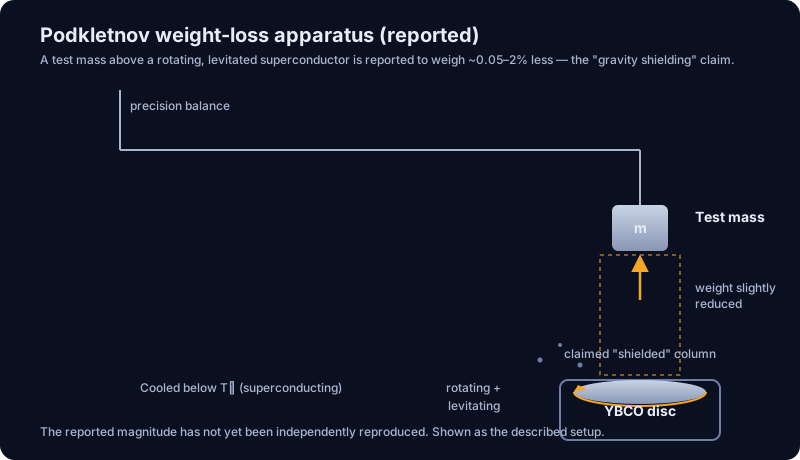
Around the same time Eugene Podkletnov reported something more direct. Objects hung above a large, spinning YBCO superconductor seemed to lose a little weight. He called it gravitational shielding. He later described an "impulse gravity generator" that fired a force beam, using a high-voltage discharge through a superconductor.
What the measurements say
Three independent groups have run the weight-loss experiment. Woods, Helme, Cooke and Caldwell (2001) measured no change. Hathaway, Cleveland and Bao (2003) built a well-instrumented rig and measured no change either. NASA-funded evaluations at Marshall did not confirm an effect. The 1997 Podkletnov preprint was withdrawn; the peer-reviewed footprint is the 1992 Physica C paper.
Those runs are not the end of the thread. They are its specification. They fix the size any real effect has to beat. They also raise the obvious question: what did the different runs do differently? A 2026 stream put a specific answer on the table. Perhaps what matters is how fast the disc is spun up, not the speed it finally reaches. That turns a disagreement between laboratories into a number you can scan.
Spin-up, not spin
Thirty years of rotating-superconductor experiments varied one thing: how fast the disc finally turned. Nobody varied how fast it got there. Set the two independently — the angular acceleration of the ramp, and the steady rate at the end of it — and the ledger below says which published runs would have seen an effect that depends on the rate, and which would have been blind to one that depends on the ramp.
- The range reported in 1992
- The bound published in 2003
- If it depends on the rate:
- 0.055 %
- If it depends on the spin-up:
- 0.011 %
- Time to reach that rate:
- 4.8 s
At this setting: A balance read only at the plateau is read at zero angular acceleration. Against a law of that kind such a run is not a null; it is blind, and its bound is a bound against the rate and nothing else. That is the whole argument: a bound constrains only the parameter that was varied.
What each published run would have seen
The original claim is peer-reviewed, the published replications are nulls that name the conditions they did not reach, and the acceleration-rate hypothesis is a stated, testable refinement with no data either way. The settling measurement is the fractional weight change of the test mass plotted against angular acceleration at fixed final angular velocity, with the ramp reversed and with a non-superconducting disc of matched mass and moment of inertia as the control. If nothing appears, the bound is published against a parameter nobody had bounded, which is itself a real contribution.
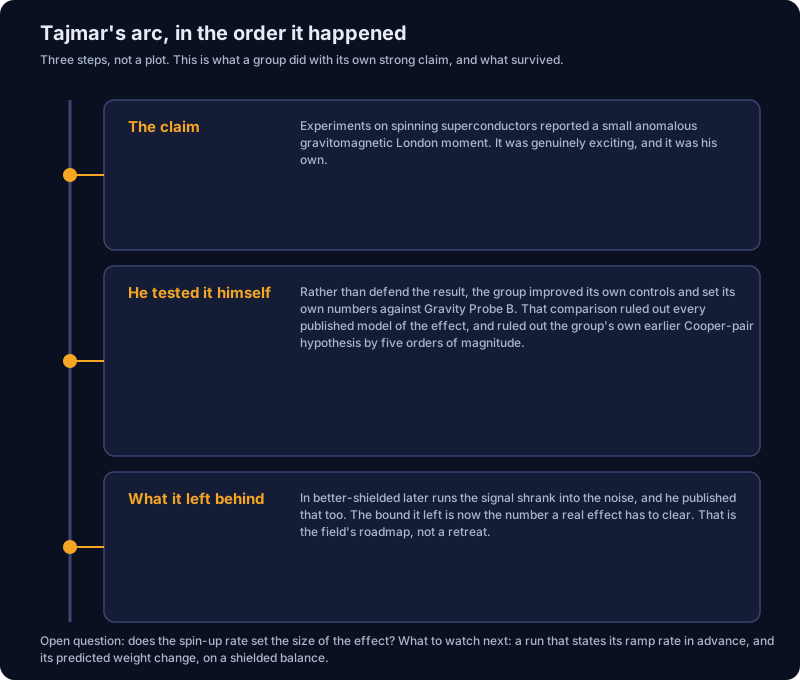
The most instructive story is Martin Tajmar's. His 2006–07 experiments reported a small anomalous "gravitomagnetic London moment" around spinning superconductors. It was genuinely exciting. He did the right thing with it and improved his own controls. By 2007 his group was already setting its own numbers against Gravity Probe B, and reporting that the comparison ruled out every published model of the effect — their own earlier Cooper-pair hypothesis by five orders of magnitude. In better-shielded runs from 2009 to 2011 the signal shrank into the noise, and he published that. That is the field's roadmap, not a retreat. His bound is now the number a real effect has to clear.
Open question: does the spin-up rate set the size of the effect? What to watch next: a run that states its ramp rate in advance, and its predicted weight change, on a shielded balance.
Published measurements of superconductor gravity modification disagree. Comparing apparatus, shielding and operating conditions is necessary to identify the cause.
“Every careful independent attempt to replicate superconductor gravity modification has come back at or near zero, including the proponent's own better-controlled runs.”
That is a fair summary of the measurements, and this chapter reports them as they stand. Start with what is certain underneath. Gravitomagnetism is real, and Gravity Probe B watched Earth drag spacetime around by exactly the amount relativity predicts. So the question is never whether the effect exists. It is whether coherent matter can make it big enough to notice. The runs that came back at zero give that question a number to beat, and the tightest number in that comparison is Gravity Probe B's, which is the yardstick his group set every published model against — their own earlier one included. Two live variables are now on the table: the rate at which the disc is spun up, and, in the nuclear-spin line, the sample temperature that Stark, Grafe and Tajmar's 2024 test showed can imitate a weight change. Watch for a run that states its ramp rate and predicted effect size in advance. That is the experiment this chapter is waiting for.
What the field added — July to September 2026
Three gravity-control threads came back. One new result joined the chapter from an unexpected direction.
Mark Sokol presented Frederick Alzofon's 1981 idea. Polarise the nuclear spins in a sample, Alzofon said, and its weight should change. Sokol described his lab's work on it. The idea now has a modern test on record. Stark, Grafe and Tajmar ran it in 2024 with an NMR machine. They found that temperature is the thing the next experiment must control. A stream proposed a new variable for the spinning-superconductor effect: how fast the spin is ramped up, not the final speed. That turns a dispute between labs into a number to scan. Archival interviews with McDonnell Douglas engineers Robert Wood and Paul Czysz added a real 1968 memo proposing gravity experiments. A major aerospace company funded this line of thought sixty years ago.
The new result is the NbSe₂ cavity paper in Chapter 2. Reshape the vacuum around a superconductor and its critical temperature rises. That is a different quantity than weight. But it is the same family of physics this chapter is about, and it is peer-reviewed. Laithwaite's 1974 spinning-disk lift made a good classroom demonstration of how gyroscopes behave. Research log. Phase and coherence — the thread joining the London moment, flux quantisation and the junction arrays — have their own course: quantum phase and coherence. For the junction physics itself — the two Josephson relations, SQUIDs, qubits and junction arrays — take the Josephson-junction drill-down course.
The gaser: build the emitter, instead of amplifying the field
Every programme in this chapter so far tries to make a superconductor change the weight of something near it. There is a second way to spend the same coherence, and in January 2026 it arrived as a finished engineering proposal. Gary Stephenson, an engineer at Seculine Consulting, published "Stimulated Emission of Gravitational Waves via Dissimilar Superconducting Josephson Junctions" in the Journal of High Energy Physics, Gravitation and Cosmology. His device is a gaser — the gravitational counterpart of a laser. It does not nudge gravity. It radiates it: a wafer that makes gravitational waves on a laboratory bench, instead of waiting for two black holes to collide. Chapters 4 and 8 name it in passing. This is the chapter it belongs to, and this is where it gets built.
The lineage is three papers long. Halpern and Laurent worked out in 1964 how a quantum system radiates gravitationally, and found spontaneous graviton emission very small. Lawrence Ford returned to it in 1982 with a fully quantum treatment and found the result that makes a device possible: the radiated power goes as the square of the number of coherent emitters, and that number can be made arbitrarily large, so quantum-gravitational effects need not be confined to Planck dimensions. Giorgio Fontana turned that into a machine in 2012 — the HTSC gaser — as a bulk device, which meant fabricating bulk cuprate, among the most demanding materials anyone has tried to manufacture. Stephenson's contribution is the redesign that makes it buildable: thin films on a standard silicon wafer, laid out as a phased array.
The mechanism sits in the junction. A Josephson junction is a sandwich of two superconductors. Make the two halves deliberately unlike each other — a plain s-wave superconductor such as lead joined to a d-wave cuprate such as YBCO — and a Cooper pair crossing between those two pairing symmetries has to change its orbital angular momentum by two units. A spin-2 transition is exactly the transition that emits a graviton. In ordinary materials those s-to-d transitions are drowned out by far more probable electric and magnetic ones; Cooper pairs in a cuprate have nowhere else to go, because they support no states other than s-wave and d-wave. One junction is still a faint emitter — Fontana's figure is a graviton emission probability about 4.8 × 10⁻⁴³ of the photon's, for the same electron transition — which is why Ford's square law is the whole reason to build an array rather than a single junction.
What follows is a parts list, and that is what earns this proposal its place. The junction supplies its own oscillation through the AC Josephson effect: bias it, and it rings at a frequency the bias sets. Stephenson selects 24.048 GHz, a US amateur microwave band, because the bands below it give emitter features too large to fit an array onto a standard wafer. The Josephson relation then fixes the bias at 49.73 microvolts — not a free parameter, but the voltage that frequency demands. The wavelength there is 1.25 cm, so each emitter pad is a quarter wavelength across, 3.1 mm, and the pads sit a full wavelength apart so that every one of them emits in step. Eighty-one fit on a 150 mm silicon wafer. The films are lead over YBCO, with tantalum named as the substitute for a deposition chamber that must stay lead-free and BSCCO as the near-equivalent cuprate, and the wafer runs below 7 kelvin, set by lead's critical temperature. The estimate is about 1.5 milliwatts of gravitational-wave power per emitter, about 121.5 milliwatts from the 150 mm array, and about 193.5 milliwatts from a 200 mm wafer carrying 129 emitters.
The first experiment is self-contained, because the junctions work both ways. Reciprocity means the same junctions biased to emit can be used passively to detect, so one bench can make the signal and read it back. At a bandwidth of 10 kHz the noise equivalent power is about 600 picowatts, which puts the 150 mm array better than 83 decibels above its own noise floor. And the whole thing is meant to sit in an ordinary low-temperature cryogenic probe station of the kind that already tests quantum-computing wafers, which is the practical reason the thin-film redesign matters: the fabrication and the test rig both already exist.
This is designed, not yet built. Stephenson's conclusion says so in one line — the remaining work is for the described hardware to be built and tested — and he is equally direct about what is not yet known. The d-wave to s-wave conversion efficiency the device depends on is not well understood, and he recommends running a range of doping regimes to find the best one. Speaking about the design in July 2026 he put the remaining coupling shortfall at roughly twenty orders of magnitude, and said plainly that the device as specified generates gravitons rather than amplifying them. That candour is the point. A proposal that names its materials, its frequency, its bias voltage, its wafer, its predicted power, its detector and its own open question is a proposal a reader can check and an engineer can start — and the shortfall has a handle on it, because on the same broadcast he gave the scaling that governs it: strain rises with the square of the frequency, and radiated power with the fourth power.
What to watch: the first wafer. One array, biased to 49.73 microvolts, emitting at 24 GHz, with a second array of the same junctions listening.

- Geometry computed from
- The wafer at true in-plane scale: 81 emitter pads a quarter wavelength across, 3.1 millimetres, on full-wavelength centres of 12.47 millimetres over a 150 millimetre silicon wafer, with the pad size and the pitch computed from the published design frequency of 24.048 gigahertz and checked back against the paper's own table, as is the 49.73 microvolt junction bias the frequency fixes. Above the pads are the flat in-phase wavefronts that spacing produces, and beside the wafer a callout of the layer order of the dissimilar junction — silicon, then the d-wave film, then the s-wave one
- Numbers from
- Gary V. Stephenson, Stimulated Emission of Gravitational Waves via Dissimilar Superconducting Josephson Junctions, Journal of High Energy Physics, Gravitation and Cosmology 2026, held in full text in this site's library, for the frequency, the 150 millimetre wafer, the 81 emitters, the quarter-wave pad rule, the full-wavelength spacing, the lead and YBCO films on silicon and the sub-7-kelvin operating point set by lead; the lineage is Halpern and Laurent 1964, Ford 1982 and Fontana's bulk device of 2012, with the thin-film wafer-scale array being Stephenson's own contribution
- Schematic parts
- The nine-by-nine arrangement is a reconstruction rather than a copy: the paper's array figure has not been seen, and a square lattice is the arrangement that satisfies all three published constraints at once — exactly 81 emitters, one full wavelength between centres, and the whole pattern inside the wafer. Film thickness is not published, so each film is drawn 40 micrometres thick only so that the dissimilar junction is visible at wafer scale; that exaggeration is in the vertical axis alone, and the two films being drawn equally thick carries no claim. The junction callout beside the wafer is to no scale in any axis and carries exactly two facts, the order of the three layers and that the two superconductors are dissimilar. The feed network, the cryostat, the bias supply and the probe station are absent rather than guessed, the wafer is drawn as a plain disc because no flat, notch or bevel is published, and the 200 millimetre variant is omitted because its published emitter count cannot be reproduced from the published pitch without seeing its figure. The wavefronts depict the wave and not hardware: their spacing is the published wavelength, their flatness is the paper's own result, and their number, extent and one-sided cut are drawing choices implying no amplitude.
Two questions follow that wafer, and the axis below answers both from published figures alone. Is anything listening at 24 gigahertz? And how far short does the design still fall, by its own author's count? Switch between the two views to see where the gaser's band sits among the detectors that exist, and how many orders of magnitude separate it from being heard.
The gaser, measured against the instruments
Stephenson's wafer is specific enough to be measured, so measure it. Here is the megahertz-to-gigahertz band with the published detectors laid across it, and 24.048 gigahertz — the frequency the gaser is designed to emit at — drawn as a line through them. Then the distance the author names himself: roughly twenty orders of magnitude of coupling still to find. A zoomable scale would hide that, because above about a million readers stop reading a logarithmic axis logarithmically. So the orders are counted instead, one rung at a time, next to two distances of known size.
- Strain noise per root hertz
- An upper limit already set on a background
- The gaser
- The gaser's emission frequency:
- 24.0 GHz
- The published ideal case:
- 1.2E-1 W / 6E-10 W
- The shortfall the author states:
- 20
- Where that leaves the device today:
- -11.7
Reading: A microwave cavity on ADMX parameters. 3E-22 — strain per root hertz. Its published band stops short of 24.048 gigahertz.
Berlin and colleagues show that an axion haloscope is already most of a gravitational-wave detector: an eight-tesla field, a tenth of a cubic metre of cavity, a quality factor of 100,000, one kelvin and a minute of integration reaches about 3 × 10⁻²² at a gigahertz, and a phase-sensitive matched filter takes it to about 10⁻²³. The hardware exists; what changes is what it is asked.
The published ideal case assumes nearly perfect conversion, and the author is explicit that the conversion is the open problem. Subtract the shortfall he states and the ledger closes where the drawing shows it.
This is what taking a proposal seriously looks like. A programme that names no frequency and no output cannot appear on these axes at all; the gaser can, because it names a wafer, a bias voltage, an emitter count, a predicted power, a detector and its own missing number. The distance is real, and so is the fact that it is stated rather than discovered by a critic.
Three things would move the line. The frequency scaling Stephenson gives on the same broadcast: strain rises with the square of the frequency and radiated power with the fourth, so the whole ledger moves with the band a future wafer is designed for. The coherence law the array exists for: radiated power grows with the square of the number of emitters kept in step, so 81 pads on a 150 mm wafer is the smallest version of the device, not the largest. And the conversion efficiency itself — the doping sweep across d-wave and s-wave regimes that the paper recommends as the first experiment is the measurement that would put a real number where twenty orders of magnitude currently stand.
Read the source sheets. The 100-megahertz recycling interferometerA microwave cavity on ADMX parametersARCADE 2, recastThe Li–Baker detectorThe gaser
Measurements to make next
A spin-up test should state its ramp rate and predicted weight change in advance. For the nuclear-spin proposal, use an Alzofon-style experiment with temperature controlled to determine whether a weight shift persists.
Sources
Primary - the programmes
- G. V. Stephenson (2026), "Stimulated Emission of Gravitational Waves via Dissimilar Superconducting Josephson Junctions," J. High Energy Phys. Gravit. Cosmol. 12(1), 585-605, doi:10.4236/jhepgc.2026.121029 - the gaser, with materials, frequency, bias and a first test. Full text on the source sheet. (Open licence, CC BY 4.0.)
- N. Li & D. Torr (1991), "Effects of a gravitomagnetic field on pure superconductors," Phys. Rev. D 43, 457; (1992) Phys. Rev. B 46, 5489 - the amplification proposal.
- E. Podkletnov & R. Nieminen (1992), "A possibility of gravitational force shielding by bulk YBa2Cu3O7-x superconductor," Physica C 203, 441 - the peer-reviewed origin (the later 1997 preprint was withdrawn).
- E. Podkletnov & G. Modanese (2001), "Impulse gravity generator...," arXiv:physics/0108005 / physics/0209051. Full text on the source sheet. (Downloaded.)
Real gravitomagnetism - the yardstick (beyond the source corpus)
- B. Mashhoon (2003), "Gravitoelectromagnetism: a brief review," arXiv:gr-qc/0311030 - GEM is real weak-field relativity; the lab-scale field is ~1e-20 of the claimed effects.
- C. Everitt et al. (2011), "Gravity Probe B: Final Results...," Phys. Rev. Lett. 106, 221101 - measured frame-dragging at its tiny predicted size.
Where the physics is worked out
- M. Tajmar et al. (2006-2011): Experimental Detection of the Gravitomagnetic London Moment (arXiv:gr-qc/0603033), Search for Frame-Dragging-Like Signals Close to Spinning Superconductors (arXiv:0707.3806) - an early signal, then the 2007 round in which the group sets its own numbers against Gravity Probe B and reports that the comparison rules out every published model of the effect, its own earlier hypothesis included. (Downloaded.)
- Independent Podkletnov runs: Woods, Helme, Cooke & Caldwell (2001), AIAA 2001-3363; Hathaway, Cleveland & Bao (2003), Physica C 385, 488 - no weight change measured. These fix the size a real effect must beat.
Where the replication stands: the positive reports are a thin cluster, and the best-instrumented runs measured nothing. The 2026 threads answer with a variable nobody scanned - the spin-up rate - which is what makes a disputed effect testable again.