Inertial Mass Reduction, the Navy Patents, and Transmedium Craft
One subject, one unit: the patents and who put their name to them, the mechanism they specify, and what the sensors do and do not show.
Three threads meet here, and the knot has to be tied with care. A set of government documents sits on one side. A specific proposed mechanism sits in the middle. A real observational record sits on the other. This chapter teaches them apart, because each one is tested in its own way.
Start with the documents, because they are the firm ground. The workspace below sets the two granted Navy patents beside the cavity they specify: choose a claim line and the part it describes lights up in the drawing. The lines marked as mechanism are the ones an experiment could settle; the rest specify hardware. A patent settles legal novelty, and no physics at all.
The patent, beside its physics
Two granted Navy patents on the left, the hardware they specify on the right. Choose a document, then choose a claim line: the part of the cavity that line describes lights up in the drawing, and the line carries a link to the chapter of this site that discusses it. Lines that name a physical mechanism are marked apart from lines that only specify hardware, because those are settled by different things — an experiment for the first, a filing for the second.
- Charged outer resonant wall
- Xenon-filled annular cavity
- Spinning, vibrating charged core
- Microwave emitters, 300 MHz to 300 GHz
- Claimed polarised-vacuum sheath
- This line describes:
- Microwave emitters, 300 MHz to 300 GHz
- Where in the document:
- Background
- Discussed in:
- CH08
A granted patent establishes legal novelty and utility on paper, and the assignment to the US Navy is public record. That is what this workspace shows. The measurement is a separate record, and this chapter keeps the two on separate shelves.
The idea, as a conditional
Chapter 3 introduced an idea: inertia is a reaction force from the vacuum. It is the resistance you feel when you push matter through the zero-point field. The patents below describe a claimed electromagnetic way to disturb that field. Put the two together and you get the boldest proposal in the book.
IF inertia is vacuum drag, THEN thinning or restructuring the vacuum around a craft would cut its effective mass. The craft could then accelerate at thousands of g with no reaction mass. It could also slip between air, water, and space, because it barely interacts with any of them.
Harold Puthoff and colleagues laid out the theory in a 2002 paper on engineering the zero-point field and polarizable vacuum for interstellar flight. Notice the shape of it. This is an if-then, and its "if" is Chapter 3's open question. That shape is a strength, because it names in advance the single measurement the whole chapter turns on, and Chapter 3 is where that measurement lives.
Before going further, separate two statements that are easy to run together. The first is textbook and is not in dispute; it is the definition every claim below is measured against.
The second statement is the proposal, and it is a different kind of claim entirely: that some field arrangement could make a body's effective inertial mass smaller than its ordinary mass, so that the same modest force produced a far larger acceleration. That would be a new process, not a rearrangement of equation 8.1, and the rest of this chapter examines its proposed tests.
Get the documents right first
In 2016 the U.S. Navy began filing patents so extraordinary they read like science fiction. One was a craft that flies by cutting its own inertial mass. Others: a room-temperature superconductor, a compact fusion device, and a generator of high-frequency gravitational waves. The inventor, Dr. Salvatore Cezar Pais, worked at the Naval Air Warfare Center. Here is a real government signature on ideas at the far edge of physics. Sloppy sourcing has muddied this story, so we pin the primary records exactly:
- US10144532B2 — "Craft using an inertial mass reduction device," granted 4 December 2018. This is the famous "UFO patent."
- US20170313446A1 — the earlier published application for that same craft invention (it issued as US10144532B2 above). It is not a separate gravitational-wave patent, though it is often mislabeled as one. Same invention, two document numbers.
- US10322827B2 — "High frequency gravitational wave generator," granted 18 June 2019. This is the real gravitational-wave patent. It invokes the Gertsenshtein effect: turning electromagnetic waves into gravitational waves inside a magnetic field.
- US20190058105A1 — the piezoelectric room-temperature-superconductor application, which the Navy abandoned in November 2019 after an unanswered USPTO rejection.
The patents exist and are assigned to the U.S. Navy. That is public record, and it is the firm ground the rest of the chapter stands on.
What the patents claim
Pais's central idea is this. Spin and vibrate an electrically charged object at extreme frequencies. That builds an electromagnetic flux so intense it polarizes the vacuum itself. Locally, this would restructure the quantum vacuum, cut the object's inertial mass, and make its own gravitational field. In effect, it is a proposed electromagnetic route to the metric engineering of Chapter 4 and the inertia engineering of Chapter 3. It names a mechanism, a geometry and a number. That is what makes it testable, and it is why spin, vibration and spin-up rate recur across this whole book.
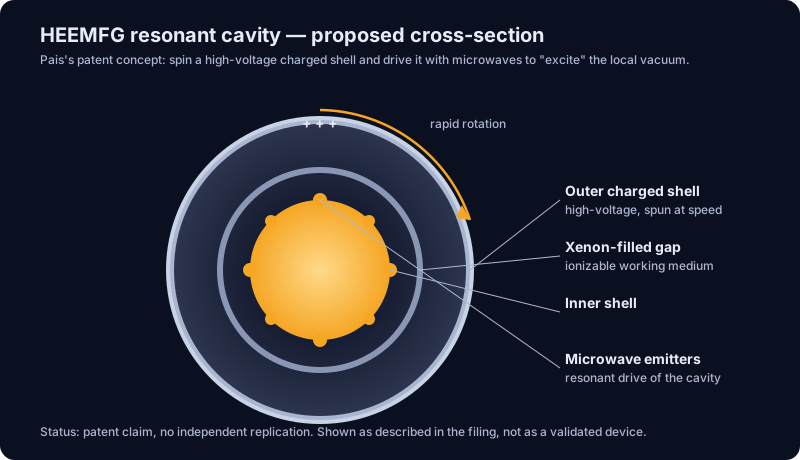
The cutaway above is the cavity. Read the same description as a division of labour and the whole craft can be drawn.

- Geometry computed from
- The patent's claim lines built as geometry: an electrically charged outer cavity wall divided into the four sections the patent drives separately to steer, a xenon-filled annular gap holding the microwave emitters, an electrically insulated inner wall which the patent says does not vibrate, a frustum at each end on the claimed rotation axis, and the claimed polarised-vacuum region standing off outside the outer wall, with a wedge cut away so the inner wall and the emitters can be seen. The patent states no craft dimension anywhere; the model's single scale anchor is the 2 metre radius of the spinning charged disc in the worked example of the patent's own first equation, and using that as a size is a declared choice rather than a patent dimension
- Numbers from
- Salvatore Cezar Pais and the United States Department of the Navy, Craft using an inertial mass reduction device, US10144532B2, filed 2016 and granted 4 December 2018, a public-domain United States government document held in this site's library and read alongside the sibling generator patent US10322827B2
- Schematic parts
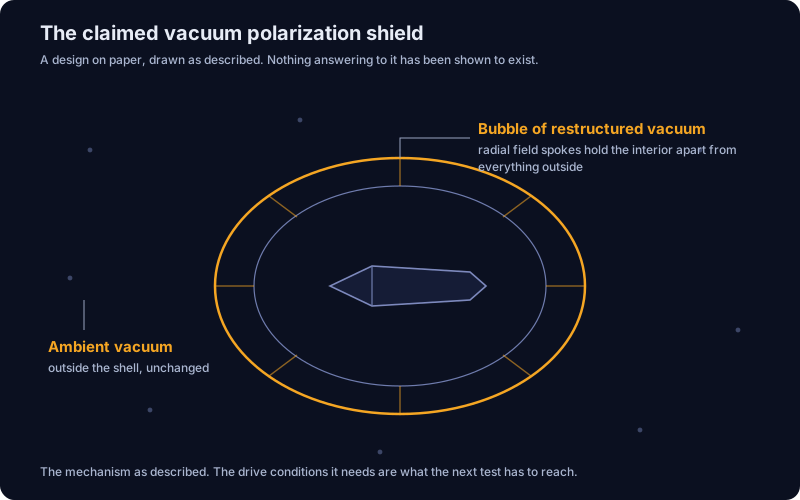
- This is a patent's described apparatus, not a photographed object, and nothing answering to this description has been shown to exist. The patent gives no length, diameter, aspect ratio, wall thickness, gap thickness or frustum dimension, so the equal axes, the gap set to a tenth of the anchor radius, the frustum proportions and the 70 emitters drawn on the mid-surface of the annulus are modelling choices; only the placement of the emitters within the cavity and the divisions into leading and trailing, top and bottom, are the patent's own. Both walls are modelled as surfaces so that no thickness is invented. The polarised-vacuum region has no stated thickness and is drawn translucent so it reads as a region rather than a hull, and the rotation axis is an annotation of a claimed axis rather than a part. The crew compartment, power plant, cargo bay and Faraday-type cage the patent names without shaping are omitted rather than guessed, and so is the vibration itself: its amplitude is a free parameter the patent never gives a value, so what is drawn is which surface vibrates and which does not.
Outside the hull the patent claims something further — a region of restructured vacuum the craft is meant to ride inside. That claim, and the drive conditions it needs, is what a test has to reach.
The attestation, and what it is
The strongest document in the case is an attestation. When a patent examiner balked, Dr. James Sheehy stepped in. As Chief Technology Officer of the Naval Aviation Enterprise, he formally told the USPTO the invention was "operable." He warned that China was chasing similar technology, and he pointed to an experimental demonstration. Reporters at The War Zone obtained this correspondence via FOIA. A senior official putting that in writing is a strong signal of intent.
It is a different kind of record from a measurement. This chapter keeps the two on separate shelves.
The claimed effect sits here: a fully specified mechanism, with a first test on the record, waiting for a run at its own stated drive conditions.
Where the experimental record stands
No lab outside the Navy has yet run the test at the patents' drive conditions. Physicists asked by The War Zone over about two years found no basis for the effect in known physics. Several of the patents have since lapsed for non-payment. What the record does hold is a first attempt. The Navy built and tested the field generator from 2016 to 2019, and the inventor has now described it in public.
Open question. Can real materials hold the surface charge the patent asks for, at the frequencies it asks for?
What to watch next. An independent, pre-registered run at the stated drive conditions. The detector and the expected signal level are named in advance.
“These are just patents full of buzzwords. A government agency patenting something — even swearing it's 'operable' — tells you nothing about whether it violates the laws of physics. No one has ever replicated any of it.”
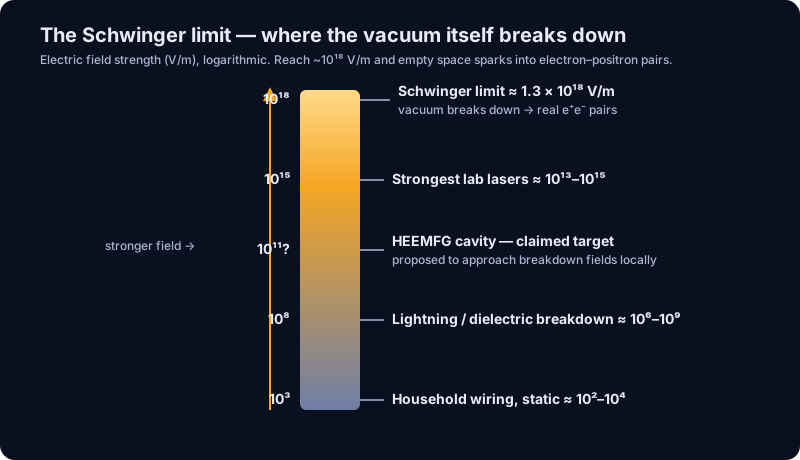
Patents certify legal novelty, and an attestation records a senior official's professional judgement. This chapter counts both as documents rather than measurements, and says so at the top. The quantitative question is the productive one. Polarizing the vacuum calls for fields near the Schwinger limit (Equation 8.2), and craft-scale hardware is far below that. The inventor says the same thing: the Navy's own rig reached a surface charge about eight orders of magnitude under the patent's figure, so no definitive result was expected from it. That leaves a clear picture. A real institution filed, funded and tested a specified idea, and the specified experiment has not yet been run. What to watch next: a pre-registered replication at the patents' drive conditions, with the detector and the expected signal level stated in advance.
The observations that make people look
The empirical hook is the U.S. Navy's declassified UAP videos — GIMBAL, GOFAST, FLIR1 — and the testimony around them. Witnesses describe objects that seem to accelerate, stop, and turn in ways no known aircraft could survive. In a peer-reviewed 2019 paper in Entropy, former NASA scientist Kevin Knuth and colleagues did the math. They estimated the accelerations implied if the sensor data are taken at face value. The numbers were extraordinary — hundreds to thousands of g.
That conditional clause is the whole method. Knuth states it himself, and that is what makes the paper usable.
The acceleration bars
Six published lower bounds on reported manoeuvres, and what an airframe and a human body are known to take, drawn to scale on one axis. Nothing here is asserted: the bars are the numbers, and their lengths are the ratio. Every estimate is the smallest acceleration the observed manoeuvre could have involved, computed under constant acceleration with liberal uncertainties, and every one is conditioned on the sensor data being taken at face value — which is the authors' own stated method.
Read off the axis
- Japan Air Lines Flight 1628, 1986 — first kinematic model — 68 g, Visual contact, 5× times the chosen limit
- Nimitz, 2004 — ATFLIR infrared video — 76 g, Infrared video, 5.6× times the chosen limit
- Japan Air Lines Flight 1628, 1986 — second kinematic model — 84 g, Visual contact, 6.2× times the chosen limit
- Nimitz, 2004 — pilot visual contact — 150 g, Visual contact, 11.1× times the chosen limit
- US Navy, 1951 — the Bethune encounter — 1,700 g, Visual contact, 125.9× times the chosen limit
- Nimitz, 2004 — Princeton radar track — 5,370 g, Radar track, 397.8× times the chosen limit
F-35 Lightning II airframe, structural integrity maintained: 14 g · 68–5,370 g
Knuth, Powell and Reali, 2019 — the sheet with every figure and its locator
The reported track is worth seeing as motion, not as a number. This is that turn, modelled.
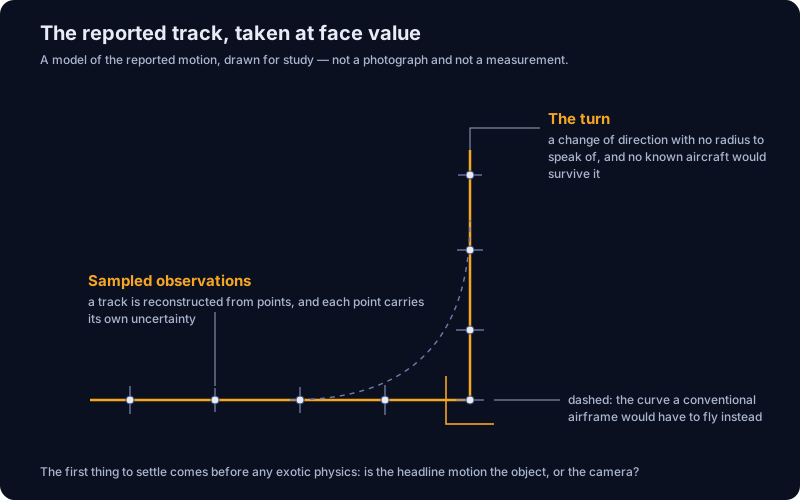
The first thing to settle: what the sensors saw
One question comes before any exotic physics. Is the headline motion the object, or the camera? Careful analyses argue for the camera. Mick West and the Metabunk community reproduced GIMBAL's rotation from the camera's own gimbal roll, and parts of the U.S. government's 2024 AARO report agree. GOFAST's "low, fast" object is, by parallax, plausibly a distant slow one. There is a physical check as well. A solid object entering water at hypersonic speed should leave cavitation and shock heating. Those signatures are absent from the released data.
This is exactly the kind of question a measurement settles, and the tools to do it now exist. Chad Wanless's ten-point checklist of warp observables gives you the list: lensing at the outline, vapour cones on the leading edge, oscillation blur from a pulsed field. Each one is something you can go and look for, frame by frame.
Whether the famous video accelerations are object kinematics or sensor effects is under active test. Published reconstructions and the raw sensor records are being argued case by case.
How the chains stack
The mechanism combines Chapter 3's vacuum-inertia hypothesis with the electromagnetic actuation specified in the patents. A torsion-balance experiment can test the predicted force while monitoring electrical inputs and competing forces.
The reversal test
Turn the thruster around inside the vacuum chamber without opening it, and see whether the force turns around with it. Choose a device and an orientation, and the trace redraws with the noise floor and the light-pressure limit on the same axis. The lesson is the one the Dresden group published: a real thrust reverses — and so does a warm cavity acting through its mount. What separates them is the sideways orientation, the shape of the transient, and the size of the reading.
- A Mach-effect thruster, as reported: eight discs at 39.3 kHz on about 170 W
- Noise floor of the 2019 balance, 11 nN
- Peak reading:
- 2,100 nN
- Reading per kilowatt:
- 12,353 nN/kW
- Times the light-pressure limit:
- 3.7×
- Light-pressure limit, per kilowatt:
- 3,336 nN/kW
- Turns around with the mount:
- Yes
- Falls into the noise when turned sideways:
- Yes
Peak reading: 2,100 nanonewtons. Falls into the noise when turned sideways: Yes.
A claim that cannot survive the sideways orientation is a thermal claim, and saying so plainly costs the field nothing and saves it years.
The settling measurement is thrust in nanonewtons per kilowatt, measured forward, sideways and reversed in one session, published together with the thermal transient and the drive current on the same time axis.
The open ground the Dresden authors name themselves is the superconducting cavity, where the quality factor rises by orders of magnitude and nobody has yet looked.
“The 'anomalous' videos are explained by parallax, glare, and camera-gimbal rotation. And the U.S. government's own 2024 review found no evidence of exotic craft or reverse-engineering programs. There is no anomaly here for exotic physics to explain.”
The reconstructions deserve their weight, and this chapter does not offer the videos as evidence for a mechanism. The GIMBAL and GOFAST work is careful, the transmedium wake signatures are missing, and the 2024 AARO Historical Record Report found no evidence of exotic craft. What remains is narrower and firmer. Some UAP reports are still unresolved on the official record, including the AC-130J Gulf of Oman report described below — a named platform, a date, a sensor type and quantified speeds. That is a reason to keep measuring. And the mechanism now has a far better test than any camera: Exodus Propulsion Technologies' electrostatic drive, whose patent reports about 237 micronewtons at 25 kilovolts from a nine-blade article, and a scaling with ground area that matched its own computation to within two per cent, with a public orbital test target within a year. What to watch next: that flight, and the first UAP video whose claimed lensing is measured against a known background.
What the field added — July to September 2026
Salvatore Pais appeared live on the channel on 9 August 2026 and gave this chapter what it most needed: the inventor's own account. The Navy built and tested his high-energy field generator. The surface charge it reached was about eight orders of magnitude below the one-coulomb figure in the patent. At that level no definitive result was expected. That is the roadmap for anyone who wants to try again, and it matches the 2021 FOIA record of a three-year test on about half a million dollars. Pais also confirmed a classified meeting with a member of Congress. The chapter's history got deeper as well. Froning and Barrett wrote in 1998 about "conditioned" electromagnetic fields; give a beam a form closer to the one underlying gravitation, they argued, and the coupling to gravitation or to the vacuum's zero-point state gets much stronger. That work is the ancestor of the patents, two decades earlier, and Froning's own experiment proposal sits in NASA's Breakthrough Propulsion Physics workshop proceedings from August 1997. A device joined the gravitational-wave thread too: Gary Stephenson's "gaser" is a wafer of Josephson junctions designed to emit high-frequency gravitational waves, specified down to its first experiment. The author identifies a testable question — the quantum efficiency of the junction. The junction physics behind it has its own course: the Josephson junction, novice to research. Research log.
Two more things this chapter had wanted arrived in the same season. The first is an official primary document: on 7 August 2026 the Department of War released an intelligence report and clips from an AC-130J gunship exercise over the Gulf of Oman on 8 September 2021 — two roughly four-foot "cold" orbs above a dropped flare, about 25 further contacts at 250 to 1,300 mph, objects that appeared to react to cannon fire. The document records the platform, date, sensor and reported speeds. "Cold" in the infrared is exactly what a non-equilibrium plasma reading predicts, and the channel's dense-plasma-focus comparison is the physics behind that. The second is the most concrete propellantless programme in the field. Charles Buhler and Andrew Aurigema of Exodus Propulsion Technologies presented their patented electrostatic drive, a QED account of the force and a public target of an orbital test within a year, with free build instructions for replicators. The patent's own bench numbers are small and specific: about 237 micronewtons from a nine-blade article at 25 kilovolts, rising to 421 when the grounded area was widened — a factor of 1.77 where their own computation had predicted 1.8, which is the part a reviewer should notice. No sheet in this library carries a thrust-to-weight figure for the device; the orbital test is what would settle the scale. The proposed flight would test the thrust at orbital scale. Chad Wanless's ten-point checklist of warp observables gives the chapter a way to test kinematic claims frame by frame. Research log.
Measurements to follow
an independent, pre-registered run at the patents' drive conditions, with the detector and the expected signal level named in advance — the Navy's first test came in about eight orders of magnitude below the specified surface charge, and that gap is where the next attempt starts. On the bench side, the Exodus orbital test: a trajectory change that fits the claimed thrust and does not fit drag, outgassing or radiation pressure. On the video side, a case where the claimed lensing is measured against a known star field, with the optics documented.
Sources
The documents (patents and attestation), the mechanism (inherited from Ch. 3) and the anomaly (observed kinematics) are tested separately, and are listed separately here.
Primary — the patents
- US10144532B2, "Craft using an inertial mass reduction device," S. C. Pais / US Navy, granted 2018-12-04. Google Patents.
- US20170313446A1 - the pre-grant application publication of that same craft invention (issued as US10144532B2). Widely mislabeled as a separate gravitational-wave patent; it is not.
- US10322827B2, "High frequency gravitational wave generator," Pais / US Navy, granted 2019-06-18 - the actual HFGW patent (invokes the Gertsenshtein effect). Google Patents.
- US20190058105A1, "Piezoelectricity-induced Room Temperature Superconductor" - abandoned Nov 2019 after an unanswered USPTO rejection.
- J. Schwinger (1951), "On gauge invariance and vacuum polarization," Phys. Rev. 82, 664 - the ~1.3e18 V/m threshold that sets the design target for any vacuum-polarization device.
The evidentiary basis, sourced carefully
- The Sheehy attestation via FOIA: The War Zone, "Navy's Advanced Aerospace Tech Boss Claims Key 'UFO' Patent Is Operable" - Naval Aviation Enterprise CTO Dr. James Sheehy told the USPTO the invention was "operable" and cited an internal demo. This is an attestation plus an unpublished demo, and it is filed here as a document rather than as data.
- The War Zone / The Drive investigation (2019-2021): physicists consulted over ~2 years found no basis for the claimed effect in known physics.
- Several Pais patents have lapsed for non-payment and the superconductor application was abandoned.
- The inventor's own account (9 August 2026): the Navy rig reached a surface charge about eight orders of magnitude below the patent's specification, which is the number the next test has to beat.
Mechanism side (inherits Ch. 3)
- H. Puthoff, S. Little & M. Ibison (2002), "Engineering the zero-point field and polarizable vacuum for interstellar flight," JBIS 55, 137 (arXiv:astro-ph/0107316) - the closest thing to a primary theoretical statement of "modify the vacuum -> reduce effective inertia." (Downloaded.) The arXiv record was withdrawn in 2010; its notice states that Ibison does not endorse some of the document's speculative proposals.
Anomaly side - the quantified, peer-reviewed version (beyond the source corpus)
- K. Knuth, R. Powell & P. Reali (2019), "Estimating flight characteristics of anomalous unidentified aerial vehicles," Entropy 21(10), 939 (open access) - a former NASA scientist's kinematic bound, explicitly conditioned on "if the sensor data are taken at face value."
Where the observations are worked out
- US DoD/AARO (2024), Historical Record Report, Volume 1 - found no evidence of exotic craft or reverse-engineering programs.
- ODNI (2021), Preliminary Assessment: Unidentified Aerial Phenomena.
- Sensor-artifact analyses (Mick West / Metabunk) of GIMBAL/GOFAST/FLIR1 - parallax, gimbal rotation and glare reproduce the headline imagery from mundane objects. Separating that from real motion is the first measurement any case has to pass.
- A physical check anyone can apply: a real object entering water at hypersonic speed would leave cavitation and shock-heating signatures. Those are absent from the released data, so they are among the things a future case would need to show.
Reading the record: a patent tests novelty and utility on paper. The physics is settled by a measurement at the specified drive conditions - the experiment the inventor himself names as the next step.