Wormholes, Energy Conditions, and the Negative-Energy Budget
The price the equations name, how much of it has been measured, and the bounds that decide whether a geometry is buildable.
The previous chapter gave you the geometry. This one gives you the invoice. General relativity is generous in a way that trips people up: pick any spacetime you like, run Einstein's equation backwards, and it will tell you what matter would produce it. That freedom is why a warp bubble and a traversable wormhole are easy to write down. What is hard — and what this chapter teaches — is reading off the material the geometry demands, and then finding out how much of that material physics will actually lend you.
Morris and Thorne: choose the shape, read off the stuff
In 1988 Michael Morris and Kip Thorne wrote what they intended as a teaching exercise in elementary general relativity, and changed a field. Their traversable wormhole is a class of exact solutions describing a throat a person could pass through. The decisive design requirement is that the throat carries no horizon — because a horizon traps a traveller rather than passing them through — and that the tunnel flares out on both sides of its narrowest point.
Before you move anything — what do you expect?
Optional, and there is no score. The instrument below works exactly the same whether you answer or not.
One symmetric wormhole profile
Move the selected coordinate circle. This is an embedding aid for one constant-time, equatorial spatial slice — not a tunnel drawn in an external direction.
- embedding coordinate z / b₀
- 0.00
- circle radius r / b₀
- 1.00
What this drawing is
This is a coordinate profile, not a vertical tunnel, a force map, or a route through space.
What the profile can establish
For this chosen static profile, the throat is the minimum-area circle and the geometry flares outward on both sides.
What it does not establish
A material source, stability, a second universe, or a traversable route.
Impose those two conditions and the field equations dictate the material. The throat must be under a radial tension of roughly the pressure at the centre of the most massive neutron star, scaled by twenty kilometres over the throat's circumference, squared — and that tension must exceed the material's own mass-energy density. Nothing known behaves that way. Matt Visser's book-length treatment is where that requirement, and the machinery for working with it, was assembled into one technical subject: energy conditions, thin shells, topological censorship.
As mathematics, traversable wormholes are valid solutions of Einstein's equations. Buildability turns entirely on the source term, which is the rest of this chapter.
The rulebook, and what kind of rule it is
The conditions that appear to forbid all this have a name and a status, and the status matters.
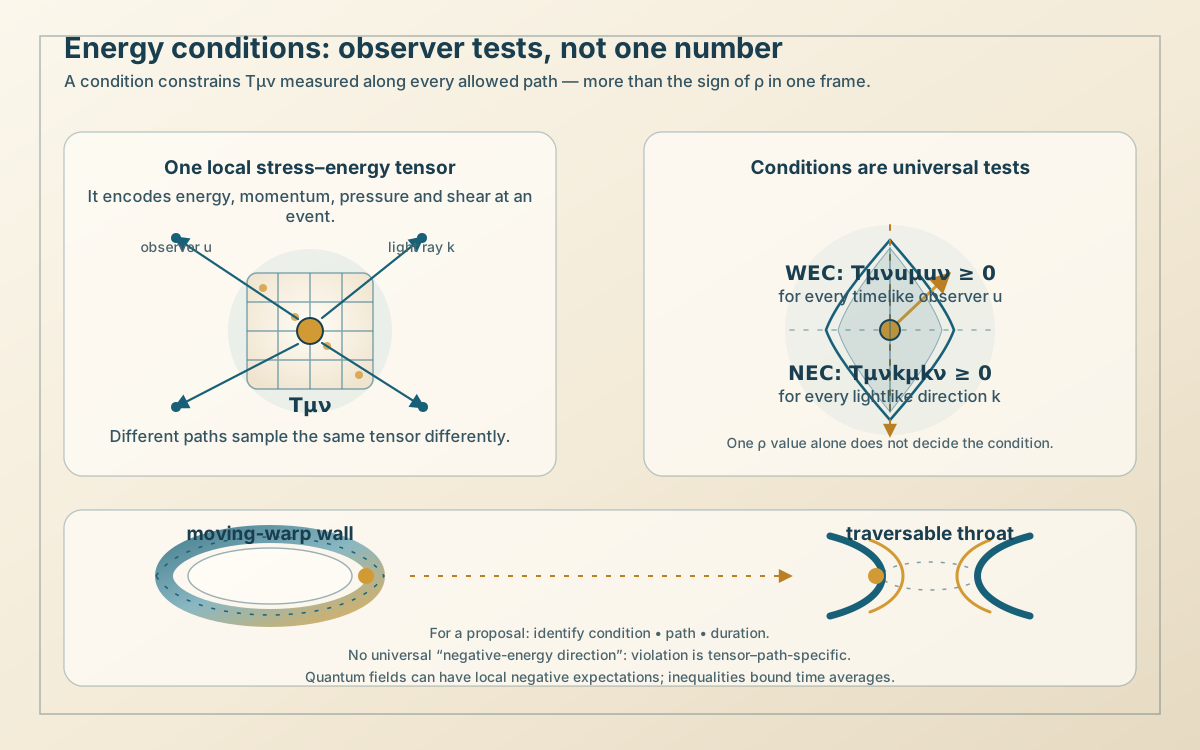
Now the crucial point, and the one most often missed by both enthusiasts and critics. The energy conditions are assumptions about matter, not theorems about nature. The standard review by Kontou and Sanders makes it explicit: every one of the original point-by-point conditions is broken systematically by quantum fields, and by some quite ordinary classical fields too. Barceló and Visser show that a plain classical scalar field breaks them as soon as it is coupled to curvature, and produce a whole branch of traversable wormhole solutions from it — at the stated price that the field must reach values above the Planck scale somewhere in the geometry.
So the field did what a healthy field does: it replaced a broken rule with a weaker and more durable one. Two survivors matter. Quantum energy inequalities say exactly how far the energy may dip below the ambient vacuum level and for how long. And the achronal averaged null energy condition — the energy summed along an entire light ray — is the one version the review's authors expect to hold universally.
A condition is quantified over all observers: it fails if any observer sees it fail. That is worth turning over rather than reading past, so hold one geometry still and move the observer instead. The tensor below never changes; the density measured off it starts above the ambient vacuum level, and crosses below it at an exact rapidity.
The observer sweep
An energy condition is not a property of a place. It is a statement about one stress-energy tensor contracted with every timelike observer's four-velocity, and it fails if any one of those observers sees it fail. Here is one fixed geometry — a throat whose energy density a static observer reads as positive — and one control that walks an observer around the hyperbola of allowed boosts. The tensor never moves. The density they measure changes sign.
- The hyperbola of allowed observers
- above the ambient vacuum level
- below the ambient vacuum level
The tensor, unchanged
- Energy density in the throat frame:
- 1.2E38 J/m³
- Radial pressure:
- -4.82E38 Pa
- Density plus radial pressure:
- -3.61E38 J/m³
- Unchanged by the control:
- r₀ = 100 m, b′ = 0.25, normal
These three numbers are printed from the same frozen tensor at every setting of the observer control, and this instrument's test asserts it is the identical object throughout the sweep while the measured density changes sign. Only the measurement moves.
- Speed, as a fraction of the speed of light:
- 0.00 c
- Lorentz factor:
- 1.00
- Density this observer measures:
- 1.2E38 J/m³
- Weak energy condition:
- violated
- Sign change at rapidity:
- ±0.55
- The observer at rest in the throat frame:
- ✓
What this observer reads: 1.2E38 J/m³ — above the ambient vacuum level.
The crossing is exact rather than fitted: density plus the square of the speed times pressure vanishes when the square of the speed equals the shape derivative, so the sign changes at the inverse hyperbolic tangent of the square root of a quarter. Slower observers read a density above the ambient vacuum level; faster ones read one below it.
The verdict below is the condition checker's own, and it already reads broken for the observer at rest — because the checker, like the definition, quantifies over every observer rather than the one whose map you happen to be looking at. This sweep shows you which observer makes it so.
The rule, literally. An energy condition is quantified over all observers: it fails if any observer sees it fail. One observer reading a positive density settles nothing, because the condition was never asked of one observer.
Contracting a stress-energy tensor with a timelike four-velocity is textbook general relativity, and the arithmetic here is the same function the condition checker on this page already uses. What is at stake is only which observers you remember to ask.
- Morris and Thorne: the throat, and the field equations that price it
- Santiago, Schuster and Visser: warp claims that checked only the co-moving observer
The bill, itemised
The first serious pricing was done in 1997 by Michael Pfenning and Larry Ford, and it is the number every warp design since has been measured against. Apply the quantum inequality inside a region small enough to count as flat, and the bubble wall is forced extraordinarily thin — of order a hundred Planck lengths times the bubble's speed. Integrate the energy density across a wall that thin, for a bubble large enough to hold a ship, and the total comes to roughly ten to the twentieth galaxy masses. Going faster thickens the wall but raises the bill in exact proportion. Pfenning's dissertation with Ford extends the derivation into static curved spacetimes and prices the hundred-metre bubble at a negative energy far above the mass of the visible universe.
That is not a closed door. It is an itemised bill, and every design since — Van Den Broeck's topological bottle, White's toroidal reshaping, Bobrick and Martire's positive-energy subluminal shells — is an attempt to cut a line off it.
How much, and for how long
The rule that sets the budget is worth understanding properly, because it is beautiful and because it is misquoted constantly. Ford and Roman's original result and its simpler re-derivation say this: quantum field theory will let the energy density at a point sit below the vacuum floor by as much as you like, but nature keeps the books over time.
Christopher Fewster generalised it to any smooth path in any globally hyperbolic spacetime, which is the setting a real design occupies. Kontou and Olum supplied the explicit version in a spacetime with small curvature, and their neat result is that only the Ricci tensor enters, so along a path through genuinely empty space the flat-space bound applies unchanged. And Ford and Roman added the line that turns the inequality into an accounting principle.
Quantum interest. Separate a pulse below the vacuum level from the compensating pulse above it, and the second must be strictly larger than the first, with a surcharge that grows as the gap between them widens. An energy loan is always repaid, and repaid with interest. There is also a hard ceiling on how far apart the two pulses can be placed at all.
Here is the bill itself, as an instrument. Ask for a deeper dip below the ambient level and watch the window you may hold it in collapse — the quartic trade that every warp design since Pfenning and Ford has been measured against.
How much, and for how long
Nature will let the energy density at a point sit below the ambient vacuum level by as much as you like — and then it keeps the books over time. Ask for a deeper dip and the window you may hold it in collapses, as the fourth root. Set a depth, set a duration, and watch the envelope decide.
At this setting: This request sits outside the envelope. Hold the same depth for a shorter window, or take a shallower dip, and it comes back inside.
- Deepest dip this window allows
- 3.72E-26 J/m³
- Longest window this depth allows
- 4.39E-19 s
- The floor the inequality sets
- -3.72E-26 J/m³
A dip is a loan, and it is always repaid with interest. Separate a pulse below the ambient level from the compensating pulse above it and the second must be strictly larger than the first, with a surcharge that grows as the gap between them widens — and there is a ceiling on how far apart they can be placed at all.
This is a bound along a worldline, and only along a worldline. There is no spatially averaged quantum inequality in four dimensions: an explicit normalisable state can make the density averaged over a region of space at one instant as far below the ambient level as you like, over a region as large as you like, with the worldline bound still holding and the total energy still positive.
Scope: the flat-space bound for a massless scalar field with a smooth sampling window, which is the form every warp design is measured against. The curved-spacetime versions are stronger statements and carry their own papers.
- The source sheet: Ford and Roman on restrictions on negative energy density in flat spacetime
- The source sheet: Ford and Roman on the quantum interest conjecture
- The source sheet: Pfenning and Ford pricing the warp bubble
Quantum inequalities constrain energy density averaged along a worldline under the assumptions of each theorem. A proposed geometry must be checked against the bounds applicable to its spacetime and quantum fields.
Where the rulebook has no page
This is the part that keeps the subject alive, and it is all in the peer-reviewed literature.
There is no spatially averaged quantum inequality in four dimensions. Ford, Helfer and Roman built an explicit normalisable state — the vacuum superposed with particle pairs whose momenta nearly cancel — whose energy density averaged over a region of space at one instant can be made as negative as you like, over a region as large as you like. The worldline inequality still holds and the total energy is still positive. So the common shorthand, that quantum inequalities cap how much below-ambient energy you may gather in one place, is simply not what the theorems say.
That is one of eleven such rows, and holding them all in your head is the hard part — so here is the map instead. It is a shape question rather than a magnitude one: which averaging region has a theorem behind it at all. Pick a region, set the dimension and the kind of field the bound was proved for, and read whether that region is bounded, bounded on a stated conjecture, excluded outright, proved to admit no bound of that shape, or simply open. The rows carry their own papers: Fewster and Roman on light rays, Kontou and Olum on curvature, and Aron Wall on an advance measured out to infinity.
The averaging-domain map
The theorems of this subject are reported almost everywhere as saying that negative energy is impossible. What they say is narrower, and it is a question of shape rather than size: which averaging region has a theorem behind it at all. Pick a region, set the dimension and the kind of field the bound was proved for, and read what the literature actually establishes there.
- The averaging region:
- A region of space, at one instant
- Verdict:
- no bound of this shape exists
- Across the whole map:
- 5 bounded · 1 conditional · 1 excluded · 2 unbounded · 2 open
What this region says: Ford, Helfer and Roman build a normalisable state — the vacuum superposed with particle pairs whose three-momenta nearly cancel while their energies cannot — whose energy density averaged over a region of space at one instant can be made as negative as you like, over a region as large as you like. No bound of this shape exists in four dimensions. It is not a free lunch: the worldline bound still holds in the very same state, the total energy is still non-negative, and the compensating positive energy is real. It simply sits arbitrarily far from the negative region.
Settled by explicit construction, with an ordinary free massless minimally coupled scalar field — which is why it answers the general question rather than a special case.
What it bounds. Unbounded in four dimensions; bounded in two, and the papers say the dimension is the reason.
A region of space, at one instant. Verdict: no bound of this shape exists. Settled by explicit construction, with an ordinary free massless minimally coupled scalar field — which is why it answers the general question rather than a special case.
Scope: each verdict is the one that region's own authors stated, for the dimension and the field shown. Nothing is interpolated between rows, and nothing is carried past what a sheet says.
Every verdict on this map is a published result or a published counterexample. Where a paper rests on a stated conjecture the row reads conditional; where its authors call a case open, the row reads open.
Two things the map cannot say for you. Serguei Krasnikov reruns the standard impossibility argument and finds it resting on assumptions that often fail — it needs two curvatures to be comparable, which is false in any curved empty region — then builds shortcuts that satisfy the inequality outright and prices the smallest of them in milligrams. And the newest bound of the set, the smeared null energy condition, states the cleanest summary of the whole subject: the energy conditions never forbid negative energy, which quantum field theory guarantees exists. They only price it.
Say it correctly, or hand a critic a free win
Here is the language rule this chapter exists to enforce. Negative energy means below the ambient vacuum level, not below nothing. Eric Davis and Harold Puthoff say it themselves in their own laboratory survey — negative here is just a misnomer — and the physics behind the wording is plain. Closing two Casimir plates excludes only the longest, lowest-energy modes from the gap. Almost the entire energy of the zero-point field is still in there. The force we measure comes from that thin excluded sliver alone.
Nothing in this dispute touches the mathematics. It touches the label, and the label is what makes readers think the effect is exotic when the accounting is ordinary. Write below the ambient vacuum level. Every quantum inequality in this chapter is quoted that way for exactly this reason.
The accounting is easier to see than to say, so here it is as a bar. Walk the four steps and watch where the word comes from: the level in the gap never reaches zero, and the negative reading appears only once the zero of the scale has been moved up to the ambient vacuum line.
Before you move anything — what do you expect?
Optional, and there is no score. The instrument below works exactly the same whether you answer or not.
Below the ambient level, not below nothing
Four steps, and the phrase comes out right at the end of them. Start with the surrounding vacuum. Close two plates, and the longest modes no longer fit in the gap. What is left inside is the same field minus a thin sliver — still an overwhelmingly positive quantity. Only when you move the zero of the scale up to the ambient level does the reading go negative, and that is all the word negative ever meant here.
The sliver is drawn magnified by 2,000 times, so that it is visible at all.
This is the surrounding vacuum, and it is the unit of the whole drawing. Everything below is measured against this line.
- Energy inside the gap, against an absolute zero
- 99.990%
- The same energy, measured from the ambient level
- -0.010%
- Fraction of the field still inside the gap
- 99.990%
- The excluded sliver: the long modes that no longer fit
- 0.010%
The bar never reaches zero. At every separation in this drawing the absolute energy inside the gap is positive, and the negative reading appears only after the zero of the scale has been moved.
Scope: an accounting diagram for the label, not a calculation of the Casimir force. It fixes the wording the chapter depends on and asserts no absolute energy density.
The source sheet: Davis and Puthoff, experimental concepts for generating negative energy in the laboratory
That ledger answers where the number comes from. The reading is a second question, and it is the one that trips people: the same unchanged level can be written down as a large positive number or as a small negative one, and the only difference is where the scale was told to put its zero. Four more steps, and the sentence this section exists to enforce falls out of the drawing.
The two zeros
One region of space, one unchanged amount of energy in it, and two perfectly correct numbers you could write down for it — because a reading only means something once you say where the zero of your scale is. The ledger above shows where the number comes from. This shows how the same number gets two labels, and why only one of them carries a minus sign. Four steps, and the sentence comes out right at the end.
This window shows only 4 times the depth of the dip. What the break leaves out, as a multiple of what it shows: 2E3.
The true zero of the scale — far below this picture
Energy-scale definition
Here is the energy scale with its own floor at the bottom: the true zero, the level the phrase below nothing would have to mean. The ambient vacuum level sits far above it — so far that the window drawn here has to be broken, and the caption says by how much. Everything that follows happens in the thin strip at the top.
The same level, read twice
- Measured from the true zero
- 99.990%
- Measured from the ambient vacuum level
- -0.010%
Both rows describe one region and one unchanged amount of energy. Nothing was removed between them, and nothing went below nothing: the origin of the scale moved, and that is all.
So the sentence to write is below the ambient vacuum level, and never below nothing. Davis and Puthoff say as much in their own laboratory survey — negative here is a misnomer — and the accounting behind it is ordinary. The label is what makes the effect sound exotic.
Scope: this is a drawing about where a scale puts its zero. It is not a measurement of an absolute vacuum energy density, and no number here is one.
The sheets this wording answers to
- Davis and Puthoff: experimental concepts for generating negative energy in the laboratory
- Kontou and Sanders: energy conditions in general relativity and quantum field theory
- Freivogel, Kontou and Krommydas: the energy conditions price negative energy rather than forbidding it
Where the ingredient is actually made
Now the good news, and it is genuinely good. The condition the geometry demands is produced in laboratories today. Davis and Puthoff's catalogue of experimental concepts lists them: Casimir cavities, squeezed states of light, vacuum fluctuations squeezed by a gravitational field, certain electron field states — and then sketches machines to make it on demand, principally a laser and a lithium niobate resonator whose squeezed output alternates positive and negative pulses, with a fast rotating mirror to separate them. They note that squeezed-vacuum sources had already been demonstrated with nothing more exotic than a diode laser and a cell of rubidium vapour.
Making it is one problem; seeing where it is is another. The reference document on quantum tomography of negative energy states proposes the instrument: optical homodyne tomography, pairs of photodiodes subtracting their outputs to read the fluctuations of the electric field itself, one phase angle at a time, until the quantum state can be reconstructed like a scan. Portable versions would map the field around an engineered region. Eric Davis's Teleportation Physics Study for the Air Force Research Laboratory is where the two halves — the geometry and the negative-energy budget — were put on official letterhead together.
Below-ambient energy densities are made and measured. The large, sustained, correctly shaped quantity a geometry needs is far past anything produced so far. That gap is the whole engineering problem, and it is also the job list. What to watch: a portable homodyne tomography rig mapping a below-ambient region in a Casimir cavity directly, rather than inferring it from the force — the measurement this whole chapter is waiting on.
Wormholes built out of measured effects
The most encouraging development in this subject is that people have stopped inventing exotic matter and started building throats out of effects that exist.
Maldacena, Milekhin and Popov construct a traversable wormhole in four dimensions from two nearly extremal black holes with large opposite magnetic charges: massless charged fermions ride closed magnetic field lines, a massless fermion on a circle carries a negative Casimir energy, and that holds the throat open. Their own emphasis is that no exotic matter is required and the ordinary matter of the Standard Model is enough. Garattini and Tzikas take a Casimir device as the literal source term, add a scalar field, and insist that the total stress-energy be conserved rather than assumed — and find exactly one combination that survives the test.
Around those sit the practical constructions. Kuhfittig shows that the two published escape routes — quantum support, and arbitrarily little exotic matter — have a catch, and builds a model that keeps tidal forces inside human limits with a mouth four astronomical units out and a six-day transit at one gravity. Edward Teo's rotating traversable wormholes let a designer move the exotic material around the throat so that fast enough travellers cross without passing through it — and a fast enough throat grows an ergoregion, a place from which rotational energy can be taken. Sushkov sources a throat from phantom energy, a form of dark energy cosmology already argues about. And a thin-shell construction at an extremal horizon returns zero energy density on the shell with finite positive pressure, stable under radial perturbation.
The live route through the constraints
The best modern constraint is also the best modern specification. Santiago, Schuster and Visser compute the whole stress-energy of a general warp field and prove that every drive in the family violates the null energy condition somewhere in the shell — because space has to return to flat once the bubble passes. And then they do the thing that makes it useful: they name the five places a warp programme can go next, and say plainly that one of them has to be faced. Ken Olum's earlier theorem is the same shape, and ends by pointing at the Casimir effect as a laboratory system that already produces the required ingredient.
The constraints are easier to hold once you can turn them. Pick a geometry below, move an observer past it, and read which condition it breaks, where, and for whom — with the two that carry a closed-form stress-energy computed here and the rest quoted from the papers that state them.
The condition checker
The energy conditions are assumptions about matter, not theorems about nature — and the useful question is never whether a geometry is forbidden. It is which condition it breaks, at which place, and for which observer. Choose a geometry, set its one control, then move an observer past it and watch the verdicts change.
What this setting says: Null energy condition: broken here. Weak energy condition: broken here. Dominant energy condition: broken here. Averaged null energy condition, along a whole light ray: broken here.
- Energy density in the frame of a static observer
- 0E0 J/m³
- Pressure along the chosen axis
- -4.82E38 Pa
- Energy density this observer measures
- 0E0 J/m³
- Density plus pressure, the null sum
- -4.82E38 J/m³
- Flare-out
- the throat stays open
Every energy density here is measured from the surrounding vacuum level, which is where the word negative comes from and all it ever means. It is never a quantity below nothing.
The energy conditions are assumptions about matter rather than theorems about nature. Quantum fields break them routinely, and the Casimir effect is the standing laboratory example — so a broken condition is a price to be read, not a door that has closed.
Scope: pointwise conditions at one place in the geometry. The averaged condition along a whole curve is not a pointwise quantity, so it is quoted from the literature and never computed here.
Two live proposals answer the bill directly. Bobrick and Martire's 2021 result — that subluminal warp shells can be built from positive energy — is the most important recent peer-reviewed move in the field and belongs on every propulsion page. And Chance Glenn argues that the negative sign in Alcubierre's energy density is an artefact of assuming a real-valued shaping function: let it be complex, and the required density turns positive. He names the material, the frequency, the cavity dimensions and the measurement, built the bench, and reports honestly that his energy density is orders of magnitude short. That is what an on-the-bench claim looks like when it is stated properly. One caution from the same season: Garattini and Zatrimaylov's wormhole-warp correspondence finds that the very conditions making a throat safe for a traveller are what make it a curvature singularity as far as a warp bubble is concerned, and they name three ways the obstruction might be evaded.
Time loops that close on themselves
A traversable wormhole with one mouth moved relative to the other is also a time machine — Morris, Thorne and Yurtsever said so in the 1988 paper this chapter already cites. So the energy bill is not the only specification a throat has to meet. It also has to meet the question of what happens around a closed loop in time.
The oldest working answer is self-consistency. Wheeler and Feynman's absorber theory of radiation, which John Cramer built on for his transactional interpretation, lets the future absorber and the past emitter take part in one exchange, and the only exchanges that happen are the ones consistent from both ends. Cramer's own conclusion is careful: in standard quantum mechanics the advanced waves cancel everywhere outside the exchange, so nothing can be signalled backwards. Read as a principle, it says a closed loop has to agree with itself.
That one principle handles the famous puzzles:
- The grandfather loop. A history in which the traveller prevents their own birth does not agree with itself, so it is not one of the histories that happens.
- The bilking loop. A message from the future says "press the button", and pressing it is what sends the message. A history where you refuse is not consistent, so the loops that occur are the ones where the button is pressed.
- The uncreated book. A book arrives from the future, you publish it, and years later you send it back. Nobody wrote it. That loop is consistent, and nothing in the principle forbids it. It is the strangest of the three precisely because it is allowed.
Where does a real door open? In the linearity of quantum mechanics. The theorems that forbid signalling through entanglement assume the wave function evolves linearly. Steven Weinberg turned the size of any nonlinearity into a precise, measurable parameter in 1989, with ion frequency standards as the detector. Joseph Polchinski then showed in 1991 what such a nonlinearity would do: either entangled systems could signal to each other, or, if that is forbidden, the different branches of the wave function could. A slight nonlinearity is exactly the parameter that decides what quantum correlations can carry — and precision spectroscopy is how it is bounded.
What to watch: tighter precision bounds on nonlinear terms in quantum evolution, and any laboratory analogue of a closed loop that tests self-consistency directly.
Who works on this
Numerical-relativity researchers, computational physicists, quantum-field-theory theorists, and precision-measurement physicists working at Casimir-scale energy densities. The last of those is the job the field needs most and advertises least: somebody has to build the tomography rig that reads the field where it dips, because a budget nobody can measure is not an engineering programme.
What the field added — July to September 2026
The season's clearest contribution here was linguistic, and it is worth more than it sounds. Douglas Miller and Ashton Forbes worked through the mode counting on air and reached the verdict this chapter enforces: "negative energy is definitely a misnomer," because almost the entire zero-point energy remains inside a closed Casimir gap and the measured force comes from the thin excluded sliver. A reader who has that picture will never mistake the accounting for magic, and will never be talked out of the real effect by someone attacking the label.
The second addition is the reminder that the constraint literature is where the progress is. Santiago, Schuster and Visser's theorem, Wall's carefully bounded no-go and the missing four-dimensional spatial inequality are not obstacles to route around. They are the specification, and this is the only chapter on the site where reading the specification carefully is the entire skill.
The season also produced a new kind of specification. Fell and Loeb simulated a warp bubble crossing Earth's atmosphere (2026) and computed what the air around it would do. An aircraft-sized bubble moving at relativistic speed drives a bow shock that shines at more than a terawatt, mostly in gamma rays the upper atmosphere absorbs and re-emits, and above roughly ten per cent of light speed the glow is brilliant and unmistakable. Slow it down and shrink it and the light falls steeply; the authors state that compact, slow bubbles would not shock the air at all and leave that regime to future work. Readings of slow, micrometre-scale orbs as warp bubbles come from Loeb's separate blog post, not from this paper. A geometry that tells you what it would look like is a geometry a sky survey can go looking for.
Research measurements
- A general curved-spacetime bound without the remaining conjecture
- the open question is what the spacetime-averaged bounds are
- An independent group reproducing the construction and its stress-energy
- A device producing a sustained, correctly shaped below-ambient region and a tomography measurement of it
- A resonator reaching the predicted energy density, with an independent interferometric reading
Sources
The chapter where the geometry stops being free. Every bound here is a specification, not a refusal.
The geometries
- M. Morris & K. Thorne (1988), "Wormholes in spacetime and their use for interstellar travel," Am. J. Phys. 56, 395. /library/stm-b8b6ab9b94.
- M. Morris, K. Thorne & U. Yurtsever (1988), "Wormholes, time machines, and the weak energy condition," Phys. Rev. Lett. 61, 1446. /library/stm-a2430e29f0.
- M. Visser (1996), Lorentzian Wormholes: From Einstein to Hawking. /library/stm-1e6a0b75bc.
- J. Maldacena, A. Milekhin & F. Popov (2018), "Traversable wormholes in four dimensions" (arXiv:1807.04726). /library/stm-d0d2a8e701.
The rulebook
- E.-A. Kontou & K. Sanders (2020), "Energy conditions in general relativity and quantum field theory." /library/stm-1bcd336342.
- L. H. Ford & T. A. Roman (1995), "Averaged energy conditions and quantum inequalities," and (1997), "Restrictions on negative energy density in flat spacetime." /library/stm-5e822858ce, /library/stm-09a7d97555.
- L. H. Ford & T. A. Roman (1999), "The quantum interest conjecture." /library/stm-e1bdffd056.
- C. J. Fewster (2000), "A general worldline quantum inequality." /library/stm-22ba5ed09b.
- M. Pfenning & L. Ford (1997), "The unphysical nature of warp drive" (arXiv:gr-qc/9702026) — the bill every later design answers. /library/stm-710bf626ca.
Where the rulebook runs out
- L. H. Ford, A. D. Helfer & T. A. Roman (2002), "Spatially averaged quantum inequalities do not exist in four-dimensional spacetime." /library/stm-755a293263.
- C. J. Fewster & T. A. Roman (2003), "Null energy conditions in quantum field theory." /library/stm-d1e51c2294.
- S. Krasnikov (2003), "Quantum inequalities do not forbid spacetime shortcuts." /library/stm-898c89f416.
- A. C. Wall (2013), "The generalized second law implies a quantum singularity theorem" — with the author's own statement of where it does not apply. /library/stm-15e3404f9f.
- B. Freivogel, E.-A. Kontou & D. Krommydas (2022), "The return of the singularities: applications of the smeared null energy condition." /library/stm-75affcb30e.
Making it, measuring it, and the route through
- E. Davis & H. Puthoff (2006), "Experimental concepts for generating negative energy in the laboratory." /library/stm-2fa40aad9d.
- E. Davis (2004), Teleportation Physics Study, AFRL-PR-ED-TR-2003-0034, DTIC ADA425545. /library/stm-5b568f0316.
- "Quantum Tomography of Negative Energy States in the Vacuum" (2011), DIRD. /library/stm-07d12a8c5d.
- J. Santiago, S. Schuster & M. Visser (2021), "Generic warp drives violate the null energy condition" (arXiv:2105.03079). /library/stm-467f9a2835.
- A. Bobrick & G. Martire (2021), "Introducing physical warp drives," Class. Quantum Grav. 38, 105009 (arXiv:2102.06824) — subluminal shells from positive energy.
- C. Van Den Broeck (1999), "A warp drive with more reasonable total energy requirements" (arXiv:gr-qc/9905084) — the topological bottle.
- C. M. Glenn (2026), "Overcoming the negative energy density requirements in the Alcubierre warp field equations with a complex shaping function." /library/stm-d4ce3e0e56.
Closed loops, and the new signatures
- S. Weinberg (1989), "Precision Tests of Quantum Mechanics," Phys. Rev. Lett. 62, 485. /library/stm-06e5a27568.
- J. Polchinski (1991), "Weinberg's Nonlinear Quantum Mechanics and the Einstein-Podolsky-Rosen Paradox," Phys. Rev. Lett. 66, 397. /library/stm-0aff150da2.
- J. G. Cramer, "The transactional interpretation of quantum mechanics" (original Rev. Mod. Phys. 58, 647, 1986). /library/stm-57e4eb66e8.
- S. D. B. Fell & A. Loeb (2026), "Radiative Signatures from Warp Drives Traveling Through the Earth's Atmosphere" (arXiv:2608.10800). /library/stm-5b701628cb.