Getting Energy From the Vacuum — and the Thermodynamics Objection, Answered
The dynamical Casimir effect, quantum energy teleportation, and the three funded programmes building toward net power.
This is the chapter with a product at the end of it. It also has the strictest rule in the book to satisfy. Learn that rule first and every device programme here becomes easy to read. You will be able to tell, in a minute, where any given design gets its energy from.
Before the rule, the measurement that made it necessary. In 2011 a mirror was shaken billions of times a second and the vacuum gave back real, detectable light. Press play and watch where along its motion the photons leave it.
Before you move anything — what do you expect?
Optional, and there is no score. The instrument below works exactly the same whether you answer or not.

Nothing went into that mirror except motion. So the first question is the obvious one — where did the energy come from? — and the answer is the rule every design in this chapter has to satisfy.
The rule every design must satisfy
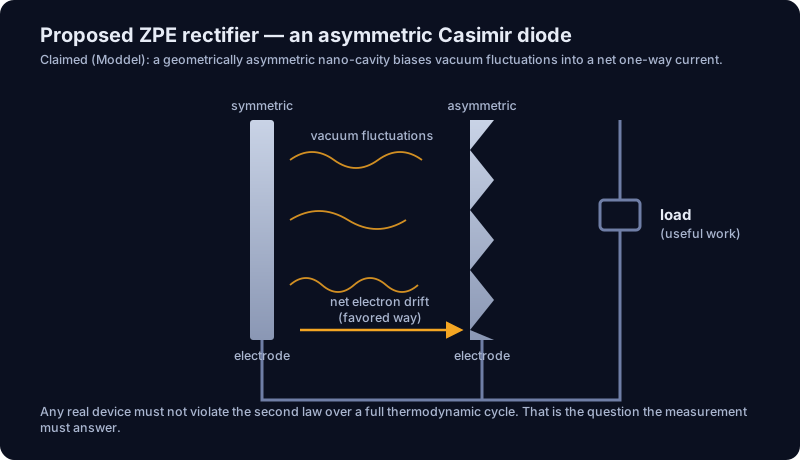
The vacuum is the ground state. It is the lowest-energy setting there is, so there is no lower state to fall into. Now picture a device that runs in a loop and comes back to exactly where it started. Over that closed loop it cannot deliver net work. Let two Casimir plates snap together and energy is released. Pulling them apart costs the same energy back. The loop closes at zero. This is the design constraint, and every serious programme in this field is built around it.
The clearest statement of that constraint comes from a proponent. Garret Moddel and Olga Dmitriyeva's 2019 review in Atoms walks through the extraction schemes one at a time. It sorts them against thermodynamics, shows which ones cannot close their books, and then identifies the narrow window that survives. That review is the field's roadmap. It is also why Moddel's own Casimir-cavity diodes are shaped the way they are.
Shaking the vacuum makes real light
Here is that measurement in full, and it is the one that changed the subject. In 2011 Christopher Wilson and colleagues made real photons appear out of the vacuum by moving a mirror. Not a metaphor — real, detectable microwave light. They shook the boundary of a superconducting circuit billions of times per second. That was fast enough that the vacuum's virtual photon pairs could not keep up. Some of them were promoted to real photons. This is the dynamical Casimir effect (DCE), and it has been reproduced on several platforms since.
The DCE is real and measured. The lesson it hands a designer is precise: the vacuum converts work into light. Supply the drive and you get photons out.
Quantum energy teleportation: energy where you want it
There is a second piece of fully rigorous, peer-reviewed physics here. It is Masahiro Hotta's Quantum Energy Teleportation (QET). You measure the vacuum at one point and send the plain result to a partner elsewhere. With that result in hand, the partner can draw a little energy from their own local vacuum, sooner than they otherwise could. It works because the two regions are quantum correlated. It looks like magic, and the books balance exactly. The measurement itself injects at least as much energy as is later drawn out.
QET is genuine physics, and later work extended it to arbitrary distance. It is a transport result rather than a source: the energy is paid for at the measurement step. That makes it the cleanest worked example of the closed-cycle rule in action.
Where a circuit's power comes from
Every design on this page is an argument about a ledger, so it is worth knowing exactly where an ordinary circuit's energy travels before meeting an extraordinary proposal about it.
Start with the settled part. The energy that lights a lamp does not travel along inside the copper. It travels in the electromagnetic field in the space around the wire, and the wire's job is to guide it there. John Henry Poynting wrote the accounting for that flow in 1884, and it is the accounting every power engineer still uses. The field half of this picture is taught at greater length in the vector-potential course. Settled physics.
The second settled point is the one readers rarely meet. Of all the flow moving through the space around a conductor, only the component that strikes the surface charges is turned into the wire and does the work. The rest sweeps past and is never intercepted. Oliver Heaviside described that larger remainder in the 1880s, and in Bearden's chapter on the active vacuum the intercepted part is named after Poynting and the remainder after Heaviside — two names for two components of one standard solution, not two rival theories. Settled physics.
Now the proposal, and the reason it belongs in a chapter about thermodynamics. Ask what a potential actually is, and what it costs to keep one. A battery does not push energy down the wire. It spends its chemistry separating charge, making a source dipole — a positive end and a negative end held apart. That dipole is a boundary condition on the field, and while it stands, the field around the circuit is the one it sets up. On Bearden's reading, what the shaft work or the chemistry buys is not the flow; it is the dipole. What destroys the dipole is driving the circuit's spent charge back through it, which is precisely what an ordinary closed loop does — and that is why his design requirements are all about keeping the load out of the source's own current loop. What to watch. The structure he assigns to the potential comes from a published result: Whittaker showed in 1903 that a scalar potential can be decomposed into paired counter-propagating components, and reading that decomposition as a real energy flow rather than a mathematical identity is the part that would have to be tested.
Hold one distinction hard here, because this is the easiest place on the site to slip. Energy flow and energy source are different quantities. Saying that more flow passes a wire than enters it is a statement about catchment — how much of a field a given conductor manages to divert. It is not a statement that the flow is unpaid for, and it does not loosen the closed-cycle rule of Formula 6.1 by a single line. A circuit that caught more of the passing flow would still have to show on a meter where its energy entered. A bigger catchment is not a bigger supply.
Where a circuit's energy lands
Energy travels along the equipotential surfaces around a circuit, out from the source and in on whatever turns it into heat or work. Draw those surfaces at equal steps of potential and each one carries the same share, so counting them is honest bookkeeping. Move the work from the resistance of the line to the load and watch what changes.
- Ending on the load
- Ending on the line
- Surfaces leaving the source:
- 12
- Ending on the load:
- 0
- Ending on the line:
- 12
Reading: The number leaving the source never changes. Only where they land does — which is the whole distinction between a bigger catchment and a bigger supply.
This is the 1884 accounting, worked through the paper's own motor case: as the motor takes more of the work, more level surfaces converge on it and fewer cut the rest of the circuit. Nothing here is a claim about drawing more energy out than was put in.
Poynting, On the Transfer of Energy in the Electromagnetic Field (1884)
One result from ordinary optics anchors the catchment idea. A resonant particle can absorb and re-radiate substantially more light than falls on its geometric cross-section, explained in the standard way by the resonance sweeping a larger effective area than the static calculation assumes. Settled physics. The particular figure that travels with it, a factor of up to about eighteen, comes from Craig Bohren's 1983 paper in the American Journal of Physics, in the form Bearden's chapter quotes it. What to watch: the paper itself, read at the source, gives the exact figure and the conditions it holds under, and that reading is what will fix the number on this page.
The hardware written to these principles is the motionless electromagnetic generator, and its function is worth reading even by someone who never follows the argument around it. A permanent magnet sits inside a closed core that offers its flux two paths. Two small input coils are pulsed alternately at high frequency, each pulse pushing back against the flux in its own path, so the magnet's field is shuttled from one side of the core to the other with nothing turning and without driving the core into saturation. Two output coils take current from the swings. It is a machine for changing the geometry of a standing field rather than for pushing against one. Designed, not yet built covers the requirement list that goes with it: an open exchange during discharge, the load kept out of the source's loop, and repeated collection from the flow that ordinarily passes by.
What would settle the accounting is not an argument; it is a bench. One metered run, every input line instrumented — the switching supply included — with the ledger closed by Poynting's theorem over a complete cycle, the raw traces published, and a control run in which the magnet is replaced by an unmagnetised slug of the same geometry. That measurement is cheap, it is unambiguous, and nobody has published it.
| Claim | What would settle it | |---|---| | A circuit's energy travels in the field around the conductor, not inside it | Poynting's 1884 accounting is standard engineering practice | | Only the component of that flow reaching the surface charges enters the conductor; the remainder passes by | it is a reading of the standard solution, not a new one | | A resonant particle absorbs and re-radiates more light than its geometric cross-section intercepts | with the standard resonance explanation. What to watch: Bohren's 1983 paper, read at the source, fixes the factor of about eighteen that Bearden quotes from it | | Shaft work or chemistry is spent forming a source dipole, and the dipole is what the circuit's flow is organised around | A metered bench run with every input line instrumented and the ledger closed by Poynting's theorem over a complete cycle | | Whittaker's 1903 decomposition of a potential read as a real energy flow rather than a mathematical identity | A measurement that distinguishes the two readings, which nobody has yet proposed in a testable form | | A circuit built to collect repeatedly from the non-intercepted flow | A build to the stated requirements, measured on the bench above, with a control run against an unmagnetised core |
What is in hand, and what is being built
- The vacuum's force is engineerable — repulsive and tailored Casimir forces are demonstrated.
- Vacuum fluctuations can be converted to real photons (DCE).
- Three funded programmes are investigating standalone devices; measuring net output requires a complete energy balance over a cycle.
Six lines, then, and they are not interchangeable. Each card below names the builder, the organisation, how far the programme has actually got, and the one measurement that would settle it — so you can tell at a glance which of them has hardware on a bench and which is still a drawing with a disagreement attached.
The six programmes being built right now
Six device lines, each with a named builder, a named organisation and a named next measurement. The phrase on each card is the ceiling on what that programme has shown so far, and the links beneath it are where you check it. None of these is a net-power result, and none of them is presented as one.
The asymmetric optical and Casimir resonator
Who is building it: Garret Moddel — University of Colorado Boulder
One cavity carries more vacuum modes than the next, so there is a pressure difference across the pair, and that difference drives electrons around an external circuit. Moddel's own 2019 review sorts every extraction scheme against thermodynamics first; this is the design his sorting leaves standing.
The measurement that would settle it: Output power per unit area from cavity-bearing and cavity-free devices made on one wafer, with the difference surviving the published artefact list.
Engineering cards
Source sheets
The Casimir power cell
Who is building it: Harold “Sonny” White — Casimir Inc., with the Limitless Space Institute
Vacuum pressure made deliberately non-uniform by geometry and predicted with the worldline method. The patent says what the geometry is: two walls with three pillars standing between them to break the symmetry, the pillars electrically isolated from the walls, so the tunnelling current across to the pillars is the output.
The measurement that would settle it: The transient amplitude in millivolts against pillar geometry, compared with the worldline-numerics prediction for each geometry, with the no-pillar control on the same die.
Engineering cards
Source sheets
The asymmetric resonant tunnelling diode
Who is building it: Charles Chase — the UnLab
Vacuum fluctuations couple to a tunnelling current, and the asymmetric potential inside the diode gives that coupling a preferred direction, so what comes out is a momentum rather than only a current. Chase states the governing rule against himself: nothing can be drawn from the vacuum without breaking a symmetry or leaving equilibrium.
The measurement that would settle it: Force in nanonewtons per kilowatt, measured forward, sideways and reversed in one session, published with the thermal transient and the drive current on the same time axis.
Engineering cards
Source sheets
The graphene fluctuation harvester
Who is building it: Paul Thibado — University of Arkansas
A freestanding graphene sheet ripples with its own thermal motion, and a pair of diodes rectifies that ripple into a current. The published measurement is small and carefully stated: tens of picowatts at one diode, with the accounting given at a single temperature.
The measurement that would settle it: Power per unit area from a scaled array, held to the same ledger the field applies to every cell: the output has to survive the artefact list and the accounting has to close at one temperature.
Engineering cards
Source sheets
The tabletop momentum device
Who is building it: Charles Buhler — Exodus Propulsion Technologies
Buhler's group reports about three thousand experiments on a tabletop device and states plainly that the momentum is exchanged with the quantum vacuum. A spaceflight test is being prepared. This is the only line in the set with a stated momentum result, which is also why it sits in the replication ledger.
The measurement that would settle it: Thrust in nanonewtons per kilowatt, measured forward, sideways and reversed inside the chamber in one session: a real thrust turns around with the device, and a thermal artefact does not.
The moving-boundary tapered cavity
Who is building it: Douglas Miller — Zero-Point Field Technologies LLC, Houston
Every other programme here is solid state and moves its boundaries electronically. Miller means to move real walls, and to move them along a taper, so different sections of the cavity carry different mode counts and the device has a time structure built into its shape. His stated payoff is knowledge before power. Ashton Forbes objects on air that moving parts buy friction and failure modes; the disagreement is on the record and unresolved.
The measurement that would settle it: Photons out per joule of drive energy in, for each rig, at matched effective boundary velocity, plus the two-mode squeezing signature that separates real vacuum photons from amplified heat.
Engineering cards
Source sheets
The one shared principle
Chase puts all six under one sentence: they rest on the same attempt to create an asymmetry in the vacuum and to use that asymmetry to do work, make a force, or generate a current. Ashton Forbes's image for it is a waterfall — instead of burning fuel, you make a gradient in an ambient field and let it flow.
The closed-cycle rule governs all six. Around a loop that returns a device to exactly its starting condition the net work is at most zero, so every serious programme names where its energy enters: a drive, a temperature difference, or an asymmetry built into the device itself. The milestone the whole field names is the same one — a complete ledger, actuation and measurement included, that comes out net-positive over a closed cycle and that a second laboratory repeats.
Nothing here moves on its own. Each card is drawn once, in full, and stays put.
That board ends with one sentence that is supposed to hold the hardware lines together. It is a good sentence and it is worth taking apart, because the useful half of it is knowing exactly where the resemblance stops.
The one shared principle, and exactly how far it goes
Seven frames, advanced by you. Charles Chase puts the device programmes under a single sentence: build an asymmetry into the vacuum around the device, and take work from the asymmetry. That sentence is worth learning, and it is worth learning precisely — a sentence that unifies three architectures is exactly the kind of statement that goes wrong by being generous. So the frames lay the three devices onto one diagram, then separate what is genuinely shared from what only looks shared.
- The closed cycle, and what it permits
Frame 1 / 7
The rule first, because everything else is built around it
The vacuum is the ground state: the lowest-energy setting there is, with nothing beneath it to fall into. Take any device around a full loop, back to its exact starting condition, and the net work it can deliver over that loop is at most zero. Every serious programme in this chapter is shaped by that rule, and the clearest statement of it in the literature comes from a proponent — Moddel's own review sorts the extraction schemes against thermodynamics before it proposes anything.
Moddel's cell is the most advanced hardware claim on that board, and the right way to hold a hardware claim is as a ledger. Here it is: the claim on one side, every artefact that has been tested and how it was excluded on the other, and the one control the field most needs.
The Moddel cell, and the ledger that would settle it
A tunnelling diode about two nanometres across with a Casimir cavity on top, reported at about seventy watts per square metre with no apparent input. This is the ledger: the claim on one side, every artefact that has been tested and how it was excluded on the other, and the one control the field most needs. Filter the rows by what they are, and by which apparatus they belong to.
The claim, as its author states it
- Reported power density
- 70 W/m²
- For comparison, a solar cell over the same area
- 210 W/m²
- Insulator the electrons tunnel through
- 2 nm
- One patented device, up to a terahertz cut-off
- 6.6E-10 W
- Candidate measurement artefacts investigated by the author
- 9
- Measured evidence — 5
- Artefact excluded — 5
- Argued against, not ruled out — 1
- Left open by the authors — 2
Measured evidence: 5. Artefact excluded: 5. Argued against, not ruled out: 1. Left open by the authors: 2
| The row | What it is | Which apparatus |
|---|---|---|
| Short-circuit output rises as the Casimir cavity is made thinner, for cavities filled with PMMA and with silicon dioxide alike.This is the trend the author identifies as the signature to look for, because a thinner cavity suppresses more of the long-wavelength modes. It is a dependence on geometry, which is what separates this claim from a thermal one.The paper | Measured evidence | The tunnelling diode with a Casimir cavity |
| The trends are reported across many thousands of devices produced in dozens of batches.A count of devices is not a replication, and the paper does not present it as one. It is what makes a systematic fabrication artefact less likely, and it is reported here as exactly that.The paper | Measured evidence | The tunnelling diode with a Casimir cavity |
| Nine candidate measurement artefacts were investigated by the author, and none was able to explain the observed results.The enumeration is in that paper's own appendix, which this site does not reproduce. The count is reported as a count.The paper | Artefact excluded | The tunnelling diode with a Casimir cavity |
| A Casimir resistor through a high-frequency line into a diode with a terahertz cut-off gives 0.66 nanowatts per device at a matched load.The patent also gives the recipe: micrometre-scale cells of chromium, silicon dioxide and aluminium, wired into series and parallel arrays.The paper | Measured evidence | The tunnelling diode with a Casimir cavity |
| The Joule-Thomson effect, in the gas-flow experiment.Excluded: the lock-in phase was inverted, which indicates cooling rather than the heating the artefact would produce.The paper | Artefact excluded | The gas-flow experiment |
| Turbulence in the flowing gas, in the gas-flow experiment.Excluded: the Reynolds number sits far below the turbulent threshold at flows under two centimetres per second.The paper | Artefact excluded | The gas-flow experiment |
| Absorption or adsorption at the membrane, in the gas-flow experiment.Excluded: the signal did not scale with membrane surface area, which it would have to if the surface were producing it.The paper | Artefact excluded | The gas-flow experiment |
| Frictional heating of the gas, in the gas-flow experiment.Argued against but not ruled out: the ordering across gases comes out wrong, and the dependence on flow is linear where friction would make it quadratic. The authors say so themselves.The paper | Argued against, not ruled out | The gas-flow experiment |
| The measured power stayed below one microwatt for every gas and sample, about three orders of magnitude under the prediction.The authors call the result tantalising but inconclusive, and name what they would do next: nanopores of consistent size and shape, the radiation imaged to find its source, and its spectrum measured.The paper | Left open by the authors | The gas-flow experiment |
| Rectifying the zero-point field with a diode, or with an antenna feeding a diode.Excluded as a route, by the same author's own review: the field is in true equilibrium, so detailed balance binds each step separately and no net power can be drawn that way.The paper | Artefact excluded | The thermodynamic route analysis |
| Extraction from Casimir cavities is consistent with thermodynamics in principle.Cole and Puthoff worked the entropy through both a reversible squeeze and an irreversible one, and the books balance. The permission slip is old and it is real; what it permits is a device, not a conclusion.The paper | Measured evidence | The thermodynamic route analysis |
| Where the energy ultimately comes from.Left open by the author in his own words. That is the right way to leave it, and it is the question the settling measurement below would begin to answer.The paper | Left open by the authors | The thermodynamic route analysis |
| A freestanding graphene sheet rectified into a diode circuit reached forty picowatts at one diode.Kept beside the cell as the clean comparison, not as support: that device draws on thermal fluctuations at a single temperature, and its authors keep the accounting that way.The paper | Measured evidence | The clean comparison beside it |
The measurement that would settle it
Output power per unit area from cavity-bearing and cavity-free devices on one wafer, measured in the same session by a second laboratory, with the difference surviving the artefact list. One wafer, two populations, one session: that is the control the field most needs and the one nobody has published.
Keep the two claims apart, because keeping them apart is what makes either one assessable. Thibado's graphene harvester rectifies the thermal ripple of a freestanding sheet and reached forty picowatts at one diode, with the accounting explicitly at a single temperature. That device draws on thermal fluctuations. The cell above is a claim about geometry.
Scope: a ledger of what has been measured and what has been excluded, with every row sourced. It is not a verdict, and it does not need to be one — the settling measurement is named above and somebody can go and take it.
The ledger turns on one word — pair. Here is what that pair looks like: two devices built the same way on one substrate, and a cavity over only one of them.

- Geometry computed from
- A pair of identical chromium resistor devices on one substrate at true relative scale, one of them carrying a Casimir cavity and one of them bare, built to the patent's own fabrication numbers: a cell 2 by 3 micrometres, a 20 nanometre chromium film patterned as a resistive region of ten squares, and over one device of the two a cavity layer of 30 nanometres of silicon dioxide beneath a 150 nanometre aluminium reflector. Beside the pair stands a layer-order callout, to no scale in any axis, for the reported metal-insulator-metal device: palladium and nickel separated by an insulator about two nanometres thick
- Numbers from
- Garret Moddel, Quantum noise power devices, US11258379B2, application 16/855,897 filed 22 April 2020 and granted 22 February 2022, assigned to the Regents of the University of Colorado and held as a sheet in this site's library, for every dimension and for the asymmetry that is the mechanism — a structure that reduces the zero-point energy density beside one device and not beside the other, so that power flows from the device without the cavity to the device with it; the palladium and nickel stack of the reported device from Moddel, Zero-Point Energy: Capturing Evanescence, Journal of Scientific Exploration 36(3), 2022, carried in the library as a summary under its source licence. These are the same sources as the chapter's own Moddel ledger, and the model adds no claim the ledger does not already carry
- Schematic parts
- The layer-order callout is to no scale at all and its five bands are drawn equally thick on purpose: two of the five, the palladium and the nickel, have no published thickness in any source here, so the callout carries the order of the stack and the material of each layer and nothing else. The resistor strip's absolute width and length are a modelling choice — what is published is the ten-to-one ratio, which the drawn strip satisfies exactly. The substrate thickness and the spacing between the two cells are modelling choices; the patent arrays cells without giving a pitch. No contact pads are drawn, because the patent's pattern figure is not on the library sheet, and the lateral extent of the cavity pattern is not published either, so the cavity layers are drawn covering the cell while their thicknesses, which are the point, are exact. The Casimir cap is cut back across part of the cell so the film beneath it stays visible; the real patterned layers are not cut. The two resistor films are given the same material deliberately, because the patent's argument is that the two devices are identical and only their surroundings differ. No material is modelled, and the circuit is absent rather than guessed: no leads, no rectifying diode, no load, no array wiring.
At the other end of the cost scale sits the cheapest device in the whole programme, and it is the one a reader could actually build. Walk the five steps, then warm the cell and read the published curve.
The Lattice Energy Converter, built
Two electrodes of different metals, gas in the gap, standard pipe fittings, nothing plugged in — and a hand meter that reads a voltage rising steeply with temperature. Walk the five build steps, then set the temperature and read the published curve. It is the only device on this site whose first rung costs less than a bicycle.
Start with an iron pipe nipple — black iron, from a hardware shelf. Iron is the version that matters, because hydrogen moves through it about a hundred times faster than through palladium at room temperature, and because it costs almost nothing and is available everywhere.
- Open-circuit voltage
- 1E-5 V
- The rise between the two measurements
- 52,500 : 1
- Measured across an effective load of
- 9.36E5 Ω
- Optimum cell voltage at room temperature
- 0.25 V
- Measured: about ten microvolts at 28 degrees
- Measured: more than 525 millivolts at 185 degrees
The climb, one year apart
- 2,022 — Reported output: 3E-7 W, Current per square centimetre: 4 µA/cm²
- 2,023 — Reported output: 3E-5 W, Current per square centimetre: 138 µA/cm²
- What is still missing: 5 → 3 W · 8 → 3,000 W
- Independent reproductions reported: 5
Five further orders of magnitude would give three watts and eight would give three kilowatts. The authors name the five levers that would close it: cleaner metallurgy, gas chemistry, cell geometry, running warmer, and simply more electrode area.
The accounting is the authors' own and it is strict: the cell converts lattice energy, and no excess energy is claimed. That is what makes this a teaching instrument rather than a dispute — the claim is small, precise, cheap to test, and it has been reproduced.
The control that makes a result out of a reading: a dead cell built identically from unloaded iron, measured in the same session. Build both, and the difference between them is your result.
Scope: the published voltage curve and the two reported output rungs. As a power source the device is six to nine orders of magnitude short of useful, and the instrument says so rather than letting the curve imply otherwise.
Those steps are an order of assembly. The drawing below is the same cell pulled apart, so you can count how few parts there are.

- Geometry computed from
- An exploded assembly of nine named parts: the plated working electrode on a standard iron pipe nipple, the gas gap, the coaxial counter electrode, and the fittings that close it
- Numbers from
- The device description in the Gordon and Whitehouse sheets, which name a black iron pipe nipple and standard pipe fittings; a half-inch nipple's dimensions then follow from the pipe standard, and the model computes the plated area the published power density multiplies
- Schematic parts
- Choosing the half-inch size is this model's decision — the papers name standard fittings without a size. The nipple length, the gap, the counter electrode, the caps and the leads are not published and are drawn plainly. Threads are left off rather than approximated.
“But the dynamical Casimir effect PROVES you can get real energy out of the vacuum — so limitless vacuum power is just an engineering problem away.”
The DCE does exactly what it says on the tin, and that is the useful part. It converts the mechanical work used to shake the mirror into photons, through the vacuum's own modes. The Wilson experiment's own energy accounting shows this, and independent analyses agree. Recall Jaffe's 2005 result from Chapter 2, which points the same way: the static Casimir force can be derived without a zero-point reservoir at all. So every measured vacuum effect so far — Chapter 2's force, the DCE, QET — closes its books. That is why the whole field names the same milestone: a device whose complete ledger, actuation included, is net-positive over a closed cycle, measured by an independent laboratory. What to watch next: Casimir Inc.'s SpaceWERX Phase I results, Moddel's next published measurement, and Thibado's scaled-up graphene circuits.
What the field added — July to September 2026
Zero-point energy went to the lab this season. Casimir Inc., Harold "Sonny" White's company, won a US Space Force SpaceWERX STTR Phase I contract on 25 August 2026 for its solid-state generator, on top of a National Science Foundation award in 2024. Garret Moddel's Casimir-cavity diodes, Paul Thibado's graphene fluctuation harvester, and ZPF Technologies' nano-cavity array were all presented by the people building them. Tom Valone, whose 2007 book laid out the field, gave a long interview, and Charles Chase described the resonant-tunnelling structures the UnLab is working on — a mechanism stated plainly, with no geometry attached to it. Three funded device programmes with named physicists is what a young experimental field looks like.

- Geometry computed from
- The published profile built as a surface: the height at a point is a peak height times the cosine of one half pi times the radial distance divided by 75 ångström, out to a radius of 75 ångström, with the annulus from 75 to 90 ångström left flat and frozen exactly as the paper freezes it. The peak height is the published 10.55 ångström of ripple 1, measured at a single apex vertex so the one stated number is exact rather than interpolated, and the same surface is drawn a second time with that height negated, because the source states the sheet is stable in both arches. Beneath it is the fixed electrode that makes the sheet one plate of a variable capacitor
- Numbers from
- Mangum, Kabir, Amin, Rahman, Ashaduzzaman and Thibado, Spectrum Analysis of Thermally Driven Curvature Inversion in Strained Graphene Ripples for Energy Conversion Applications via Molecular Dynamics, in this site's library, for the equation, the 75 ångström profile radius, the frozen 75 to 90 ångström annulus, the 10.55 ångström apex and the bistable centre height; Thibado, Kumar, Singh, Ruiz-Garcia, Lasanta and Bonilla, Fluctuation-induced current from freestanding graphene, Physical Review E 102, 042101, 2020, for the measured circuit, where 40 picowatts is dissipated at one diode and identically prepared rigid graphene produces no such current. What is modelled is the SIMULATED ripple, 15 nanometres across inside a frozen ring 18 nanometres across, because that is the one with a published equation; the ripple measured under a scanning tunnelling microscope in the 2015 Ising study is a different object, about 10 nanometres across, and that figure is not this model's width
- Schematic parts
- The fixed electrode is a drawn object in every dimension. The sources name it as the second plate of the variable capacitor and publish no standoff, diameter or thickness, so all three are chosen; the capacitance argument is about the change in that distance, so no claim in the figure depends on the chosen value, and it is drawn narrower than the frozen ring and close under the membrane so that the one invented object does not become the loudest thing in the scene. The rest of the circuit is absent rather than guessed: no diodes, no rechargeable bias source, no leads, because the paper names them and publishes no geometry for them. The membrane is drawn as a continuous surface rather than as its atoms, since drawing the lattice would claim an atomic registry the source does not give, and it has zero thickness because graphene is one atom thick and any drawn thickness would be invented. A third of a turn is cut out of the membrane and its frozen ring so the two profiles can be read as curves; every drawn vertex still lies exactly on the published function. Only ripple 1 of the ten is drawn, and the inverted copy is translucent because it is a state the same sheet is sometimes in, never a second sheet present at once.
Two more programmes belong beside Moddel, White, Chase and Thibado. Charles Buhler's Exodus Propulsion Technologies has run about three thousand experiments on a tabletop device. Buhler states plainly that the momentum is exchanged with the quantum vacuum, and a spaceflight test is being prepared. Douglas Miller's Zero-Point Field Technologies is building the one design here that is not solid state. Every other group modulates its boundaries with electronics. Miller means to move his, and to move them along a taper. Different sections of the cavity then hold different numbers of modes, and the device carries a time structure. His stated purpose is measurement before power: a rig that can "test materials, test boundaries, test things that we've never been able to test before." Ashton Forbes objected on air, and the objection is a good one. Moving parts mean friction and failure modes, which is why nobody else does it. Designed, not yet built, with a real disagreement attached.
Two numbers are worth knowing if you wonder what it costs to enter this field. A first test wafer at a foundry runs about half a million dollars, on top of a team and the design work. The harder constraint is not the money. Foundry access is "somewhat controlled," and Miller expects a free-energy-adjacent design to raise a flag somewhere. That is the real shape of the barrier here, and it is not a physics objection.
The physics underneath was taught too. Cole and Puthoff showed in 1993 that Casimir-based extraction is consistent with thermodynamics in principle, and Schwinger's proposal that sonoluminescence is "Casimir light" remains a live research question thirty years on. The engineering milestone everyone is aiming at is net power: a device that delivers more than it consumes, measured independently. The channel predicted on 20 July that all three chip programmes will deliver; the site records that as a dated forecast and will revisit it. The dynamical Casimir effect has measured photon production; usable power is the experiment in progress. Sources and timestamps: research log. For the physics under all three programmes — the Casimir force, the dynamical Casimir effect and the ground-state rule — take the zero-point-field course.
Measurements to follow
a device whose complete ledger — actuation and measurement included — is net-positive over a closed cycle, and that a second laboratory repeats. Casimir Inc.'s Phase I results, Moddel's next measurement and Thibado's scaled circuits are the three tests now running.
Sources
Primary
- C. Wilson et al. (2011), "Observation of the dynamical Casimir effect in a superconducting circuit," Nature 479, 376 (arXiv:1105.4714) - real photons from the vacuum. (Downloaded.)
- M. Hotta (2011), "Quantum Energy Teleportation: An Introductory Review," arXiv:1101.3954 - rigorous vacuum-energy extraction that conserves energy and obeys the 2nd law (the extractor pays via measurement). (Downloaded.)
- G. Moddel & O. Dmitriyeva (2019), "Extraction of Zero-Point Energy from the Vacuum," Atoms 7(2), 51 (arXiv:0910.5893) - the field's roadmap: it sorts the extraction schemes against thermodynamics and names the window that survives. (Downloaded.)
Independent corroboration / engineering kernel (beyond the source corpus)
- M. Hotta, J. Matsumoto & G. Yusa (2014), "Quantum energy teleportation without a limit of distance," Phys. Rev. A 89, 012311 (arXiv:1305.3955).
- A. Rodriguez, F. Capasso & S. Johnson (2011), "The Casimir effect in microstructured geometries," Nature Photonics 5, 211 - engineered and repulsive Casimir forces; the seed of the "Casimir diode."
- V. Dodonov (2020), "Fifty Years of the Dynamical Casimir Effect," Physics 2(1), 67 - independent DCE demonstrations across platforms.
Where the thermodynamics is worked out
- The closed-cycle rule, stated properly: the zero-point field is the ground state, so a standalone cyclic engine has to show where its energy enters. Moddel (2019) above applies that test to his own proposals first, which is what makes the review useful.
- D. Sheehan (ed.), Quantum Limits to the Second Law (AIP Conf. Proc. 643, 2002) - the peer-reviewed venue where these questions are argued in detail.
- D. Miller, ZPE All Stars interview, Hard Truths Podcast (8 September 2026; YouTube
5MIGis0S8Fc, @52:59, @54:01, @59:48, @1:02:41, @1:14:39) - Exodus Propulsion as a fifth device line, White's power cell read off the patent as two walls and three isolated pillars, the moving-boundary tapered cavity, and the foundry cost and access numbers.