The Zero-Point Field and the Casimir Effect: how empty space pushes
Pump out every atom, cool the walls, shut out the light — and two mirrors in the box are still pushed together. The formula contains no property of the metal at all. This is the measurement the whole field is built on.

The picture to keep: waves roll against the outer hulls, but the narrow channel between the ships is too tight for the long ones. More push outside than inside, and the ships drift together. That is the Casimir effect, in water you can see.
Empty space is the lowest setting of every field in nature, and the lowest setting is not zero. The fields still tremble, and that trembling is the zero-point field. In 1948 Hendrik Casimir worked out what happens when you put two mirrors close together in a perfect vacuum: the gap only admits waves of certain sizes, so the outside pushes harder than the inside, and the mirrors are driven together by what is not there. The force was measured in 1997, measured again to about one percent in 1998, and reversed in a liquid in 2009. Today three federally funded laboratories are building devices around it. This course takes the idea from two ships rolling in a swell to the research frontier in six levels, with everyday analogies at every step and a plain-language twin beside every formula.
Level 0 · The picture
Pump every atom out of a box. Cool the walls toward absolute zero. Shut out every ray of light. What is left inside?
The honest answer — and the mainstream, textbook one — is: a great deal.
Empty space is not an absence. It is the lowest setting of every field in nature, and the lowest setting is not "off". The fields still tremble. Physicists call that trembling the zero-point field, and its energy the zero-point energy. It is the quietest state the universe permits, and it is not quiet.
Here is the whole course in one sentence. Space is full of waves that never stop. Put two mirrors close together and you change which waves fit between them. The waves outside then push harder than the waves inside, and the mirrors are shoved together by what is not there.
Count the modes the gap shuts out
A wave only fits between two plates if a whole number of half-wavelengths spans the gap, so the longest wave the gap can hold is twice the separation. Closing the plates shuts out the waves longer than that — the few carrying the least energy — and everything shorter stays exactly where it was. Move the separation and watch the ladder of allowed modes redraw, and watch what share of the zero-point energy in that volume the closing gap actually excludes.
- Modes that fit in the gap
- Too long to fit — what the gap shuts out
- Modes that fit, up to the cutoff:
- 14
- Longest wave the gap holds:
- 2,000 nm
- Share of the zero-point energy in that volume the gap excludes:
- 0.077%
- Share still inside the gap:
- 99.9229%
What this shows: The excluded sliver is thin. Almost all of the zero-point energy in that volume is still inside the gap, and the measured force comes from the thin excluded sliver alone. This is why negative energy between plates is a naming convention rather than a substance: say below the ambient vacuum level, never below nothing.
About 136 nanometres — a gold mirror stops reflecting above its plasma frequency
Scope: a one-dimensional scalar field with a sharp shortest wavelength — the standard teaching model for mode counting and the energy bookkeeping. It is not a computation of any laboratory force, and it asserts no absolute energy density of empty space. The force laws and the real-material corrections belong to Lifshitz and scattering theory.
Where this is worked through: the zero-point field and the Casimir effect
That push has a name: the Casimir effect. Hendrik Casimir predicted it in 1948. Steve Lamoreaux measured it in 1997. Umar Mohideen and Anushree Roy measured it again in 1998, in a different laboratory with a different instrument, to about one percent. In 2009 a group at Harvard turned it around and made it push the other way. It is one of the most beautiful confirmed predictions in physics, and it is the foundation stone of this whole site.
Two ships in a swell. The clearest everyday picture comes from the sea, and sailors found it before physicists did.
A stadium crowd. Here is a second picture for the same idea. A crowd wave running around a stadium needs room. In an open stand, waves of every length can run. Now imagine two solid walls dropped across the seating a metre apart. Between them, only very short ripples of standing and sitting can propagate — nothing long fits. Outside, the full waves keep rolling. The walls feel more shoving from outside than inside. Boundaries do not create the waves. They select them, and selection is enough to make a force.
The string that can never be perfectly still. The third picture is the deepest, and it is the one to keep.

Take a guitar string and damp it with your palm. Wait. It looks perfectly still. Classically it is perfectly still — zero motion, zero energy. Quantum mechanics says no. Perfect stillness would mean knowing both exactly where the string is and exactly how fast it is moving, and the uncertainty principle forbids that pair of certainties. So the string keeps a last, irreducible shiver. It cannot be cooled away, damped away, or shielded away. It is the price of existing.
The apparatus explorer
Three ways a laboratory reaches out and touches the vacuum: two flat plates, a sphere facing a plate, and a cantilever probe that reads the force gradient rather than the force. Choose the apparatus, set the gap, and read the prediction off the curve — with each published measurement drawn beside it as the range of gaps it covered and the agreement it reported.
- A sphere facing a flat plate
- Published measurements, with the gaps they covered
- Force:
- 2.67E-13 N
At this gap: A sphere against a flat needs no parallelism at all, which is why it carried the first precision measurements. The law is the proximity-force approximation, and it holds while the gap stays small against the sphere radius.
Published measurements, with the gaps they covered
The curve is the perfect-reflector, zero-temperature limit: only Planck's constant, the speed of light and the geometry appear in it, and the material does not. Real mirrors depart from it — finite conductivity, roughness and temperature all move the answer, which is what Lifshitz and scattering theory exist to compute.
What these measurements establish is that the electromagnetic ground state couples to matter and exerts a calculable force between boundaries whose sign and size can be engineered. They are not a reading of an absolute vacuum energy density: Jaffe reaches the same force from the fluctuating charges and currents in the plates, with no zero-point reservoir in the bookkeeping. The force is real either way.
The source sheets for every measurement above are in the library
Now the leap that makes the whole subject. Every possible light wave in empty space behaves exactly like one of those strings. Long waves, short waves, waves in every direction — each is an oscillator, and each keeps its irreducible shiver. Add up the shivers and you have the zero-point field: a restless, permanent hum filling every cubic centimetre of the universe, including the box you just emptied.
Ways to think about it
- The vacuum is not a container. It is a medium — the ocean, not the void.
- Mirrors do not create vacuum waves. They choose which ones are allowed, and choosing is enough to push.
- The force is not a leftover or a correction. It is the direct, calculable consequence of the fact that nothing in nature can hold perfectly still.
- Nothing about the metal enters the answer. The strength of the push is built from Planck's constant, the speed of light and the size of the gap. That is the fingerprint of a vacuum effect.
Level 1 · Foundations
The oscillator that never rests. Start with the simplest vibrating thing in physics: a mass on a spring, or a pendulum, or a single note on a string. Solve it with quantum mechanics and you get a ladder of allowed energies. The rungs are evenly spaced, separated by ħω, where ω is how fast the thing swings. The surprise is where the ladder starts. Not at zero. Half a rung up.
This is not exotic physics. It is first-year quantum mechanics, it is measured in the vibration spectra of ordinary molecules, and chemists use it every day when they compute reaction rates.
Every mode of light is an oscillator. Now take Maxwell's equations and quantise them. The electromagnetic field in a region of space decomposes into independent modes — one for each wavelength and direction and polarisation — and each mode obeys exactly the mathematics of the mass on the spring. Same ladder. Same half-rung at the bottom.

You have already seen the vacuum act. Two everyday effects in atomic physics are the zero-point field showing its hand.
The first is spontaneous emission. An excited atom, sitting alone in the dark with nothing to disturb it, drops down and emits a photon. Why now? Nothing pushed it. In the quantum picture, the vacuum's own fluctuating field is the nudge. Every glow-in-the-dark toy, every fluorescent tube, every laser depends on the vacuum tickling atoms into falling.
The second is the Lamb shift. In 1947 Willis Lamb and Robert Retherford found that two levels of the hydrogen atom that Dirac's theory said should have identical energies actually differ, by about 1,058 megahertz. The explanation is that the electron is being continually jostled by the vacuum's fluctuating field, which smears out its position slightly and changes how strongly it feels the nucleus. That measurement launched modern quantum electrodynamics — the most precisely tested theory humanity has.
So by 1948 the zero-point field was already doing visible work in atoms. What Casimir added was a way to make it push on something you can hold.
Casimir's 1948 move. Casimir was working at the Philips laboratories on a practical question: why do colloidal suspensions behave the way they do? That led him into the attraction between neutral molecules — the van der Waals force, the weak stickiness that lets geckos climb glass and lets nitrogen become a liquid. Casimir has recounted that a conversation with Niels Bohr pointed him toward zero-point energy as the way to see it. He then asked the cleanest possible version of the question: two perfectly conducting plates, nothing between them but vacuum. Count the allowed waves inside. Count them outside. Compare.
The answer was a force. Not a metaphor, not an analogy — a pressure, with a number attached.
Van der Waals is the short-range cousin. The two effects are the same physics at different distances. When two objects are very close, the field between them acts almost instantaneously and you get the familiar van der Waals attraction. Push them further apart and light's finite travel time starts to matter: the fluctuation at one surface takes measurable time to reach the other. That delay is called retardation, and it changes how fast the force falls off. Casimir and Dirk Polder worked out the retarded case for atoms in the same year, 1948. The Casimir force between plates is what van der Waals attraction becomes once the gap is wide enough that the speed of light is part of the answer.
Level 2 · The rules
Here is the result. One line, and everything above Level 2 is commentary on it.
A worked example you can check. These are ideal-mirror values — perfect reflectors, vacuum, zero-temperature, edges neglected — so read them as the model, not as an apparatus reading. Take two plates of one square centimetre each, held one micrometre apart, about a hundredth the width of a human hair.
Work the numbers. The combination π²ħc/240 is about 1.3 × 10⁻²⁷ joule-metres. Divide by d⁴, which is 10⁻²⁴ m⁴, and the pressure comes out at about 1.3 millipascals. Multiply by the area, 10⁻⁴ square metres, and the force is about 1.3 × 10⁻⁷ newtons — roughly what a grain of fine sand weighs. Small, but a torsion balance can feel it easily, and in 1997 one did.
Now close the gap to ten nanometres, about thirty atoms across. The gap shrank by a factor of a hundred, so the model's pressure grows by 100⁴ = 10⁸ — a hundred million times, to about 130 kilopascals, more than the atmosphere pressing on your skin right now. On that same square centimetre that is around thirteen newtons in the ideal model.
Hold those two numbers at the right scope. Finite conductivity, surface roughness, finite temperature and the real geometry of an apparatus all move the answer, and at ten nanometres they move it a great deal: real gold is a far worse mirror at the frequencies that matter than the ideal calculation assumes. Level 3 hands the job to Lifshitz theory, which puts the material's measured optical response back into the calculation and is what experimenters actually compare against.
This is why the Casimir force is not a curiosity for microchip engineers. At the scales modern devices are built on, empty space is one of the dominant forces in the room. Moving parts in microelectromechanical systems stick together — an effect known as stiction — partly because of it.
The mode-counting picture. Why does a gap select waves? Because a conducting surface forces the electric field along it to vanish. A wave can only survive between two mirrors if it fits — if a whole number of half-wavelengths spans the gap. That is exactly the rule for a guitar string clamped at both ends: only certain notes are allowed.

Shape, not material
Same metal, same air, same room temperature: gold facing gold. Change only the shape of the lower surface and the Casimir force changes by more than a factor of twenty, and the way it falls off with distance changes too. Choose a surface, move the gap, and read the multiplier against a plain flat plate of the same metal.
- A single pillar, 300 nanometres across the radius
- Force multiplier against the gap
- Multiplier against a flat plate of the same metal:
- 0.12×
- Multiplier against a single isolated pillar:
- 1.00×
- Share of the force carried by the supporting plate below:
- 60.1%
- How the multiplier runs as the gap opens:
- Falls away faster than the flat-plate case, until the supporting plate below takes over
What this surface does: A single 300-nanometre pillar cuts the force by roughly a factor of ten. As the gap opens, the supporting plate below takes over the interaction — its share runs from well under one per cent at ten nanometres to above ninety per cent at three hundred.
Read the two multipliers carefully, because they have different baselines. The array's near-threefold gain is measured against a single isolated pillar, never against a flat surface — against a flat plate the array is still below one.
Fabricated dimensions
- Sphere radius:
- 33,100 nm
- Pillar radius:
- 300 nm
- Pillar height:
- 120 nm
Scope: the proximity-force approximation with the ideal plate pressure. The measurement itself used Lifshitz theory with the gold's own measured optical data and a roughness correction, and reports agreement with these sharp-edged shapes to within about a factor of three. The lesson is the one the authors draw: the magnitude and the distance law are both set by geometry alone, with the material held fixed.
The source sheet: Shelden and colleagues, Casimir force control enabled by 3D nanostructures, 2025
Why only ħ, c and d. Look again at equation 3. Planck's constant is there because the effect is quantum: without ħ there is no zero-point energy at all, and the force vanishes. The speed of light is there because the modes are light waves and retardation matters. The gap is there because the gap is what does the selecting. Nothing else survives. Any force that depends on the conductivity, the colour, the density or the chemistry of the plates is a correction to this — and Level 3 shows how those corrections are computed for real materials.
Ways to think about it
- The plates are a filter. The vacuum is the same everywhere; only the menu of allowed waves differs.
- The fourth-power law is the whole story of why this is a nanotechnology force and not an everyday one.
- A formula with no material constants in it is a formula about space itself. That is the point.
Level 3 · Undergraduate
The derivation, in outline. The calculation is a small classic, and it is worth walking through even if you do not grind out every step.
Start with the energy of the field between the plates: half a quantum for every allowed mode. Along the plates the wave vector is continuous, so you integrate over it. Across the gap it is quantised at nπ/d, so you sum over n. Each term is (ħc/2) times the magnitude of the total wave vector, and there are two polarisations.
The sum diverges. Every single term is finite, but there is no shortest wavelength in the idealised problem, so adding them all gives infinity. The same is true of the free-space energy in the same volume. Physically this is not a crisis, because no real mirror reflects X-rays — above some frequency the plates are transparent and stop selecting anything. Mathematically the standard move is regularisation: multiply each term by a smooth cutoff that switches off very short wavelengths, do the sums, and then take the difference between the inside and the outside before removing the cutoff. The infinities are identical and cancel exactly. What remains is finite and cutoff-independent.
The cleanest bookkeeping uses the Riemann zeta function. The sum over n³ that appears is assigned the value ζ(−3) = 1/120, and that single number is where the 720 and the 240 in equations 3 and 4 come from. The regularised answer agrees with the physical cutoff calculation, and with a completely different derivation using the reflection properties of real mirrors. Three routes, one number.
Lifshitz theory: real materials, real answers. Casimir's plates are perfect. Real gold is not. In the mid-1950s Evgeny Lifshitz built the general theory, later extended with Igor Dzyaloshinskii and Lev Pitaevskii, and it is what experimenters actually use.
The idea is elegant. Instead of counting modes, describe each body by its dielectric function — how it responds to fields at every frequency — and evaluate that response along the imaginary frequency axis. The force between two slabs separated by a third medium then follows from the reflection coefficients of the two interfaces. Perfect mirrors in vacuum give Casimir's formula back exactly. Weakly interacting atoms at short range give the van der Waals and Casimir–Polder results back exactly. Everything in between — gold at finite conductivity, silicon, a liquid in the gap, finite temperature — comes out of the same machine.
Lifshitz theory also delivers a spectacular prediction. If the material filling the gap responds more strongly than one plate but less strongly than the other, the sign of the force flips and the plates repel. That is not a loophole; it is what the equations say. It was measured in 2009.
The measurements. Three landmarks, in order.

Lamoreaux, 1997. Steve Lamoreaux hung a torsion pendulum in a vacuum chamber and brought a flat plate close to a spherical lens — a sphere-plate geometry, because keeping two flat plates parallel to within a fraction of a micrometre is brutally hard. He measured the twist as a function of separation from 0.6 to 6 micrometres and found agreement with the theory at roughly five percent. Forty-nine years after the prediction, the vacuum's push had a number on it.

Mohideen and Roy, 1998. Umar Mohideen and Anushree Roy took a different route: an atomic force microscope, with a metallised polystyrene sphere glued to the cantilever, scanning from 0.1 to 0.9 micrometres. A laser beam bouncing off the cantilever read the deflection. Agreement with theory came in at about one percent. This is the measurement that matters most for confidence, because it is a genuinely independent instrument in a genuinely independent laboratory. Two different apparatus, same number.
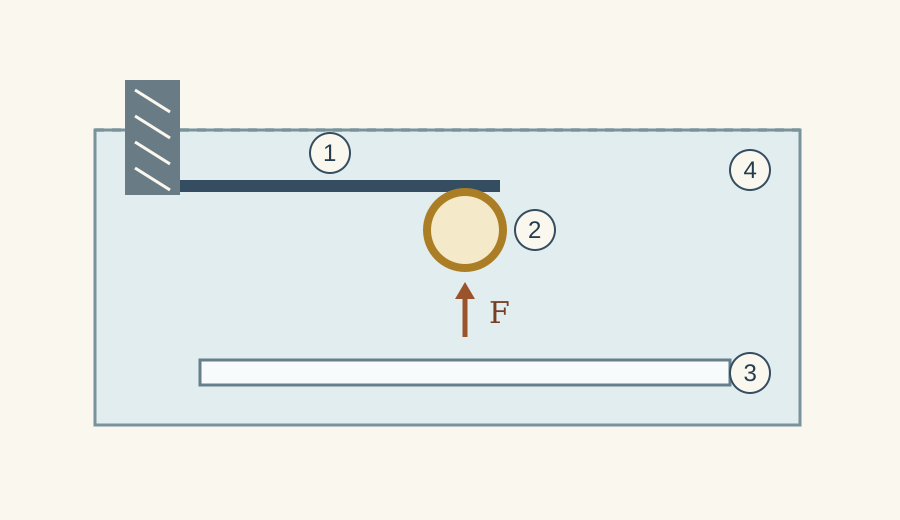
Munday, Capasso and Parsegian, 2009. Jeremy Munday, Federico Capasso and Adrian Parsegian took Lifshitz theory at its word. They glued a gold-coated sphere to the underside of an atomic-force-microscope cantilever — a flexible arm clamped at one end — held it above a silica plate, and filled the gap with bromobenzene, a liquid whose optical response sits between the two solids. What they measured was the bending of that arm, read optically, and the force it reported was repulsive: long-range, quantum, and pushing the wrong way on purpose. Free levitation is what such a force makes possible; what this apparatus demonstrated is the sign reversal itself, with the sphere attached throughout. Published in Nature in 2009, this is the experiment that turned the Casimir force from a fact of nature into a design parameter.
The Casimir force is predicted, measured by independent groups with independent instruments, described quantitatively for real materials by Lifshitz theory, and reversed in sign on demand.
Ways to think about it
- Regularisation is not a trick. The infinities are identical inside and outside, and the difference is what nature computes.
- Lifshitz theory is the bridge: van der Waals at one end, Casimir at the other, one formula spanning both.
- Once you can flip the sign of a force by choosing three materials, you are no longer observing the vacuum. You are engineering it.
Level 4 · Graduate
The energy of empty space, and the best open question in physics. Take equation 2 seriously and compute the energy density of the vacuum by integrating over all modes up to some shortest wavelength.
That gap is the cosmological constant problem, laid out definitively by Steven Weinberg in 1989, and it is worth being precise about what is being compared. On one side is an estimate: the cutoff-dependent zero-point contribution of one field among many, plus every other field's contribution, plus a bare cosmological term nobody has measured separately. On the other side is an observation: astronomers put the dark-energy density at roughly a billionth of a joule per cubic metre. Between the two sits a factor of about 10¹²⁰. Nobody knows what does the cancelling; no mechanism for it has been demonstrated. That is not an embarrassment to be apologised for. It is the largest gap between an estimate and an observation anywhere in physics, it sits squarely on the vacuum, and whoever closes it will have explained what empty space is actually made of.
What to watch: whether dark energy is constant. The DESI survey's dark-energy results, which hint that it may evolve with time, are the measurement most likely to move this question in the next few years. Constant, and the problem stays a single stubborn number; evolving, and the vacuum acquires a dynamics that any explanation now has to reproduce.

What the Casimir measurement settles, precisely. One useful sharpening belongs here. Robert Jaffe showed in 2005 that the Casimir force can be derived entirely from the fluctuating charges and currents in the plates, as a relativistic van der Waals force, without a zero-point reservoir appearing in the bookkeeping at all. So be exact about the observable: the experiment measures an interaction force between two bodies as a function of their separation, and it does not measure the absolute energy density of the vacuum. What it establishes beyond doubt is that the electromagnetic ground state couples to matter and exerts calculable, sign-controllable force — and it identifies the coupling to matter as the place where any energy ledger has to be written. That is exactly the distinction Level 5's device builders work with.
The dynamical Casimir effect: making light from a moving boundary. Now the most striking result in the subject. Gerald Moore predicted in 1970 that a mirror accelerating in vacuum should emit real photons. The static Casimir effect rearranges the vacuum's modes; a moving boundary rearranges them faster than the field can adjust, and some virtual excitations get promoted into real, detectable light.
The problem is speed. To get a measurable photon rate a mirror must move at an appreciable fraction of the speed of light, which no mechanical mirror does. The trick that solved it was to move an effective boundary instead.

In 2011 Christopher Wilson and colleagues terminated a superconducting transmission line with a SQUID — a superconducting loop whose effective electrical length depends on the magnetic flux threading it. Modulating the flux at gigahertz rates makes the end of the line behave like a mirror sliding back and forth at a few percent of the speed of light, with no mass to accelerate. Microwave photons came out, in pairs, with the two frequencies of each pair adding up to the drive frequency — the signature the theory predicts. It was published in Nature in 2011 and has since been reproduced on several platforms.
Real photons from a moving boundary is settled physics, reproduced across platforms. Be precise about the apparatus that did it: Wilson's boundary was electrical, not mechanical. The SQUID terminating the transmission line was flux-modulated at gigahertz rates, the radiation that emerged was microwave, and the photons arrived in correlated pairs whose frequencies sum to the drive — a two-mode squeezing signature, and it is that correlation, rather than a raw count, that identifies the vacuum as their origin. The lesson for a designer is blunt: a mechanical mirror moves at a millionth of light speed, so its output is hopeless; an effective boundary in a superconducting circuit reaches a few percent, and that is why the effect was seen there first. Note also the honest ledger the experiment supplies. The drive that shakes the boundary supplies the energy, and only a very small part of it leaves as light. The vacuum supplies the modes; the drive pays for the photons. That is a genuine and useful capability, and it is the mechanism most device proposals reach for.
Casimir-force engineering. Because the force comes from mode selection, anything that changes the mode structure changes the force — which makes it designable.
- Geometry. Corrugations, gratings, pillars and trenches all shift the force away from the flat-plate law, and non-trivial geometries can produce lateral forces and even torques. Rodriguez, Capasso and Johnson surveyed the microstructured cases in Nature Photonics in 2011.
- Materials and metamaterials. Since Lifshitz theory runs on dielectric functions, tailoring the optical response tailors the force. Switching a material between phases — crystalline and amorphous, for example — changes the Casimir force across the same gap.
- Torque. In 2018 the Casimir torque was measured between a birefringent crystal and a liquid crystal: two anisotropic surfaces in vacuum twist toward alignment, driven by nothing but the fields between them.
- Sign. The 2009 repulsion result of Level 3 is the strongest statement of all. Attraction is not compulsory.
“The Casimir force is just van der Waals in disguise, so it proves nothing about vacuum energy.”
Start with the physics, because the physics is unusually clean here. Lifshitz theory does not treat the two as rivals; it derives both from one expression. Feed it two atoms at close range and out comes the London–van der Waals result. Feed it two mirrors at wide separation and out comes Casimir's formula. The parameter that carries you between them is the ratio of the separation to the wavelengths that dominate the material's response. Below that scale the interaction is effectively instantaneous, and you are in the van der Waals regime. Above it, the finite travel time of light matters, and you are in the retarded regime. Retardation does not erase material properties. What changes is which part of each body's optical response the gap is sampling; it is only in the idealisation of perfect reflectors at zero-temperature that ħ, c and the gap are all that survive, and that idealisation is a limit, not a general result. That is not a disguise either; it is a measurable change of behaviour, and the two regimes have different power laws. Van der Waals pressure between plates falls off as the inverse cube of the separation; retarded Casimir pressure between ideal mirrors falls as the inverse fourth power. Experiments walk across the crossover and see the exponent change.
The two formulations are also complementary rather than competing on the fundamentals. You can compute the force by summing zero-point modes, or, following Jaffe in 2005, from the fluctuating source currents in the plates. Milonni's monograph works both routes and shows they agree identically, because a fluctuating source and a fluctuating field are two descriptions of the same coupled system — related by the fluctuation-dissipation theorem. So the objection is right that the measurement alone does not hand you a reservoir of extractable free energy, and Level 5 treats that as the design constraint it is. What it does establish, definitively, is that the electromagnetic ground state exerts real, calculable, sign-controllable force on matter.
What to watch next: precision measurements across the van der Waals to Casimir crossover with well-characterised materials, where the exponent visibly changes; and the thermal Casimir regime at separations of a few micrometres, where competing models of how gold conducts at low frequency predict measurably different forces. Those two datasets are where the community's remaining quantitative questions get answered.
Level 5 · Research frontier
Levels 1 to 4 are textbook or peer-reviewed. This level is where the field is being built, and it is worth naming the rule that shapes all of it.
The design constraint every serious programme builds around. Take the ideal case first, because it is the one that can be settled with arithmetic. For a fixed attractive force with the materials held constant, assembling two Casimir plates releases energy and separating them costs exactly that energy back — in the reversible limit, the two are equal to the last decimal, and any real friction or dissipation only adds to the bill. So the interesting engineering starts after you accept that. The question is not whether you can cycle a fixed ground state for free. It is whether an asymmetric, open, driven structure can rectify vacuum fluctuations into useful output with a ledger that closes honestly — and returning the device to its starting condition does not by itself close that ledger, because an external source may have supplied work along the way. That is why every serious measurement in this field counts the drive, not just the output. Cole and Puthoff worked this through in 1993 in Physical Review E, and their conclusion is worth quoting at its actual width: the proposals they examined are correct in principle, and their analysis explicitly leaves technological implementation outside its scope. The physics is permitted; the engineering is open, and it is the engineering that is unfinished.
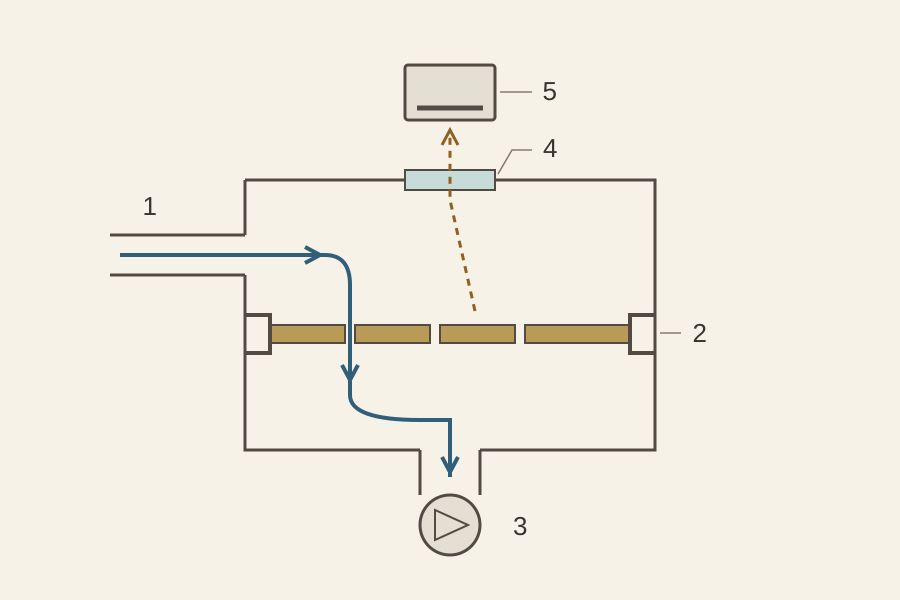
Moddel's 2019 gas-flow experiment. Garret Moddel at the University of Colorado has pursued the most explicit version of the idea, and his 2019 review with Olga Dmitriyeva in Atoms is unusual and valuable: it walks through the proposed zero-point extraction schemes, shows which fail a thermodynamic screen, and then reports an experiment. Gas was pumped through nanoporous membranes in an evacuated chamber while a pyroelectric detector, outside the chamber and looking in through a radiation-transmitting window, watched for emitted radiation. The authors are careful about what they measured and what they did not: the emitted power stayed below 1 µW for every gas and sample tried, frictional heating was not entirely excluded as the source, and the follow-up they propose is better-defined pores, imaging and spectrum of the radiation, and a direct comparison of emitted power against the pumping power driving the flow. That is what the cited paper reports; the Casimir-cavity diode devices came later and are a separate body of work.
Thibado's graphene fluctuation experiment. Paul Thibado's group at Arkansas took a different route. A freestanding sheet of graphene ripples, and a nearby electrode turns that motion into a measurable displacement current — that current is the measurement, and it is real. What the 2020 Physical Review E paper then supplies is the accounting, and it is the part to read carefully: the circuit is analysed with a numerical equilibrium model in which the thermal bath supplies exactly the average power the resistor dissipates. The paper does not report energy taken from the vacuum, and its authors do not claim it does. Setting the measurement and its stated model side by side, as they do, is a discipline the whole field benefits from, and the open question is what a complete circuit ledger looks like when many such cells are read out together.

Casimir Inc. and federal feasibility money. Harold "Sonny" White, formerly of NASA's advanced propulsion programme, founded Casimir Inc. to build a solid-state generator based on the same physics. Read the records for what they are: a 2024 National Science Foundation SBIR award, award 208315, NSF 2423233, whose scope is planned metal–insulator–metal sample fabrication, tunnelling-current tests and comparison with numerical models; and the company's own reported selection for a US Space Force SpaceWERX STTR Phase I contract on 25 August 2026 for its MicroSparc solid-state generator. These are funding and planned-work records, not independent measurements of a generator's output, and they should be read that way whichever direction your sympathies run.
When a result does arrive from any of these teams, here is how to read it. Ask for the complete cycle: the external energy inputs, changes in stored energy, and the output delivered to a load, with the calibration and the uncertainty attached. A number without those four is not yet a result, and a number with them is worth everyone's attention.
Alongside these, two teams publish their own programme descriptions. ZPF Technologies describes a MEMS propulsion array and funding-dependent prototyping and testing, and is explicit that propulsion is a different target from extraction; Charles Chase's UnLab reports fabricating and testing symmetric and asymmetric nanostructures, with predicted forces from resonant tunnelling. Those are the teams' descriptions of their own work — the right thing to read, and not the same thing as an independent measurement.
Both teams also publish what has not worked yet, revising designs in public as their own screens reject them. That is what a young experimental field looks like from the inside, and it is exactly how you would want it done.
Usable net power from a Casimir-cavity device is a well-posed proposal with funded programmes, named physicists and a stated target — and no closed ledger yet. It is waiting for its experiment.
The measurement that would settle it. One result decides this, and it is worth stating in advance so that everyone is watching the same gauge: a device that delivers more energy than it consumes over a full cycle, measured by an independent laboratory, with the energy source identified. Not a hopeful trace. Not an unexplained current. A closed ledger, replicated elsewhere. Independent replication would establish the device’s measured performance and allow its practical uses to be evaluated. If years of better instruments keep returning null, that is a real answer too, and it tells the field to spend its effort on the driven, open architectures instead.
Two things in this course are beyond dispute and worth holding onto while the rest develops: the static Casimir force, and the dynamical Casimir effect. The vacuum pushes, and a fast-moving boundary makes real light out of it. Everything at this level is an attempt to build on those two measured facts.
What to watch
- Casimir Inc.'s Phase I results. The SpaceWERX award is feasibility money with deliverables. What the MicroSparc generator produces, and how the energy is accounted for, is the most concrete near-term data point in the field.
- The gas-flow follow-up the 2019 paper asks for. Better-defined pores, an image and a spectrum of the emitted radiation, and the emitted power compared directly against the pumping power. Those measurements are what would separate a vacuum mechanism from frictional heating.
- Thibado's cells read out together. A single graphene cell produces very little. A published measurement from a large array, with the full circuit ledger attached, would tell everyone whether the approach scales or saturates.
A fourth thread is worth watching for the pure physics: precision Casimir measurements in the few-micrometre thermal regime, where different models of low-frequency conduction in gold predict measurably different forces. Whichever way that resolves, it sharpens the theory the devices are designed against.
Teaching aids
Three demonstrations you can run
- Two boats in a ripple tank. Float two flat-sided objects — matchboxes, lolly-stick rafts, small toy boats — side by side in a bathtub or a shallow tray, a couple of centimetres apart. Make waves at one end with your hand at a steady rhythm, using waves longer than the gap. The boats drift together. Then use short, choppy ripples that fit easily in the gap, and the effect weakens. Ask the class what changed. Nothing about the boats. Only which waves were allowed between them.
- The string that will not be still. Film a plucked guitar or rubber-band string with a phone's slow-motion mode, then film it again after damping it with a finger and letting it "stop". At normal speed it is motionless; in slow motion the tail of the motion goes on much longer than the eye reports. The honest lesson is that stillness is harder to achieve than it looks — and then the quantum statement lands: no matter how well you damp it, a last shiver of ½ħω is left, and it cannot be removed at any temperature.
- Counting modes with paper and a ruler. Give each student a strip of paper 10 cm long and ask them to draw every standing wave that fits between the ends: one half-wave, two, three, and so on, down to 1 cm. They will count ten. Now hand out a 5 cm strip and ask the same question down to the same 1 cm limit. They count five. Half the space, half the allowed waves. That single result — fewer modes in a smaller gap — is the entire Casimir effect, and the class derived it with a ruler.
Self-check (answers below)
- Two plates one micrometre apart feel a Casimir pressure of about 1.3 millipascals. What is it at half that separation?
- Why does the Casimir formula contain no property of the metal, and what does that tell you about where the force lives?
- What changes between the van der Waals regime and the Casimir regime, and which power law belongs to each?
- In the dynamical Casimir effect, where does the energy of the emitted photons come from?
- In one sentence: what is the milestone that would move usable vacuum power from speculative to strong?
Answers. (1) Sixteen times larger, about 21 millipascals — the pressure goes as one over the fourth power of the gap. (2) Because the effect comes from which waves the gap allows, not from what the plates are made of; ħ, c and d are all that survive, which is the fingerprint of a property of space rather than of matter. Real materials add corrections, computed by Lifshitz theory. (3) The finite travel time of light — retardation. Below that scale the interaction is effectively instantaneous and the plate-to-plate pressure falls as the inverse cube of separation; above it, the retarded Casimir pressure falls as the inverse fourth power. (4) From the drive that shakes the boundary; the vacuum converts the work supplied, it does not donate it. (5) A device whose complete energy ledger over a full cycle is net-positive, measured by an independent laboratory, with the energy source identified.
One-page summary for the wall
- Nothing in quantum mechanics can hold perfectly still. Every oscillator keeps ½ħω, and every possible light wave in empty space is an oscillator.
- Two mirrors ration which waves fit between them. Fewer waves inside than outside means a net push, and the mirrors close. Casimir, 1948.
- P = −π²ħc/(240 d⁴). No material constant appears. Halve the gap, multiply the pressure by sixteen. At 1 µm it is 1.3 mPa; at 10 nm it beats atmospheric pressure.
- Measured by Lamoreaux in 1997 to about 5%, by Mohideen and Roy in 1998 to about 1%, and reversed in sign by Munday, Capasso and Parsegian in 2009. Lifshitz theory covers real materials and unifies van der Waals with Casimir.
- Move a boundary at a few percent of light speed and real photons come out — the dynamical Casimir effect, predicted 1970, measured 2011. The energy is supplied by the drive.
- The naive zero-point energy density overshoots the observed dark energy by about 120 orders of magnitude. That mismatch is the biggest open question in physics, and it is a question about the vacuum.
- The frontier: Casimir-cavity diodes, graphene fluctuation harvesters and solid-state generators, with federal feasibility money behind them. The ground-state rule is the design constraint, and the milestone every team names is an independently measured net-positive ledger.
Hear it from the researchers
The conversations this course grew out of. Timestamps take you to the exact moment.
- Chill Physics Livestream (Casimir Inc. Space Force award) · Ashton Forbes · 2026-08-27
- The Waterfall in Zero Point Energy Is the Secret (Thibado, Moddel, White — three chips) · Ashton Forbes · 2026-07-20
- Light Appears From Nothing · Ashton Forbes · 2026-07-29
- Dark Energy Is Just Zero Point Energy · Ashton Forbes · 2026-08-23
- Atoms Cannot Exist Without Zero Point Energy · Ashton Forbes · 2026-08-16
- Can ZPE & Casimir Energy Save The World? · Tim Ventura · 2026-08-20
- The Secrets of Zero Point Energy – Tom Valone (Hard Truths) · Ashton Forbes · 2026-08-16
- ZPE All Stars – Gabriel Dias (ZPF Technologies) · Ashton Forbes · 2026-08-12
What the numbers on this page rest on
- On the attraction between two perfectly conducting plates1948
- The Influence of Retardation on the London-van der Waals Forces1948
- Demonstration of the Casimir Force in the 0.6–6 μm Range1997
- Precision measurement of the Casimir force (AFM)1998
- Measured long-range repulsive Casimir–Lifshitz forces2009
- Observation of the Dynamical Casimir Effect in a Superconducting Circuit2011
- The Casimir Effect and the Quantum Vacuum2005
- The Casimir Effect: Physical Manifestations of Zero-Point Energy2003
- The Casimir effect in microstructured geometries2011
- Recent developments on the Casimir torque2022
- The cosmological constant problem1989
- DESI DR2 Results II: Measurements of Baryon Acoustic Oscillations and Cosmological Constraints2025
- Extracting energy and heat from the vacuum1993
- Extraction of Zero-Point Energy from the Vacuum: Assessment of Stochastic Electrodynamics-Based Approach as Compared to Other Methods2019
- Fluctuation-induced current from freestanding graphene2020
- Casimir Inc. — NSF SBIR Phase I and SpaceWERX STTR Phase I awards2024
Primary sources and further reading
On the attraction between two perfectly conducting plates
H. B. G. Casimir (1948) · Paper
Proc. K. Ned. Akad. Wet. 51, 793
Two and a half pages that turned the zero-point field into a laboratory force. The prediction the rest of this course rests on.
Demonstration of the Casimir Force in the 0.6 to 6 μm Range
S. K. Lamoreaux (1997) · Paper
Phys. Rev. Lett. 78, 5
The first modern precision measurement: a torsion pendulum, agreement with theory at about the 5% level.
Precision Measurement of the Casimir Force from 0.1 to 0.9 μm
U. Mohideen & A. Roy (1998) · Paper
Phys. Rev. Lett. 81, 4549
A different apparatus in a different laboratory — an atomic force microscope — agreeing to about 1%. Genuine independent corroboration.
Measured long-range repulsive Casimir–Lifshitz forces
J. N. Munday, F. Capasso & V. A. Parsegian (2009) · Paper
Nature 457, 170
Choose the right three materials — gold, silica and bromobenzene — and the vacuum force reverses sign. Measured with the gold sphere attached to a cantilever, so the reported quantity is a repulsive force, not a free float. The sign of the force is an engineering variable.
Observation of the dynamical Casimir effect in a superconducting circuit
C. M. Wilson et al. (2011) · Paper
Nature 479, 376
Shake a boundary fast enough and real, detectable photons come out of the vacuum. Predicted by Moore in 1970; measured here in a superconducting circuit.
Casimir effect and the quantum vacuum
R. L. Jaffe (2005) · Paper
Phys. Rev. D 72, 021301
Shows the same force can be derived from the fluctuating currents in the plates, without a zero-point reservoir in the bookkeeping. A useful sharpening of what the measurement does and does not settle.
Extracting energy and heat from the vacuum
D. C. Cole & H. E. Puthoff (1993) · Paper
Phys. Rev. E 48, 1562
Shows that Casimir-based extraction is consistent with thermodynamics in principle. The physics is not forbidden; the engineering is open.
Extraction of Zero-Point Energy from the Vacuum
G. Moddel & O. Dmitriyeva (2019) · Paper
Atoms 7(2), 51
The field's own map, written by a builder: which schemes fail the thermodynamic screen, and which narrow window survives it.
Fluctuation-induced current from freestanding graphene
P. M. Thibado et al. (2020) · Paper
Phys. Rev. E 102, 042101
A rippling graphene sheet driving a current through a circuit, with the thermodynamic accounting stated explicitly by the authors.
The Quantum Vacuum: An Introduction to Quantum Electrodynamics
P. W. Milonni (1994) · Book
Academic Press
The standard monograph. Derives the Casimir force both ways — from vacuum modes and from source fields — and shows they agree.
The cosmological constant problem
S. Weinberg (1989) · Paper
Rev. Mod. Phys. 61, 1
The classic statement of the biggest open number in physics: the naive zero-point estimate and the observed dark energy differ by about 120 orders of magnitude.