Casimir Physics and Vacuum-Force Engineering
The measured force between nearby surfaces, the materials and geometries that change it, and the machines being built out of it.
The Casimir force between nearby surfaces has been measured with a torsion pendulum and an atomic force microscope.
So start at the bench. Pick a geometry, close the gap, and read what the vacuum pushes with — beside the range of gaps each laboratory actually covered and the agreement that paper itself reported.
The apparatus explorer
Three ways a laboratory reaches out and touches the vacuum: two flat plates, a sphere facing a plate, and a cantilever probe that reads the force gradient rather than the force. Choose the apparatus, set the gap, and read the prediction off the curve — with each published measurement drawn beside it as the range of gaps it covered and the agreement it reported.
- A sphere facing a flat plate
- Published measurements, with the gaps they covered
- Force:
- 2.67E-13 N
At this gap: A sphere against a flat needs no parallelism at all, which is why it carried the first precision measurements. The law is the proximity-force approximation, and it holds while the gap stays small against the sphere radius.
Published measurements, with the gaps they covered
- Lamoreaux, 1997 — a torsion pendulum, sphere against a flat, agreement at about five per cent (600–6,000 nm)
- Mohideen and Roy, 1998 — an atomic-force cantilever with a sphere, about one per cent at closest approach (100–900 nm)
The curve is the perfect-reflector, zero-temperature limit: only Planck's constant, the speed of light and the geometry appear in it, and the material does not. Real mirrors depart from it — finite conductivity, roughness and temperature all move the answer, which is what Lifshitz and scattering theory exist to compute.
What these measurements establish is that the electromagnetic ground state couples to matter and exerts a calculable force between boundaries whose sign and size can be engineered. They are not a reading of an absolute vacuum energy density: Jaffe reaches the same force from the fluctuating charges and currents in the plates, with no zero-point reservoir in the bookkeeping. The force is real either way.
The source sheets for every measurement above are in the library
The prediction, in one move
The electromagnetic field has a lowest state that still jitters. Put a conducting plate inside a conducting box and count the field modes that fit when the plate sits close to one wall, then count them again when it sits far away. Both totals are infinite and, as Casimir himself says, meaningless on their own. The difference between them is finite, and it depends on the size of the gap. Differentiate that difference with respect to the gap and you have a force per unit area.
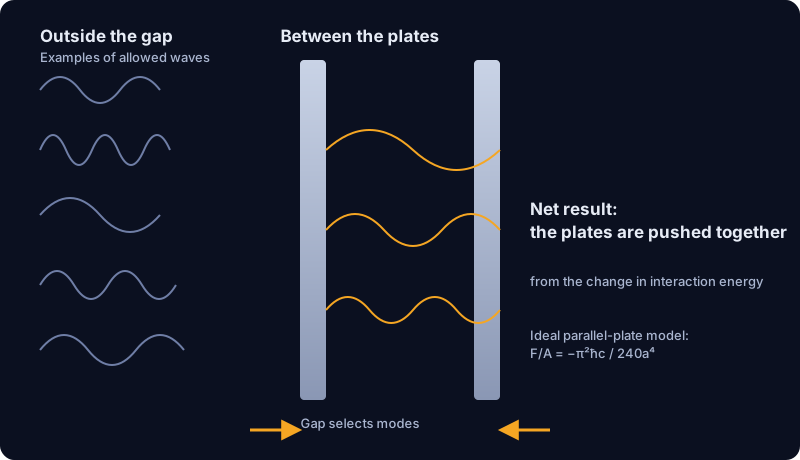
Casimir's own name for what he had found was a zero-point pressure of electromagnetic waves, which is why this chapter sits in Part II rather than in a curiosities appendix. Read the original three pages and there is no exotic ingredient anywhere in the derivation — just mode counting, and a subtraction that leaves something finite behind.
Changing the gap shifts the allowed wavelengths and changes the interaction energy. That finite energy is obtained by comparing boundary configurations consistently; it is not a measured fraction of all vacuum energy inside the gap.
Measuring it twice, in different laboratories
The prediction sat almost untested for fifty years. In 1958 M. J. Sparnaay at Philips built the first apparatus that went looking, reported an attraction consistent with Casimir's law, and — this is the part that earns the paper its place — named the artefact that had wrecked his earlier runs: a stray voltage difference between the two facing surfaces, pulling them together electrically. Every precision Casimir experiment since has had to cancel that voltage before it can see the vacuum at all.
In 1997 and 1998, two laboratories published measurements made using different methods. Steve Lamoreaux hung a torsion pendulum in a vacuum chamber, gave up on parallel plates because holding two centimetre-wide plates parallel to ten microradians is not practical, and used a gold-coated lens against a flat instead. Across gaps from 0.6 to 6 micrometres the force matched theory to about five per cent with no adjustable parameters. The following year Umar Mohideen and Anushree Roy glued a 196-micrometre sphere to an atomic-force cantilever and walked it in from 0.9 micrometres to 0.1, recording the force at 256 separations; the agreement is about one per cent at closest approach, sharp enough to resolve the corrections for finite conductivity and surface roughness that the bare formula leaves out.
The record only got sharper. In 2002 an Italian group did it Casimir's own way, holding a chromium-coated cantilever parallel to a rigid surface to better than thirty nanometres across a millimetre and reading the force off the shift in the cantilever's resonant frequency. In 2007 a micromechanical torsional oscillator reached a total error of 0.19 per cent at a 160-nanometre gap — the first time in this field that random scatter fell below systematic error. And in 2011 a torsion pendulum separated the force into its two pieces by distance, measuring the thermal Casimir force between macroscopic bodies for the first time: zero-point fluctuations dominate close in, room-temperature thermal fluctuations dominate beyond about three micrometres and fall off more slowly. That result is also the best practical reminder of what the word zero means here. It means zero thermal temperature, and nothing else — pull the plates far enough apart in a warm room and the thermal part of the field is the larger of the two.
Those laboratories are all on the explorer at the top of this chapter, and it reads differently now: set it to the sphere-and-plate geometry and walk the gap from six micrometres down to a tenth of one, and you are walking Lamoreaux's range into Mohideen and Roy's, watching the quoted agreement tighten as the gap closes.
That explorer plots what each laboratory found. The instrument below builds the apparatus that found it. Eight frames, advanced by you, in the order the work has to be done: hold the geometry, cancel the electrical force, and only then read a bend.
How the Casimir force is actually measured
Eight frames, advanced by you, one step each. A cantilever never measures a force: it measures a bend, and the bend becomes a force only because the beam obeys Hooke's law. Walk the frames and you will have built the instrument in the order a laboratory has to build it — hold the geometry, remove the electrical force, and only then read something. Every setting drawn here is the setting the site's Casimir apparatus explorer already runs on.
- The cantilever
Frame 1 / 8
A beam, and the one law that turns a bend into a force
Start with the whole of the instrument that does the measuring: a slender beam anchored to a chip, with a light beam bouncing off its top into a detector. The beam obeys Hooke's law, so its bend and the force on it are the same statement divided by its stiffness. Everything that follows is the work of making sure the only force bending it is the one we came for.
- Stiffness of the beam
- 0.3 N/m
No reading on this instrument is a measurement of an absolute vacuum energy density. The Casimir force is an interaction force between two boundaries, and Jaffe reaches the same force from the fluctuating charges and currents in the plates with no zero-point reservoir in the bookkeeping. The force is measured either way, and an actuator does not care which calculation designed it.
Where each number comes from
- The first measurement, and the named artefact: Sparnaay 1958
- Why a sphere and not a second plate: Lamoreaux 1997
- The walk in, and the one per cent: Mohideen and Roy 1998
- The gradient, to 0.19 per cent: Decca and colleagues 2007
- The same probe over a shaped surface: Shelden, Munday and colleagues 2025
- Real materials, and the live dispute over the temperature term
Real materials are not ideal mirrors
The moment you build something, formula 15.1 stops being enough. A real mirror reflects well only below its plasma frequency, so at a few hundred nanometres the finite conductivity of gold or aluminium matters; so does roughness; so does temperature. The practitioner's tool for all of it is scattering theory: describe each surface by how it reflects light at every frequency, and the force follows from those reflection amplitudes alone. The standard treatment also delivers a warning worth carrying — the popular shortcut of treating a bumpy surface as a stack of flat ones underestimates the roughness correction by about sixty per cent at a two-hundred-nanometre gap.
The decade in which this became metrology is audited in The Casimir force between real materials and in Advances in the Casimir Effect, the field's standard book: several techniques, several continents, agreement at the level of parts per thousand — plus a genuine live dispute the authors name rather than smooth over, about how the conduction electrons of a real metal should enter the temperature term. A materials-side companion, Materials perspective on Casimir and van der Waals interactions, makes the engineering point that changes everything: the gecko force and the mirror force are one phenomenon read at different distances, and graphene, topological insulators and metamaterials give it a response no ordinary metal offers. The force has become a design variable.
Geometry is the other design variable
Change the shape and you change the law, not just the number. An exact calculation for a parabolic mirror sharpened to a knife's edge shows the standard rule of thumb predicting no force at all where the true energy falls off as one over the gap squared. Push two spheres far enough apart and the force forgets the material entirely, becoming universal in temperature and shape — a regime unreachable in vacuum but reachable at a hundred nanometres in salt water, where optical tweezers can hold the beads.
Then the experiments caught up with the theory. A Hong Kong and Princeton collaboration etched two facing arrays of T-shaped protrusions out of a single silicon chip so that alignment came free with the lithography, and measured a force gradient that changes sign twice as the gap closes — at one position the vacuum stiffens the beam, a spring made of fluctuations. A Davis group held the material fixed and varied only the shape, and found that a single 300-nanometre pillar cuts the force roughly tenfold while a dense array nearly triples it, in ordinary air at room temperature, with plain theory close enough to design from.

- Geometry computed from
- The measured cell at true relative scale: a gold sphere above a periodic gold pillar array, with an isolated pillar and a holed cylinder alongside, every dimension taken from the paper
- Numbers from
- Shelden, Spreng, Garrett, Rahman, Kim and Munday, Casimir Force Control Enabled by 3D Nanostructures, Nano Letters 2025 — sphere radius 33.1 micrometres, pillars 300 nanometres across and 100 tall on a 1200 nanometre period, separation 85 nanometres
- Schematic parts
- The patch of pillars drawn is a modelling choice; the real plate is patterned over a far larger area. The surface roughness the paper corrects for is not put into the mesh, the isolated structures are drawn closer together than they really sit, and the cantilever and stage are absent.
For shapes nobody has solved on paper, there are numbers. Finite-difference computation runs ordinary classical electromagnetism software on Casimir problems in any geometry. Worldline numerics — a loop-cloud method — was used under a DARPA grant to model a Casimir cavity with pillars standing on the midplane, and the team found the pillar does not shield itself but strengthens the field around it by a factor of three to five; then they noticed that the computed energy distribution has the shape Alcubierre's warp metric asks for. That is a lead, not a warp drive, and it is filed here because it is first of all a Casimir calculation with a chip you could fabricate at the end of it.
Hold the metal fixed and change only the shape. Across these four surfaces the multiplier moves by more than a factor of twenty, and so does the law by which the force falls away.
Shape, not material
Same metal, same air, same room temperature: gold facing gold. Change only the shape of the lower surface and the Casimir force changes by more than a factor of twenty, and the way it falls off with distance changes too. Choose a surface, move the gap, and read the multiplier against a plain flat plate of the same metal.
- A single pillar, 300 nanometres across the radius
- Force multiplier against the gap
- Multiplier against a flat plate of the same metal:
- 0.12×
- Multiplier against a single isolated pillar:
- 1.00×
- Share of the force carried by the supporting plate below:
- 60.1%
- How the multiplier runs as the gap opens:
- Falls away faster than the flat-plate case, until the supporting plate below takes over
What this surface does: A single 300-nanometre pillar cuts the force by roughly a factor of ten. As the gap opens, the supporting plate below takes over the interaction — its share runs from well under one per cent at ten nanometres to above ninety per cent at three hundred.
Read the two multipliers carefully, because they have different baselines. The array's near-threefold gain is measured against a single isolated pillar, never against a flat surface — against a flat plate the array is still below one.
Fabricated dimensions
- Sphere radius:
- 33,100 nm
- Pillar radius:
- 300 nm
- Pillar height:
- 120 nm
Scope: the proximity-force approximation with the ideal plate pressure. The measurement itself used Lifshitz theory with the gold's own measured optical data and a roughness correction, and reports agreement with these sharp-edged shapes to within about a factor of three. The lesson is the one the authors draw: the magnitude and the distance law are both set by geometry alone, with the material held fixed.
The source sheet: Shelden and colleagues, Casimir force control enabled by 3D nanostructures, 2025
Making the vacuum push
For sixty years the force only pulled, and a theorem said mirror-image bodies could never do otherwise. The theorem is true and its assumptions are escapable, and getting out of it is now a research programme with four families in it: put a liquid in the gap, use magnetic materials, drive the system out of equilibrium, or sculpt the surfaces. The survey of all four weighs each by how close it is to a working experiment, and names the prize: a levitating component with almost no friction at all.
One family has already been measured. Lifshitz theory says the sign of the force follows the ordering of the three optical responses.
Gold sphere, silica plate, bromobenzene in between: the cantilever bent away instead of toward, on approach and on retraction alike, and repulsion was on the record. Since then the routes have multiplied. Pair a mirror with a strongly magnetic film and the sign flips, with a simple design rule for how magnetic the film has to be. Put a modest forward bias across a semiconductor and its emitted photons carry a chemical potential set by the applied voltage, so that gallium arsenide facing gold turns repulsive beyond a few hundred nanometres — a sign you can switch with a power supply while the device is running. Fill the gap with a chiral medium and the theorem's key step fails outright, giving a force that oscillates between attraction and repulsion and tunes with a magnet. Or use a ferrofluid, where four independent dials — the metal, a Teflon thickness, the nanoparticle size and the solvent — place a stable trap at a fixed spacing held open by the vacuum alone.
Repulsive forces have been measured with a fluid between the surfaces. Several vacuum configurations are proposed designs. A sphere-and-plate experiment could test them by measuring tens to hundreds of piconewtons of repulsion in a chamber.
The vacuum also twists
Give the plates a direction — a birefringent crystal, whose optical response depends on which way its axis points — and the field does not merely pull them together, it tries to rotate them into alignment. The review of the Casimir torque is mostly about apparatus, because the trick that saves the force experiments, swapping a plate for a sphere, does not work when the material has an axis. It offers three benches: a disc floating on a repulsive force, a three-threaded pendulum, a levitated nanorod. Adding the thermal part of the spectrum shows it fighting the quantum part rather than joining it — barium titanate at room temperature loses about 99.5 per cent of its torque, where the same correction trims the ordinary force between metals by about a third. Cool the apparatus and the torque grows while the noise shrinks. And a 2026 proposal uses altermagnets, whose spin pattern is tied to the crystal's own rotation symmetry, to switch the twist on with a field pointing straight through the plates, with the torque climbing as the square of the field and its direction chosen by an underlay.
From a force to a machine
This is where the chapter earns its title. In 2001 a Bell Laboratories team hung a doped polysilicon plate on two thin torsion rods, brought a metallised sphere up to one side, and watched the plate rotate: the first micromechanical device driven by vacuum fluctuations. The engineering lesson landed with it — once parts sit nanometres apart, quantum electrodynamics is part of the mechanical design and not a footnote to it. A second line rebuilt a 1972 capacitive detection scheme around modern nanopositioners to demonstrate actuation of a membrane by the Casimir force, spending most of its effort on the electrostatic calibration you must subtract before you may claim a force at all.
Then the force stopped being the signal and became the tool. A Kassel group patterned metal shutter blades on a chip, released them, and let a drying step bring neighbours close enough that Casimir and van der Waals forces snapped them into interlocking pairs — structure assembled out of a flat chip by the vacuum, with the hard part being prising the pairs open again. The same author who built the membrane rig argues in a keynote on nanotechnology that a semiconductor's Casimir force changes under illumination, which means a laboratory knob moves a vacuum force in real time — and a force you can switch is a force you can drive around a loop. His aerospace metrology talk places those examples on the readiness matrix engineers use to judge how near a technology is to flight.
Two further benches are worth knowing by name. Archimedes, funded by Italy's INFN, would cycle high-temperature superconducting plates through their transition so that a cavity's reflectivity — and therefore its vacuum energy — switches on and off, and weigh the difference on a balance at around ten to the minus sixteen newtons. It is an attempt to answer whether the vacuum's own energy falls in a gravitational field. In a separate 2026 experiment, researchers placed a complementary terahertz resonator over niobium diselenide without externally illuminating it. With a resonator frequency of 0.92 terahertz, a two-layer sample's transition rose from 3.02 to 3.41 kelvin. Along that flake, the shift was largest near the simulated field maximum, smaller near the gap edge and unmeasurable outside the resonator.
The frequency comparison used a different, ten-layer sample. Its transition shifted down by 0.12 kelvin at 0.69 terahertz, up by 0.10 kelvin at 0.92 terahertz and essentially not at all at 2.00 terahertz. The two panels below keep those datasets separate. The authors also tested metal structures without a cavity and temperature sweeps in both directions to check whether altered thermalization explained the shift.
The dark cavity, and what it does to a superconductor
Two measurements, two samples: a two-layer NbSe₂ flake mapped along its length, and a ten-layer sample compared at different resonator frequencies. Neither resonator was externally illuminated. Choose a dataset to explore its reported shifts.
- Measured points
- Drawn between them
- Shift in the transition:
- 0.39 K
- Transition temperature:
- 3.41 K
- Baseline, with no resonator:
- 3.02 K
Selected dataset: A positive shift means superconductivity persisted to a higher transition temperature in this comparison. Between the marked anchors, the displayed number is an illustration, not a measured value.
The ten-layer measurements change sign between 0.69 and 0.92 THz. The interpolated zero is not a measured resonance or a proof of mechanism. The paper also reports metal-structure and temperature-sweep controls addressing thermalization.
The cavity experiments this library carries
- NbSe₂: a bilayer's transition rises from 3.02 to 3.41 K; a separate ten-layer frequency comparison includes both suppression and enhancement
- Niobium diselenide inside a split-ring cavity, with the transition temperature rising and the critical current and critical field both increasing sharply near it
- An underdoped cuprate film facing a gold mirror on piezo actuators, the onset moving up by about a kelvin and the gain growing as the mirror comes nearer
- Rubidium-doped buckyballs coupled to a plasmonic gold film through a resonant polymer relay, 30 K to 45 K at ordinary pressure
- The same treatment applied to YBCO moves its transition the other way, 92 K to 86 K — the effect has a sign, and is not a generic degradation of the sample
The authors interpret these changes as cavity-mediated tuning of superconductivity. They discuss several possible microscopic mechanisms; the measurements do not establish one complete microscopic explanation. No external illumination does not mean the cryogenic transport apparatus consumes no energy.
The honest interpretation point
In 2005 Robert Jaffe showed that the same force comes out a second way — from ordinary quantum electrodynamics, by summing diagrams for the charges and currents in the plates themselves, with no appeal to vacuum fluctuations at all. Read that way the Casimir force is the relativistic, retarded van der Waals force, and it fades as the fine-structure constant is turned down. In his reaction to Charles Chase's presentation, Ashton Forbes accepts this distinction. Jaffe nevertheless doubts that a complete formulation of relativistic quantum theory can avoid zero-point energies.
The measured force can be calculated through different formulations. An actuator design depends on the predicted force; that measurement alone does not distinguish the underlying interpretations.
Who builds this
This unit feeds trades, not just theories: MEMS and NEMS process engineers, precision-metrology engineers, semiconductor and foundry process engineers, surface and thin-film physicists, atomic-force-microscopy specialists, nanofabrication technicians. If you would rather do vacuum engineering in a cleanroom than at a blackboard, this is the door, and the skills are the ones a chip foundry hires for today.
What the field added — July to September 2026
In two separate experiments, researchers changed the superconducting transition of niobium diselenide (NbSe₂) with terahertz resonators that were not externally illuminated. Wang and colleagues measured a 12-layer sample changing from 6.38 to 6.53 kelvin. Zhang and colleagues reported a bilayer changing from 3.02 to 3.41 kelvin. Wang's device uses a metal split ring; Zhang's uses its complementary shape, an opening in a metal film.
Douglas Miller described Harold White's proposed power cell as a static cavity with two walls and three electrically isolated pillars between them. In that design, electrons would tunnel to the pillars to produce a current.

- Geometry computed from
- The cavity at true relative scale, with the gap not exaggerated: two 40 by 40 micrometre plates 4 micrometres apart, three pillars a micrometre across standing from the lower wall to the cavity mid-plane, and the remaining 2 micrometres left open above each pillar top as the channel the electrons cross. The pillar height is the mid-plane of the published gap rather than a published number of its own. The upper wall is cut back across half its span so the interior can be seen, and the mid-plane is drawn as a translucent patch so the pillar tops can be seen to terminate exactly on it
- Numbers from
- White, Vera, Han, Bruccoleri and MacArthur, Worldline numerics applied to custom Casimir geometry generates unanticipated intersection with Alcubierre warp metric, European Physical Journal C 2021, in this site's library, for every dimension — an approximately 4 micrometre cavity, plates measuring 40 by 40 micrometres, pillars approximately 1 micrometre in diameter — and for the vertical asymmetry and the three-to-fivefold strengthening of the field around a pillar; the count of three pillars and the electrical arrangement, the pillars isolated from the walls so that electrons tunnel across to them and make a current, from Douglas Miller on the ZPE All Stars episode of the Hard Truths Podcast, 8 September 2026. The patent is not on this site and was not read; no number here is sourced to it
- Schematic parts
- The pillar spacing is a modelling choice — the count of three is sourced, the pitch is not — and so is the 2 micrometre plate thickness, since only the 40 micrometre square face and the 4 micrometre separation are published. How the pillars are electrically isolated at their base is not drawn at all: the arrangement is stated but no collar, pad or via is published, so the one junction where hardware certainly exists is left blank rather than invented. No material is modelled, the measurement chain is absent rather than guessed, and a single cell is drawn where the paper says the cells must be arrayed together in large enough numbers to be read. The cut in the upper wall and the mid-plane patch, drawn 12 micrometres across rather than the full 40, are drawing devices; the published separation is exact.
Douglas Miller described a design with a boundary that physically moves along a tapered cavity. He wanted to use it to test materials and different boundary arrangements. Forbes raised friction and mechanical failures as concerns.

- Geometry computed from
- The described shape built at a scale the model declares for itself: a cavity whose gap widens along its length, with the conducting boundary drawn at five stations at once, one solid and four translucent, each copy's height computed from the taper rather than chosen, because a wall has to seal the cavity it stands in. The number of modes a gap admits below a given wavelength goes with the gap, so the growth down the wedge is at once the travel and the mode-count ladder. The unit of the model is the narrow-end gap, declared at 100 nanometres so that this object sits in the same regime as the two measured Casimir geometries beside it on this page; every other length in the model is a stated multiple of that unit
- Numbers from
- Douglas Miller, founder of Zero-Point Field Technologies, speaking on the ZPE All Stars episode of the Hard Truths Podcast on 8 September 2026 at about 1:14:39: that where the dynamical Casimir effect is normally done electronically he means to move actual boundaries, along a taper, so that different sections of the cavity admit different numbers of modes with a time structure built in; and that the purpose is measurement before power — a rig to test materials, boundaries and things that have never been testable. No paper and no patent for this device exists in this site's library or in the research corpus. Everything above is spoken rather than written, and the transcript mirror, the uploads digest, the library and the chapters were each searched for a dimension and returned none
- Schematic parts
- Not one dimension of this device is published anywhere, so the whole model is a drawing at a declared scale. What is sourced is the shape — a cavity that tapers, with a boundary that physically moves along it — and that shape is what is built; the taper ratio, the cavity length and width, the wall and boundary thicknesses and the spacing of the five stations are all modelling choices, and the span those stations cover is not a claim about the real travel. The drive is absent rather than guessed: Miller rules out a lever and names vibration without describing a mechanism, so no actuator, coil, flexure or anchor is drawn and the boundary stands free in the cavity where hardware certainly exists. A travel axis was drawn in the first build and removed, because rendered it read as a shaft carrying the five slabs, which is exactly the rail the corpus never describes. No material is modelled, the measurement chain is absent although measurement is the stated purpose, and a single cavity is drawn where the product is described as an array. The upper wall is cut away across half its width so the interior can be seen, and the boundary is a plain slab spanning the local gap because its real profile, edge seal and clearance are not described.
Research measurements
- A measurement of the temperature term in real metals should distinguish the Drude and plasma descriptions.
- A second laboratory should independently replicate the non-monotonic silicon result.
- A sphere-and-plate experiment should test whether the repulsive force reaches tens to hundreds of piconewtons.
- A second measurement should check the torque, and a field-control experiment should test whether it can be switched.
- An extraction device must account for all energy entering and leaving it; measuring a force alone does not establish net energy output.
Sources
The one place in this book where the vacuum is weighed on a bench, with the interpretation dispute kept in plain view.
Primary — the prediction and the measurements
- H. B. G. Casimir (1948), "On the attraction between two perfectly conducting plates," Proc. Kon. Ned. Akad. Wetensch. B51, 793. /library/stm-11433059a4.
- M. J. Sparnaay (1958), "Measurements of attractive forces between flat plates," Physica 24, 751 — the first measurement, and the first named systematic. /library/stm-2aa45438b3.
- S. K. Lamoreaux (1997), "Demonstration of the Casimir force in the 0.6 to 6 micrometre range," Phys. Rev. Lett. 78, 5. /library/stm-e8c853485e.
- U. Mohideen & A. Roy (1998), "Precision measurement of the Casimir force," Phys. Rev. Lett. 81, 4549. /library/stm-911b036fc2.
- G. Bressi, G. Carugno, R. Onofrio & G. Ruoso (2002), parallel-plate measurement. /library/stm-208d347532.
- R. S. Decca et al. (2007), Casimir pressure to 0.19 per cent. /library/stm-3241e37fea.
- A. O. Sushkov, W. J. Kim, D. A. R. Dalvit & S. K. Lamoreaux (2011), "Observation of the thermal Casimir force." /library/stm-4fb469cffa.
Theory for real boundaries
- A. Lambrecht, P. A. Maia Neto & S. Reynaud (2006), "The Casimir effect within scattering theory." /library/stm-eb46d8bcd7.
- M. Bordag, G. L. Klimchitskaya, U. Mohideen & V. M. Mostepanenko (2009), Advances in the Casimir Effect. /library/stm-30ce9fddc2.
- G. L. Klimchitskaya, U. Mohideen & V. M. Mostepanenko (2009), "The Casimir force between real materials." /library/stm-7e33aa610f.
- K. A. Milton (2004), "The Casimir effect: recent controversies and progress." /library/stm-719d2e0a0b.
- S. K. Lamoreaux (2005), "The Casimir force: background, experiments, and applications." /library/stm-4c6743a6b7.
- A. W. Rodriguez, F. Capasso & S. G. Johnson (2011), "The Casimir effect in microstructured geometries." /library/stm-d41136300f.
The interpretation dispute, stated fairly
- R. L. Jaffe (2005), "The Casimir effect and the quantum vacuum," Phys. Rev. D 72, 021301 (arXiv:hep-th/0503158) — the force from radiation reaction, and the author's own statement of what he has not shown. /library/stm-dc5bf2b401.
- R. Onofrio (2006), "Casimir forces and non-Newtonian gravitation" — how accurately the force is known, and what that precision buys. /library/stm-8a6a8e0653.
Devices and benches
- H. B. Chan, V. A. Aksyuk, R. N. Kleiman, D. J. Bishop & F. Capasso (2001), Casimir actuation of a MEMS torsional device. /library/stm-50bc48707d.
- H. White, J. Vera, A. Han, A. R. Bruccoleri & J. MacArthur (2021), "Worldline numerics applied to custom Casimir geometry." /library/stm-1775ebeff1.
- E. Calloni et al. (2015), "The Archimedes experiment." /library/stm-f81b04508e.
- H. Zhang et al. (2026), "Cavity-enhanced superconductivity in the two-dimensional limit of NbSe2." /library/stm-812175a230.