The Vacuum at Cosmic Scale
Dark energy, the hundred-and-twenty-order gap, and the measurements that will decide whether the constants themselves move.
Two chapters back you met the vacuum as a medium. One chapter back you watched a laboratory push on it with two plates. Now step outside and look at the same medium filling the whole sky. The energy density of empty space is not a laboratory curiosity out there: it is the single largest component of the universe, it is the thing accelerating cosmic expansion, and the difference between what we calculate for it and what we measure is the largest open number in physics. This chapter is where this book makes its boldest identification — and where it shows you exactly how to state it so that it survives contact with an expert.
Three densities, on one table
Here they are on one table, in one unit. Two of the three turn out to be neighbours; the third one is not on the page, and the figure states the size of the overshoot both ways — the famous version and the version that survives an argument.
Before you move anything — what do you expect?
Optional, and there is no score. The instrument below works exactly the same whether you answer or not.
Three densities, on one table
The section above gives three numbers in three different units, which is the one way to make sure nobody can compare them. Here they are in the same unit, on the same axis: how much energy a cubic metre of the universe holds as matter, as dark energy, and as the vacuum's zero-point field on the usual back-of-the-envelope estimate.
- Measured
- A calculation, not a measurement
- Matter, ordinary and dark together
- 2.36E-10 J/m³ (-0.4)Computed from DESI's own flat-model fit: the matter share of the critical density that its Hubble constant fixes.
- Dark energy
- 5.56E-10 J/m³The rest of a flat universe, from the same fit. The chapter rounds it to one nanojoule per cubic metre, and the round figure is the one to quote aloud.
- The zero-point field, naive estimate
- 5.56E110 J/m³ (+120.0)Not a measurement, and not this site's claim. Add half a quantum for every mode out to a cutoff and you overshoot the measured value by the famous factor. It is drawn here as that multiple, which is the only form the literature ever states it in.
On this axis: On a scale wide enough to hold the calculated figure, the two measured densities are the same mark. That is the shape of the problem: everything anyone has ever weighed sits in the first pixel.
In the cosmological model used here, a negative-pressure component accounts for the accelerating expansion. The third bar is a calculation about what the vacuum should hold, and the distance between it and the second bar is the open problem this chapter is about.
Start with numbers, because the argument is a comparison. Ordinary matter plus dark matter comes to about two and a half times ten to the minus twenty-seventh kilograms per cubic metre. The dark-energy density is about one nanojoule per cubic metre. And the electromagnetic zero-point energy, integrated up to the Planck scale, is about ten to the one hundred and thirteenth joules per cubic metre.
Those are mainstream figures, and the third one is a standard calculation rather than a measurement. The distance between the second and the third is the subject of this chapter.
One quantity, two names
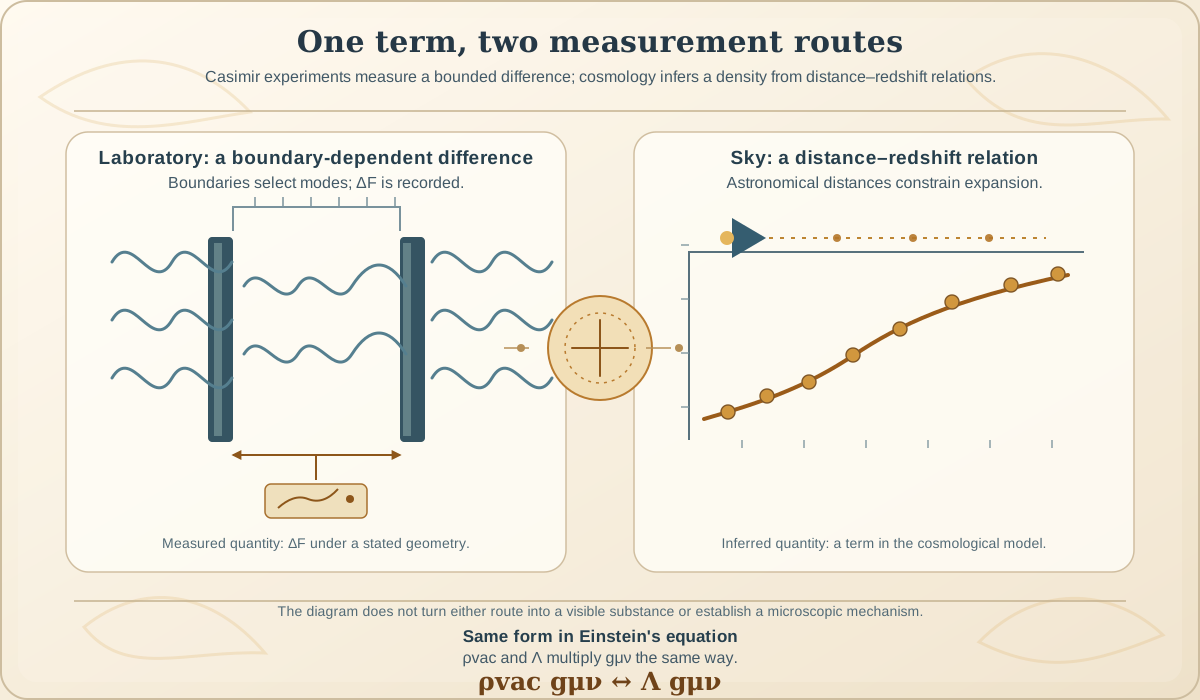
Einstein's cosmological constant and the energy density of the quantum vacuum enter the field equations in exactly the same place, with exactly the same form and the same coupling. Ruth Durrer states the consequence as flatly as it can be stated in What do we really know about Dark Energy?: no experiment can ever tell them apart, so cosmology is measuring the present vacuum energy density. Sean Carroll's Living Review is the standard reference for the same identification, and Raphael Bousso puts it in the plainest terms available in his colloquium on the problem: vacuum energy exists in nature, we know that because we can change how much of it sits inside a bounded region, and the dark energy driving cosmic acceleration is almost certainly that same vacuum energy rather than a new fluid or a change to gravity.
The physical argument for the identification is better than the semantic one, and this site always makes the physical one. Lorentz invariance forces a vacuum energy to have a very unusual equation of state.
The supernova results support accelerating expansion. 1998 supernova measurement found distant explosions ten to fifteen per cent farther away than a matter-only universe allows, ruled out the alternative at seven to nine sigma, and then spent a whole section trying to kill its own result with dust, evolution and selection effects, and could not.
Three years before that measurement, Krauss and Turner argued from a convergence of ages, structure and cluster masses that the cosmological constant was back and landed within a few per cent of the split measured today — a clean worked example of independent lines pointing the same way before any one of them is decisive. And the idea is older than either. Helge Kragh's history of the vacuum dates it to Planck's 1911 half-quantum and Nernst's 1916 proposal that empty space is filled with that radiation, through Lemaître in 1933 saying plainly that a cosmological constant means the energy of a vacuum is not zero.
The gap, quoted so that it cannot be taken away
Now the famous number. Steven Weinberg's 1989 review made the cosmological constant problem the problem everybody knows by name: add the zero-point energies of the known fields up to the Planck scale and the total exceeds what the sky allows by something like a hundred and twenty orders of magnitude. That is the figure this book quotes, and it should be quoted — but never on its own, because the way it is usually derived is the weakest part of the argument and a critic will reach for it first.
Jérôme Martin's long-form account works the correction through and lands on roughly fifty-four orders rather than a hundred and twenty-two. Cliff Burgess makes the same point harder in his Les Houches lectures: the electron alone contributes about ten to the thirtieth times too much vacuum energy, and the Z boson about ten to the fifty-fourth, and none of that depends on a cutoff. An accessible 2026 introduction shows the arithmetic explicitly and audits the headline figure the same way, and Emilio Elizalde's review of zeta-function regularisation is where the mathematics that turns a divergent sum into a comparable number is set out by one of its architects.
The calculations discussed here give a mismatch of roughly fifty to sixty orders of magnitude after renormalisation, compared with the often-quoted naive estimate of one hundred and twenty orders.
And read the gap the other way, which is this site's reading: it is the measure of what is unclaimed. A discrepancy that large between what the vacuum holds and what the sky shows is not an embarrassment to be tidied away. It is the open research programme, and it is stated in exactly those terms by the people who work on it.
The gap, spent in comparisons
The distance between what a naive field-theory calculation gives for the energy of empty space and what the sky measures is usually quoted as a number of orders of magnitude. A ruler you can zoom does not help: above about a million, readers stop reading a logarithmic scale logarithmically. So spend the span instead. Here are four of the largest ratios anybody has a feel for, laid end to end against the published figure, each stated in whole orders of magnitude.
- The chain of comparisons
- No comparison left for this part
- Orders spent:
- 83 orders of magnitude
- Orders still unspent:
- 39 orders of magnitude
- Energy density the chain has climbed to:
- 1E74 J/m³
- From the measured value to the naive sum:
- 122 orders of magnitude
Where the chain has reached: Comparisons spent: 4/4. Orders spent: 83. Orders still unspent: 39. Passed on the way: The electron's own contribution · The honest discrepancy · The renormalised prediction · The Z boson's contribution.
That is the chain. Multiply all four ratios together and you have spent eighty-three orders — and thirty-nine are still unspent, which is more than any single comparison in the chain. There is no fifth comparison. This is the honest ending: the span is not something a reader comes to feel, and a picture that leaves you feeling you now hold it has misled you.
The whole chain
- One person to everyone alive (+10) — About 8.2 billion people are alive at once. One of them against all of them is about ten orders of magnitude — and that is already a ratio most people cannot picture.
- One second to the age of the universe (+18) — The universe is about 13.8 billion years old, which is about four times ten to the seventeenth seconds. One second against the whole of that is about eighteen orders of magnitude.
- One metre to the width of the observable universe (+27) — The observable universe is about 93 billion light-years across, roughly nine times ten to the twenty-sixth metres. One metre against that width is about twenty-seven orders of magnitude.
- One atom to a whole human body (+28) — A human body holds about seven times ten to the twenty-seventh atoms. One atom against the whole person is about twenty-eight orders of magnitude — the largest rung in this chain, and it buys less than a quarter of the span.
Passed on the way
- The measured density (+0) — About one nanojoule per cubic metre — the value cosmology measures, and the zero this chain is spent from.
- The electron's own contribution (+30) — Written in measured masses, with no cutoff anywhere, the electron alone overshoots the measured density by about ten to the thirtieth. It is the hardest part of the problem to argue away, because it is carried by the particle we understand best.
- The honest discrepancy (+50) — Burgess settles on about fifty orders as the honest size of the discrepancy once everything is expressed in measured quantities.
- The renormalised prediction (+54) — Martin works the calculation through with the standard techniques that work when one computes a cross section, and lands about fifty-four orders above the measured value — much less, as he says in the same sentence, than the hundred and twenty-two usually quoted.
- The Z boson's contribution (+54) — The same accounting applied to the Z boson puts its contribution about ten to the fifty-fourth above the measured density.
- The naive cutoff sum (+122) — Half a quantum of energy for every mode, out to a cutoff: about ten to the one hundred and thirteenth joules per cubic metre, which is a hundred and twenty-two orders above the measured value. This is the headline figure, and it is the weakest part of the argument, because the cutoff cancels out of any real prediction.
Say the large figure and the correction together, in that order. The mismatch is real and enormous; the careful accounting puts it near fifty to sixty orders rather than one hundred and twenty. The third comparison in this chain already carries you past the corrected figure, which is the measure of how large even the corrected figure is.
This is not a gap nobody has looked at. It is the most worked-on number in the subject, and the chapter names four published families attempting to close it. Read the span the way its own literature reads it: the size of what is unclaimed.
The serious attempts to close it
Four published families are worth knowing, because "what to watch" means naming who is actually trying.
Four ways out, and what would separate them
The four families the section below describes are not four opinions about one number. They are four different places to intervene in one chain of reasoning, and each leaves a different fingerprint. Pick a family to see where it cuts, what it would require, and which measurement would catch it out.
- Four surgeries on one chain, and they are mutually exclusive: each family says a different link is the one that fails. That is what makes them competing answers rather than four opinions about one number.
What this family says: Renormalise the sky the way you renormalise the bench
- Where it cuts
- Cuts the first link: the naive sum was never the right calculation.
- What it proposes
- Do in cosmology what laboratory Casimir physics already does — subtract, using Lifshitz theory. What is left is not zero but a cosmological constant of about the right size, and it tracks the expansion that creates it.
- What it would require
- That curved spacetime really is an optical medium to light, and that one length near the Planck scale, where the equivalence principle stops holding, be fitted to astronomical data rather than derived.
- What would distinguish it
- The two Hubble constants. The directly measured Hubble constant should sit above the value inferred from the microwave background by a definite factor. Landau and Leonhardt reproduce the measured ratio of 1.084 with a single coupling of 1.28 times ten to the minus two.
- What the expansion does next. The cosmological term is not constant. It becomes genuinely constant only in the far future, when the expansion is exponential and the surviving vacuum energy tends to zero.
- A laboratory test. Weigh the fluctuations. The hypothesis underneath the whole calculation — that the part of the vacuum energy which gravitates is the part that exerts mechanical Casimir forces — has an experiment being prepared, inside a material whose parameters change with time.
- Galaxy-scale observation. No published figure on the sheets this chapter cites
- Where the cut-off has to sit. A dispersion length near twice the Planck length, fitted to astronomical data rather than derived: 4.69 Planck lengths in the numerical solution.
These four publications change different parts of the calculation. Compare where each intervenes and the measurements it proposes for distinguishing the models.
Renormalise the sky the way you renormalise the bench. Ulf Leonhardt's argument is that the naive estimate was never the right calculation. Subtraction is routine in laboratory Casimir physics, where leaving it out would contradict measurements; do the same in cosmology using Lifshitz theory and what is left is not zero but a cosmological constant of about the right size. His introduction for Casimir physicists carries the sentence that joins the two scales: curved spacetime appears to light as a dielectric medium, so the physics of two plates and the physics of an expanding universe are the same physics. A follow-up with Ziv Landau shows that the surviving energy tracks the expansion and makes every cosmic ingredient weigh less — quantum buoyancy.
Keep the fluctuations instead of averaging them. Wang, Zhu and Unruh decline to renormalise the huge energy away and insist it gravitates. Their observation is that the vacuum is an eigenstate of total energy but not of energy density at a point, so spacetime oscillates between expanding and contracting at every point, the two nearly cancel, and a weak parametric resonance leaves a tiny surplus that accumulates into the slow acceleration we see. Their predicted expansion rate falls as the cutoff rises — the opposite of the old runaway.
Stop the vacuum energy from gravitating at all. Kaloper and Padilla's sequestering proposal is a minimal change to general relativity in which the whole-history average of the matter stress tensor is subtracted from the source, removing the vacuum energy exactly — classical piece and every quantum loop — while local physics is untouched.
Make the vacuum a fluid and let it flow. In superfluid vacuum theory, a steady laminar flow of the underlying liquid generates the dilaton of inflation and the quintessence-plus-phantom pair of dark energy as the same object at two stages. At galaxy scale, an uneven vacuum-energy fluid has been reviewed as a stand-in for dark matter and dark energy together, with the effective gravitational constant behaving like a dielectric — the same energy density that fills a Casimir gap, allowed to vary from place to place. And an older paper by Rueda, Haisch and Cole asks what a real zero-point field would do to intergalactic plasma, and answers that it would carve the foam of voids and walls redshift surveys actually show.
The live dataset, and how to read it
This is where the chapter stops being history. The Dark Energy Spectroscopic Instrument measures a fixed ruler printed on the sky — the baryon acoustic oscillation — and its second data release reports that ruler in more than fourteen million galaxies and quasars. A constant dark energy still fits DESI's own data, but the parameters it prefers sit in 2.3 sigma tension with the microwave background; let dark energy evolve instead and the tension eases, at 3.1 sigma from DESI plus the microwave background alone and 2.8 to 4.2 sigma once supernova samples are added. The collaboration's own verdict is that the standard model is being challenged.
If dark energy is changing with time, then whatever fills the vacuum is not a fixed constant of nature but a quantity with a history. That is the measurement this site watches, and it is worth being on record in advance: Eric Weinstein has publicly predicted that the cosmological-constant term breaks at five sigma.
Read it carefully, though, because the honest version is sharper than the excited version. Shlivko and Steinhardt show that the corner of the parameter plot the data prefer — where the equation of state today sits above minus one and the sum sits below it — is exactly where ordinary rolling-field models land even though those models never break the null energy condition at any redshift. A built-in degeneracy explains the tilt of the published contours. So the correct sentence is that the data may be telling us the vacuum's equation of state is moving, and that a literal reading of the two-parameter fit is not evidence of exotic physics.
DESI DR2 gives a preference for evolving dark energy whose significance depends on the data combination. The next releases and independent surveys can test whether that preference persists.
Two papers say what would follow. If dark energy is a field rolling down a potential that eventually passes below zero, then acceleration ends, expansion halts, and a gentle contraction begins — on the steepest potential still consistent with the supernova data, about a tenth of a Hubble time from now rather than never. And Krauss and Scherrer's end of cosmology makes the sharpest point of all about our position: a hundred billion years from now, vacuum energy will outweigh matter inside the horizon by a factor of a trillion and be undetectable. We happen to live in the narrow epoch when the expansion and the energy driving it can both be read off the sky.
The dark-energy result as it arrives
Six data combinations from one measurement. Each reports the same quantity — the equation of state of dark energy today — with its own uncertainty, and each says how strongly it prefers an evolving equation of state over a constant one. Read down the list and watch the error bar close. That is what a result tightening looks like.
- Equation of state today:
- -0.752 (-0.809 – -0.695)
- Width of the reported interval:
- ± 0.057
- How the equation of state runs with time:
- -0.86
- Preference over a constant vacuum:
- 4.2 sigma
- Distance from the constant-vacuum line, in its own error bars:
- 4.4
- Tighter than the first row by a factor of:
- 4.6×
What this combination says: Plus the DESY5 supernovae. 4.2 sigma. The constant-vacuum value sits outside this interval.
No combination in this measurement exceeds 4.2 sigma, and the threshold conventionally required before a result is called new physics is 5. This is a preference, and calling it anything else would be claiming a result that has not arrived. (4.2σ / 5.0σ)
Alongside it, the tension between the constant-vacuum fit and the microwave background rose from 1.9 sigma in the first data release to 2.3 in the second. (1.9σ → 2.3σ)
There is a second reason for care. Ordinary rolling-field models land in exactly this corner of the plot without ever breaking the null energy condition, because the two parameters are degenerate. The honest sentence is that the data may be telling us the vacuum's equation of state is moving, and that a literal reading of the two-parameter fit is not evidence of exotic physics.
The source sheet: the DESI DR2 baryon acoustic oscillation measurement
Constants with a history
The boldest thread the corpus adds to this chapter comes through Douglas Miller, presenting Barry Setterfield's cosmology on the ZPE All Stars interview of 8 September 2026, and it needs its provenance stated once and plainly rather than buried. The proposal is that the zero-point field has a frequency-cubed spectrum — a few long waves at human scale, more and more of them at every smaller scale down to the Planck cut-off, which is why the pressure is enormous and why Miller illustrates it as two waves at our scale becoming six at the scale below; that where those waves interfere they raise transient particle pairs which absorb and re-emit light and so set the vacuum's permittivity and permeability; that Planck's reduced constant is a measure of the field's density; and that the density was lower in the deep past, so light negotiated less and arrived sooner. Miller's teaching image is the best in the corpus and this site adopts it: light does not slow down, it acquires more to get past — put hurdles on the track and Usain Bolt takes longer to finish, "he didn't slow down his running speed, but it took him longer to get to the end."
Two predictions come with it, and they are the only falsifiable cosmological predictions in this corpus whose proponent names, unprompted, the observation that would count against him. That is worth more than the predictions themselves, and it is why they are on this page.
Prediction one — the redshift comes in steps. If the field's density rose over cosmological time, the energy in atoms rose with it, and an electron does not drift from one Bohr orbit to the next: it jumps. So the redshift a distant atom stamps on its light should not vary smoothly with distance but land on preferred values. Miller states it in Setterfield's terms: "electrons don't smoothly move from one Bohr orbit to the next. It would be a quantum jump, and that has to do with the redshift." What to watch: this is the cheapest test in the chapter, because the data already exist. Confirmation would be a preferred spacing in the redshifts of a large public catalogue that survives honest modelling of the survey's selection function and of galaxies' own motions. What would kill it is the same analysis returning a smooth distribution — and DESI's fourteen million galaxies and quasars, already cited above, are enough to run it. Nobody on this site should claim the result before somebody does the work.
What a stepped redshift would look like
Illustrative — not a plot of measured redshifts
The claim is that the redshift a distant atom stamps on its light lands on preferred values instead of varying smoothly with distance. That is hard to picture in words and easy to see in a histogram. Dial a preferred spacing into the sky and watch a comb appear in the counts. Then turn the sky's preference back off and turn on something every survey has — its own selection function — and watch a comb appear anyway.
- The illustrative catalogue
- The same sky with no preferred spacing
- Spacing the counts prefer:
- 0.16
- Strength of that preference:
- 2.0 relative units — a smooth distribution stays low, a comb rises far above it
Reading the picture: No spacing stands out. The counts follow the broad shape of the sample and nothing else, which is what a smooth redshift distribution looks like — and what would kill the prediction if a real catalogue returned it.
Spacing the counts prefer: 0.16. Strength of that preference: 2.0. No spacing stands out. The counts follow the broad shape of the sample and nothing else, which is what a smooth redshift distribution looks like — and what would kill the prediction if a real catalogue returned it.
Why the survey can manufacture a spacing: a catalogue is not the sky, it is the sky multiplied by the chance of getting a redshift for each object. A spectral feature that has to be measured at a fixed observed wavelength lands at a redshift proportional to that wavelength, so anything that blocks fixed observed wavelengths — the forest of night-sky emission above all — removes galaxies at evenly spaced redshifts. DESI's own DR2 cosmology paper makes the general form of the point, calling the consistent handling of samples with different calibrations and selection functions a delicate operation.
The real catalogue is far larger than anything drawn here: DESI DR2 reports over 14 million galaxy and quasar tracers over more than 42 cubic gigaparsecs. That size is the reason this is the cheapest test in the chapter — the data already exist.
A preferred spacing in the redshifts of a large public catalogue that survives honest modelling of the survey's selection function and of galaxies' own motions would confirm it. The same analysis returning a smooth distribution would kill it. Both outcomes are reachable with catalogues that are already public, and nobody should claim either before somebody does the work.
DESI DR2 Results II — the catalogue this test would be run on
Prediction two — Planck's constant varies from place to place. More mass means more secondary radiation, more transient pairs, higher density: "h-bar technically is higher around large masses." Setterfield wrote that about stars; Miller says plainly that extending it to whole galaxies is his own step and not Setterfield's. The extension gives a sharper target than a temporal one, because it points at two places rather than at the past: the constant should read higher at the centre of the Milky Way, where millions of suns sit inside the distance to Alpha Centauri, than at our rim, and lower still in the empty stretch between us and Andromeda — so that "light leaving our galaxy might actually speed up on its way to M31."
And here is the falsifier, stated by the proponent against his own position. Measuring the fine-structure constant alone cannot detect any of this, because its terms move together and compensate: "the problem with what people look at is only the fine structure constant, and they don't see it move. So they're not going to notice a changing h-bar. Different tests have to be run — if they're capable of being run, because I don't know what those would be." Say that plainly and without softening it: a prediction whose only named instrument is one nobody has built yet is not a result, and the position's own advocate says so on air. What to watch: the first thing that would settle it is not an observation but a calculation — name a pair of precision observables whose ratio moves when the vacuum's energy density moves and stays fixed when only the fine-structure constant does. Measure that ratio in two environments of very different mass density and the prediction lives or dies on the spot: a ratio that shifts is a real detection, a ratio that holds is the end of the spatial gradient. A null on the fine-structure constant is neither, and anyone who offers one as a refutation has not read the claim.
The cosmology is Setterfield's, published with Daniel Dzimano in 2013; Setterfield is a creationist and Miller a Christian, and the question of how we can see distant galaxies if the universe is young is the stated origin of the varying-speed idea. Miller says on air that this will turn a lot of people off. The site records that, does not lean on it, and assesses the physics by the tests above — which is the only way anybody's cosmology has ever been assessed.
The question is older and more mainstream than it looks. In 1972 Pecker, Roberts and Vigier used a page of Nature to ask whether every redshift has to mean motion, proposing that light loses a little energy interacting with other light. Their argument is a model of how to do this well: not that the idea is prettier, but that it covers more anomalies, gives order-of-magnitude numbers, and can be tested on a bench.
The variant worth quoting intact
Charles Chase, who is building a vacuum-energy device, offers the most striking sentence in the corpus on this subject: that the accelerating expansion may be "someone else using the vacuum for something, and that's what we see — their vacuum trace, which is actually what we call dark energy." Chase presents this as an interpretation. Testing it requires a defined observable that distinguishes the proposed vacuum use from other accounts of dark energy.
Who works on this
Observational cosmologists, survey-instrument scientists, the data and pipeline engineers who turn fourteen million spectra into one contour plot, and precision-spectroscopy metrologists — the people who would build the experiment that separates Planck's constant from the fine-structure constant. That last job does not exist yet. Somebody reading this will invent it.
What the field added — July to September 2026
The season's main gain here was discipline rather than data. The identification of dark energy with zero-point energy was stated repeatedly and forcefully, and the corpus's own best version of it is the physical one: dark energy exhibits repulsive gravity, and it is the one thing in observational cosmology that does what a negative energy density is supposed to do. Alongside it came the varying zero-point-density cosmology in full, with its provenance, its two predictions and — unusually — its author's own falsifier stated on air.
What did not change is the ledger. DESI DR2 remains the live dataset, the tension remains a preference rather than a detection, and the fifty-to-a-hundred-and-twenty-order gap remains open. Those are the right things to have on the record before the next release, because a prediction made afterwards is worth nothing.
Research measurements
- A derivation that predicts the measured value rather than fitting it
- DESI's next releases, plus an independent survey reproducing the preference
- An independent group reproducing the Lifshitz calculation and its Hubble-tension prediction
- A measurement that separates Planck's constant from the fine-structure constant; measuring the latter alone cannot see it
- A preferred spacing in the redshifts of a large public catalogue that survives the survey's selection function and galaxies' own motions; a smooth distribution kills it
- An observable that distinguishes a used vacuum from an unused one
Sources
The chapter where the laboratory vacuum and the sky are the same subject — with the size of the open gap stated the way its own literature states it.
The measurement
- A. G. Riess et al. (1998), "Observational evidence from supernovae for an accelerating universe and a cosmological constant," Astron. J. 116, 1009. /library/stm-bf5b426c0c.
- DESI Collaboration (2025), "DESI DR2 Results II: Measurements of baryon acoustic oscillations and cosmological constraints." /library/stm-15541611e8.
- D. Shlivko & P. J. Steinhardt (2024), "Assessing observational constraints on dark energy" — how to read the two-parameter plot. /library/stm-2d66d437f4.
The identification, and its history
- R. Durrer (2011), "What do we really know about dark energy?" /library/stm-7caf5f6671.
- S. M. Carroll (2001), "The cosmological constant," Living Rev. Relativity. /library/stm-41ce25c10b.
- L. M. Krauss & M. S. Turner (1995), "The cosmological constant is back." /library/stm-1b0b66c867.
- H. Kragh (2011), "Preludes to dark energy: zero-point energy and vacuum speculations." /library/stm-479f3334b8.
- S. Weinberg (1987), "Anthropic bound on the cosmological constant" — the ceiling drawn eleven years before the measurement landed inside it. /library/stm-8caf4b9034.
The gap, stated carefully
- S. Weinberg (1989), "The cosmological constant problem," Rev. Mod. Phys. 61, 1. /library/stm-5610822bc8.
- J. Martin (2012), "Everything you always wanted to know about the cosmological constant problem." /library/stm-568da33759.
- C. P. Burgess (2013), "The cosmological constant problem: why it's hard to get dark energy from micro-physics." /library/stm-579c6055ce.
- R. Bousso (2012), "The cosmological constant problem, dark energy, and the landscape of string theory." /library/stm-8eb5f78376.
- A. Kaya & A. Lahey (2026), "The cosmological constant problem: an accessible introduction." /library/stm-e0ebfdf437.
- E. Elizalde (2020), "Zeta functions and the cosmos." /library/stm-1c774a8666.
Attempts to close it
- U. Leonhardt (2019), "Lifshitz theory of the cosmological constant," and (2022) "Casimir cosmology." /library/stm-748797c2ce, /library/stm-6fcdd4b948.
- Z. Landau & U. Leonhardt (2024), "Quantum noise in time-dependent media and cosmic expansion." /library/stm-6e15d609ec.
- Q. Wang, Z. Zhu & W. G. Unruh (2017), "How the huge energy of quantum vacuum gravitates." /library/stm-56b23dfa30.
- N. Kaloper & A. Padilla (2013), "Sequestering the Standard Model vacuum energy." /library/stm-c4876c9703.
- K. G. Zloshchastiev (2025), "Transition from inflation to dark energy in superfluid vacuum theory." /library/stm-4a4bcf1126.
What follows if it moves
- C. Andrei, A. Ijjas & P. J. Steinhardt (2022), "Rapidly descending dark energy and the end of cosmic expansion." /library/stm-6a8a384f20.
- L. M. Krauss & R. J. Scherrer (2007), "The return of a static universe and the end of cosmology." /library/stm-23050b5086.
- B. Setterfield & D. Dzimano (2013), Cosmology and the Zero Point Energy — the monograph behind the varying-density argument, presented by D. Miller on the ZPE All Stars interview, Hard Truths Podcast (8 September 2026), with his own falsifier attached.