Superfluid Vacuum Theory: The Vacuum as a Quantum Fluid
Volovik's programme — where particles and gravity emerge as ripples on a cosmic condensate.
Chapter 2 said the vacuum is a medium. This chapter asks the next question. What is it made of, and does it flow? The most developed answer does not come from particle physics. It comes from the study of ultracold liquids. It is strange, beautiful, and surprisingly testable.
Start on a laboratory bench, because the theory in this chapter is an attempt to generalise what happens there. Take a cloud of ultracold atoms and make it flow faster than its own sound, and a place appears that sound cannot climb back out of: a horizon, of the kind a black hole has, built out of nothing but a flowing fluid. Move the flow speed and watch that crossing appear, travel, and then vanish — first with no horizon at all, then with a channel gone wholly supersonic.
The analogue horizon
Chill eight thousand rubidium atoms into a single quantum wave, then drive them over a step of laser light so that downstream they flow faster than their own speed of sound. A sound wave upstream of that crossing can still climb out. Past it, nothing can. Move the flow and watch the horizon appear, walk upstream, and finally swallow the whole channel.
- Flow speed
- Speed of sound in the condensate
- Horizon position:
- -0.48 micrometres
- Gradient of the escape speed at the horizon:
- 288 per second
- Hawking temperature this implies:
- 0.35 nanokelvin
- The same temperature in the paper's own units:
- 0.12
- Waves that still climb out:
- 3 / 7
- Waves the flow carries away:
- 4 / 7
What the channel is doing: There is a horizon. Upstream of it a sound wave still climbs out; downstream the flow outruns sound and nothing escapes, however fast it swims. This is the case the measurement reports, at a multiplier of one.
At the measured flow this returns 0.35 nanokelvin, which is the temperature the experiment measured over 7,400 repetitions, with the spectrum matching the thermal prediction and no free parameters. (8,000)
What a fluid reproduces here is the kinematics: the metric that sound waves feel, horizon and all. Deriving Einstein's equations from the same fluid — the rule that says how a metric responds to energy — is the programme's open problem, and this instrument does not touch it.
From a helium droplet to the universe
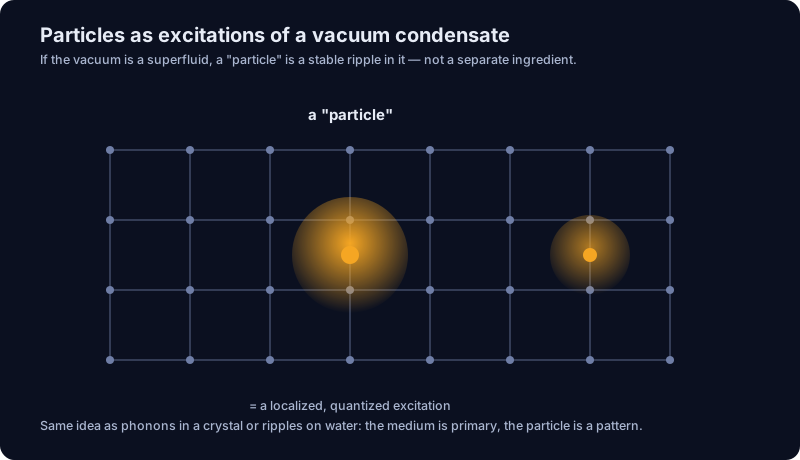
The Russian-Finnish physicist Grigory Volovik spent a career on superfluid helium-3. A superfluid is a liquid so cold that it flows with no friction at all. It also holds ordered quantum patterns inside it. In his 2003 book The Universe in a Helium Droplet, he noticed something deep. The math for the slow ripples in superfluid ³He looks exactly like the math of the particles and forces in our own universe. Electrons, photons, even a gravity-like field turn up as collective excitations. They are sound-and-vortex patterns in the fluid, not basic building blocks.
Turn that around and you get Superfluid Vacuum Theory. Perhaps our vacuum is a quantum condensate too. Then everything we call a particle is a ripple in it.
Why the analogy is taken seriously: analogue gravity
This is not poetry. It is a rigorous, mainstream line of work. Barceló, Liberati, and Visser's "Analogue Gravity" review is the standard account of it. Flowing fluids and Bose–Einstein condensates reproduce curved-spacetime physics for the ripples inside them. Make a fluid flow faster than its own wave speed and you build a sonic horizon. Sound cannot escape it, just as light cannot escape a black hole. In 2016 Jeff Steinhauer reported the analogue of Hawking radiation leaking from such a horizon in a condensate.
A curved-spacetime metric really does emerge for ripples in a real quantum fluid. That is lab-demonstrated physics, and it is the ground this chapter stands on.
The horizon the instrument at the top of this chapter plots is not a piece of hardware; it is a place where the flow outruns its own sound. Steinhauer's bench is where it was measured, and the model below is that bench — where the horizon actually stands turns out not to be where the hardware does.

- Geometry computed from
- The cell built from the paper's own measured asymptotes: an elongated condensate of 8000 rubidium-87 atoms in its red-detuned trapping beam, the waterfall potential's edge at the published x = 0, and the sound and flow speeds joined across it by the smoothest profile that has those asymptotes, s(x) = (1 + tanh(x/w))/2 with c and v riding on the same s. The horizon is where c(x) = v(x), which the model solves for rather than places: it lands about 0.48 micrometres upstream of the step. Counter-propagating sound wavefronts are drawn at equal 2 millisecond intervals from two release points 0.13 micrometres apart, one either side of that crossing, and their positions are integrated along the drift speed c - v rather than spaced by hand, so the pile-up at the horizon and the fanning-out on both sides are the arithmetic and not a drawing. The trapping beam is drawn as the far half of a surface of revolution cut along the flow, so the reader looks into the trough
- Numbers from
- Munoz de Nova, Golubkov, Kolobov and Steinhauer, Observation of thermal Hawking radiation and its temperature in an analogue black hole, Nature 569, 688-691 (2019), held as a sheet in this site's library, for the 8000 atoms, the 3.9 micrometre waist and 812 nanometre wavelength of the trapping beam, the 130 hertz radial trap frequency, the 442 nanometre step beam and its position, the sound and flow speeds of 0.52 and 0.23 millimetres per second outside and 0.31 and 0.90 inside, and the 0.35 nanokelvin Hawking temperature; Steinhauer's 2016 first observation and the Barcelo, Liberati and Visser review, both in the library, as supporting sheets. The step width is not published: it is derived here by requiring the model to reproduce that same 0.35 nanokelvin, which is also how this chapter's own analogue-horizon instrument fixes it, so the model and the instrument on the page cannot disagree
- Schematic parts
- The edge of the step is an annotation rather than a part: the 442 nanometre beam's width, its direction of incidence and its depth are not published, so only the boundary of the region it illuminates is drawn, at the published position. The channel is drawn at a constant radius, the harmonic-oscillator length the published trap frequency gives, because the real cloud's radius follows its density profile and that profile exists only as a figure. The ring radii are a drawing convention so the wavefronts can be seen around the channel; a sound wavefront has no radius of its own. The atoms are not drawn, and neither is the Hawking radiation, which is a correlation in density fluctuations measured over thousands of repetitions rather than an object with a position — a glow would invent one. The imaging optics and the field coils are absent rather than guessed, and what is built is the kinematics of the acoustic metric, not Einstein's equations from a fluid, which is this chapter's stated open problem.
The prize: the biggest open question in physics
Superfluid vacuum theory comes with a bonus. Add half a quantum of energy for every mode of every field and the vacuum comes out denser than anything the sky allows — the famous overshoot runs to about 120 orders of magnitude, and it is the cosmological-constant problem. Chapter 16 is where that gap is drawn to scale and quoted with the correction the literature attaches to it. This chapter is about a proposed way out of it.
Volovik's answer does not try to shrink the number. It says the sum was the wrong sum. A self-sustained liquid is one held together by its own internal forces rather than by a container, and such a liquid finds its own equilibrium. At that point what its ground state costs is fixed by the thermodynamics of the whole liquid, not by counting its ripples one at a time. Count the ripples and the answer is enormous. Ask the liquid what it costs to sit still and the answer is almost exactly zero, with no dial tuned to make it so. Energy appears only when the medium is stirred — by expansion, by the matter in it, by motion — and what is left over is small and nonzero because the stirring is small. That is the claim Volovik makes in The Universe in a Helium Droplet and in his open 2006 paper: the equilibrium ground-state energy of a self-sustained vacuum is not the naive sum of zero-point energies. If it holds, the problem dissolves by the nature of the medium rather than by fine-tuning.
The cosmological-constant argument is elegant and genuinely motivating. The work still to do is showing that it survives realistic matter and quantum corrections. That is the open question the programme is working on now.
The sharpest test: does the vacuum have a rest frame?
A superfluid vacuum would have a preferred rest frame. That usually shows up as a tiny violation of Lorentz invariance. Light of different energies would travel at slightly different speeds. Or a faint drift would appear at very high energy. This is a real, quantitative prediction, and it is already being measured. Physicists use gamma-ray bursts from billions of light-years away, and high-energy neutrinos. So far the speeds match, down to about the Planck scale. That is a powerful result, and it points the programme somewhere specific. The crude versions are out. The carefully Lorentz-preserving ones are where the work now is.
Open question. Can a condensate vacuum keep Lorentz symmetry exact at low energy and still give you gravity?
What to watch next. Sharper timing on gamma-ray bursts and IceCube neutrinos, and the next generation of rotating optical-resonator tests.
“Fluids reproduce the KINEMATICS of curved spacetime — a metric for the ripples — but they have never reproduced the full DYNAMICS, Einstein's equations themselves. So the analogy inspires; it does not establish that our vacuum is a superfluid.”
Analogue fluids supply an effective metric for quasiparticles. Deriving Einstein's field equations from the same fluid requires a model of how that metric responds to energy. Volovik's programme and Zloshchastiev's logarithmic-condensate model pursue this question through different condensate models. Experiments must also test their predictions against Lorentz-symmetry bounds.
What the field added — July to September 2026
A vivid illustrative resource joined this chapter. A creator known as OptoZorax built a finite-element gravity solver for spaces made of nested spherical "portals". The simulation only converges when a compensating negative-mass distribution is added, which is a numerical way of seeing what Morris and Thorne showed on paper: exotic geometry needs negative energy somewhere. It is the best plain-language picture we have found of how geometry and energy density constrain each other. The channel connected it to the cosmological-constant problem, and that connection is the right one to make. It is the biggest open question in physics, it is a question about the vacuum's energy, and the 2025 DESI data suggesting dark energy evolves make it livelier still. Every model in this chapter is an attempt at it. Research log. Phase and coherence, the thread that joins superfluids, lasers and superconductors, have their own course: quantum phase and coherence.
Measurements to follow
a Lorentz-symmetry test at higher precision, or a condensate model that gives Einstein's equations and not just the metric. Gamma-ray-burst and neutrino timing already select for the Lorentz-preserving versions, so that is where the next round of work sits.
Sources
Primary
- G. Volovik, The Universe in a Helium Droplet (Oxford UP, 2003) - the canonical text. An open statement of the same arguments:
- G. Volovik (2006), "From Quantum Hydrodynamics to Quantum Gravity," arXiv:gr-qc/0612134. (Downloaded.)
Independent corroboration - emergent spacetime is real in the lab (beyond the source corpus)
- C. Barceló, S. Liberati & M. Visser (2011), "Analogue Gravity," Living Rev. Relativity 14, 3 (open access) - the rigorous mainstream review of curved-spacetime physics emerging in fluids/BECs.
- J. Steinhauer (2016), "Observation of quantum Hawking radiation in an analogue black hole," Nature Physics 12, 959 (arXiv:1510.00621).
- K. Zloshchastiev, logarithmic-BEC Superfluid Vacuum Theory (e.g. Logarithmic nonlinearity in theories of quantum gravity: Origin of time and observational consequences (arXiv:0906.4282)) - a second, independent SVT school distinct from Volovik, so the programme has two roads open at once.
Where the limits are worked out
- S. Liberati (2013), "Tests of Lorentz invariance: a 2013 update," arXiv:1304.5795 - a literal superfluid vacuum predicts a preferred frame; Fermi-LAT and IceCube bounds set the target the surviving models have to meet.
- Emergent gravity from a medium gives the kinematics (a metric for quasiparticles) readily. Getting the full dynamical Einstein equations is the open problem the field is working on.