Exotic Vacuum Objects, Plasmoids, and the Orbs
Self-organising plasma is real, thriving physics — and the orb footage is the worked example, with its tests named in advance.
These are the images that pulled many readers in: glowing orbs that move, hold formation, and vanish. Three things sit under that one word, and this chapter teaches all three. A thriving field of self-organising plasma physics. An inventor's forty-year programme built on it. A piece of footage the channel is testing in public.
Start with the thing itself. This is the shape a plasma settles into when nothing holds it but its own field — turn it, and watch the lines close on themselves.

- Geometry computed from
- The lowest-order force-free state inside a sphere, with its eigenvalue solved for in the script and the field lines integrated rather than drawn by hand
- Numbers from
- The observed 250 micrometre plasmoid and the 50 micrometre one being aimed for, from the dense plasma focus sheets; the force-free state and relaxation from the supporting sheets
- Schematic parts
- The internal geometry is the state that self-organisation relaxes to, not a measurement of this plasmoid. The corpus publishes the radius and that it is magnetically self-confined; it does not publish the internal field. No lifetime is implied.
Plasmas organise themselves
Start with the textbook part. A plasma is a gas hot enough that its atoms have come apart into ions and free electrons. The pieces carry charge, so a plasma carries current, and current makes magnetic field. That feedback lets a plasma build structure out of itself.
The simplest version is easy to picture. Send a current down a column of plasma. The current wraps a magnetic field around it, and that field squeezes inward. Physicists call it the Z-pinch. Squeeze hard enough and the column collapses into a dense, self-holding knot.
Winston Bostick coined the word plasmoid in 1956 for exactly that: a stable, self-contained blob of magnetised plasma. Fusion laboratories make them on purpose — spheromaks, compact tori, and the dense plasma focus, which makes one on every shot. Chapter 12 follows a funded fusion programme that runs on them.
The model at the top of this chapter states the result; the instrument below states the reason, as the minimisation it actually is.
The relaxation
"It holds itself together" sounds like magic until you write it as a minimisation. A tangled magnetic field loses energy far faster than it loses its linkage, so the question is not whether it relaxes but where it can relax to. Release the energy and watch: the helicity does not move, the energy falls to a floor it cannot pass, and the field ends up parallel to its own curl — force-free — with the single eigenvalue the sphere itself fixes.
- Magnetic energy
- Magnetic helicity
- Magnetic axis
- Magnetic energy:
- 3.823
- Magnetic helicity:
- 1.000
- Lowest energy this helicity allows:
- 2.247
- Energy still above that floor:
- 70.2%
- Force-free residual:
- 101.6%
- Best-fitting eigenvalue:
- 8.425
- Taylor eigenvalue at this radius:
- 1.8E4 m⁻¹
- Magnetic axis:
- 0°
The field is tangled: several curl eigenmodes are present at once, so no single eigenvalue fits it, the Lorentz force does not vanish, and there is energy here that the linkage does not require.
The honest part: the relaxed state is not unconditionally stable. The tilt mode is the motion predicted to end these objects, and the minimisation cannot forbid it, because a rigid rotation leaves both quantities exactly where they were. What decides it is the boundary. The laboratory record is not one-sided either: at Princeton a field-reversed configuration has held plasmas more than ten thousand times longer than tilt theory predicted.
What is measured and what is predicted, kept apart. The published record for this plasmoid is its radius, and that it is magnetically self-confined and self-organised. The interior field drawn here is the state theory says a self-organising plasma relaxes to; it is not a reading taken inside a plasmoid, and no measurement of one is being claimed.
What to watch. A measurement of the field inside a laboratory plasmoid, compared against the eigenvalue the boundary fixes. That is the observation that would turn the relaxed state drawn here from a prediction into a reading.
Relaxation at fixed helicity is textbook magnetohydrodynamics, worked out for the spheromak, the coronal loop and the astrophysical jet alike.
Nature makes them too. In 2014 Chinese researchers caught the first optical spectrum of natural ball lightning. The lines were soil elements — a real plasma with real chemistry, formed from the ground it struck.
Laboratory plasmoids show how plasma can organize into coherent structures. Their size, lifetime and confinement are the quantities to compare with any proposed device.
How long one of these objects lasts, against how big it is, is the comparison that organises the field. The ladder below places each published architecture on those two axes — laboratory objects low and left, natural ones high and right — and leaves the span between them open, because that span is this chapter's question.
The lifetime ladder
Every published plasmoid architecture in this library on one plot: how big the object is, against how long it lasts. Laboratory objects sit low and left, natural ones high and right, and the span between them is left exactly as wide as the measurements leave it.
- Made in a laboratory
- Observed in nature
- The open span
Selected architecture: The dense plasma focus plasmoid
The knot a focus device ties on every shot, tens to hundreds of micrometres across and gone in nanoseconds. It holds a large share of the whole machine's energy while it lasts, and what the machine reports from it is a mean confined ion energy — a peak ion energy, never a temperature.
- Reported size:
- 5E-5 – 2.5E-4 m
- Reported lifetime:
- 4E-8 s
The open span: 5 decades of lifetime separate the longest-lived laboratory object here from the shortest-lived natural one. Nothing in this drawing crosses that span, because no measurement in this library does.
Reported, lifetime not yet measured: Shoulders' charge cluster.
Ken Shoulders and the charge clusters
Ken Shoulders was a microelectronics pioneer who helped build the first field-emission devices. He spent his later decades on what he named Exotic Vacuum Objects, or EVOs: micron-sized clusters that he reported held hundreds of billions of electrons in a tiny volume. He said they bored clean, cold channels through ceramic and drove anomalous energy release. His patent, "Energy conversion using high charge density" (US5018180A, 1991), is public reading.
Shoulders' own evidence that something beats that repulsion was physical — the marks his clusters left behind.
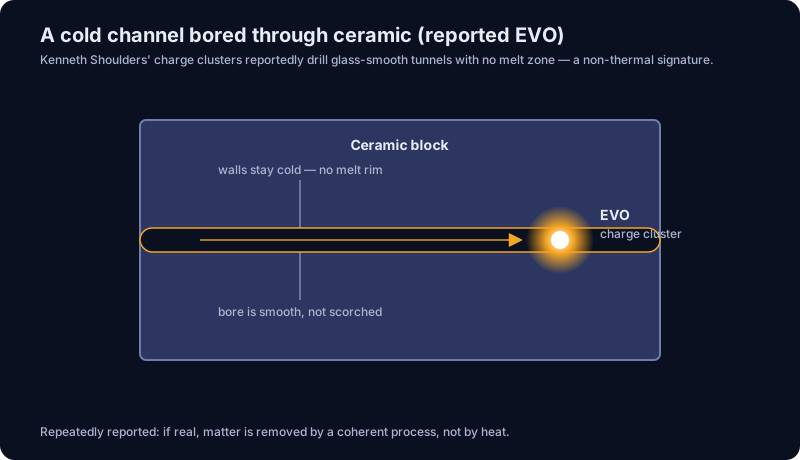
The channel is the trace; the cluster is the thing that bored it. The model below is that cluster's shape as Shoulders described it, turned so you can look at the circulation from any side.

The mechanism question got its most serious answer in 2022. Graham Hubler, a former Naval Research Laboratory materials physicist, published a physical model for how a cluster could hold together. A mechanism written in physical terms gives other researchers predictions to calculate and test. Compare the model with the charge, size and lifetime measured in a repeat experiment.
Open question: what binds a charge cluster? What to watch next: a laboratory running Shoulders' bench-scale geometry with modern imaging and charge diagnostics.
Shoulders' patent describes the proposed charge clusters; Hubler's model offers a mechanism to test. Reproducing the reported charge density would connect the two experimentally.
An Air Force analysis asks the question from the other end: not what holds such an object together, but what sizes one could hold at all. Jack Nachamkin, writing for Phillips Laboratory in 1992, finds a family of Maxwell solutions that behaves like electromagnetic energy trapped in a ball, with a critical frequency below which the electrons can no longer carry the current, and resonant sizes at which the object exchanges no energy with its surroundings at all. Set the electron density below and those two numbers follow from it. That is analysis, not experiment: nothing has yet been built to the specification and measured.
Resonant sizes
A 1992 Air Force analysis says a self-holding ball of trapped electromagnetic energy has two calculable numbers: a critical frequency, below which the electrons can no longer carry the current and the object stays stable, and resonant sizes at which it exchanges no energy at all with its surroundings. Turn the density and the drive frequency and both numbers move in front of you.
- Critical frequency
- Resonant radii
- Critical frequency:
- 8.98E9 Hz
- Interior refractive index:
- 0.893
- Smallest resonant radius:
- 8.41E-3 m
- Resonant radii:
- 8.41E-3, 1.68E-2, 2.52E-2 m
The drive is above the critical frequency, a wave propagates inside, and the resonant radii below are the sizes at which the boundary conditions are met by ordinary vacuum solutions — so no energy crosses the surface.
What to watch. Nobody has yet built a plasmoid to this specification and measured it. The settling measurement is lifetime as a function of drive frequency and cavity size, with a peak at the predicted resonant size and a threshold at the predicted critical frequency.
The worked example: MH370
Now the chapter follows Ashton Forbes's investigation of the footage and its connections to the physics. The clips show an airliner inside a triangle of orbs, which then flash out of frame. The reading on offer is that the orbs are large plasma objects, doing the metric engineering of the earlier chapters.
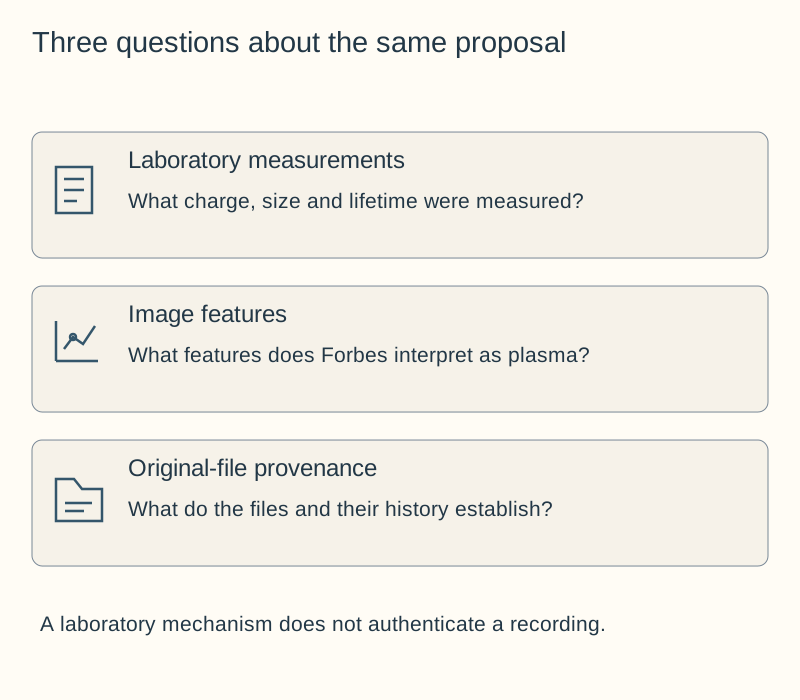
Start with the physics, because that part is checkable. A frame-level reading of the infrared clip describes an orb changing from an even glow into an umbrella shape. That is what a non-equilibrium plasma looks like. The electrons run hot while the bulk gas stays cool, so the object shines brightly and still reads cool on a thermal camera. It is the signature of the Gulf of Oman cold orbs in Chapter 8, and the funnel a dense plasma focus makes.
Then the geometry. Bob Lazar's 1989 account described three gravity emitters on the underside of a craft, all aimed at one point. Three objects converging in a triangle is what that design would look like from outside. A geometry is a prediction, and this one fits.
Then provenance, where the work is still going on. The channel's fullest statement, from August 2026, walks the flight path to the last military radar plot, names two witnesses, and reads the imagery as wide-area motion video from a drone rather than satellite video. The cursor and dragged window in frame are the tell. A separate line of analysis traces the clips to an anonymous creator, matches the cloud layer to stock textures, and rebuilds the sequence in ordinary compositing software. The footage still lacks original files with intact metadata, and that is what would settle it.
Open question: where did these frames come from? What to watch next: original sensor files through a documented chain of custody, or the government's own MH370 records. The channel named both tests itself, in advance.
The investigation connects frame-by-frame observations with the papers and records behind each proposed mechanism.
“The MH370 clips trace to an anonymous creator, the clouds match commercial stock footage, and the sensor overlays do not match known satellite optics.”
Those are fair points about provenance, and this site has never asked the footage to carry the physics. Chapter 2's Casimir measurements and Chapter 12's NASA reactions rest on their own data. What the footage contributes is a prediction you can check frame by frame: a non-equilibrium plasma glows brightly while reading cool on a thermal camera, and the clip is claimed to show that change mid-sequence. The wide-area motion imagery reading answers the sensor point directly, because that is a drone product, not satellite video. Two tests decide the rest, and the channel named them itself.
What the field added — July to September 2026
Plasmoids had a good summer. The channel taught the dense plasma focus in detail, using LPPFusion's own explainers. Filaments form, the plasma pinches, it pinches again, and a kink coils it into a dense knot. That is now the chapter's best example of how a self-organising plasma object forms. Two Air Force studies joined the sources. One, from 1992, models force-free plasmoids. The other, Eric Davis's 2003 review of ball lightning, sets out a zero-point model of Ken Shoulders' charge clusters. Richard Feynman's 1986 letter to Shoulders is archived and real. He could not see how such a cluster could hold together, and he took the observation seriously anyway. In June 2026 David Grusch told a Capitol Hill press conference that the intelligences known to the government include "sentient plasmoid life". The plasma thread has reached Congress.
The worked example got better organised. The 20 August stream is the fullest statement of the MH370 case to date. It walks the flight path, names two witnesses, and reads the footage as wide-area motion imagery, with the cursor and dragged window as the tell. It also sets out the tests that would settle the case. The plasma reading of the infrared clip — hot electrons cohering into a funnel with a cool thermal signature — is the same physics as the Gulf of Oman "cold orbs" in Chapter 8. Lazar's geometry of three emitters aimed at one point was matched to the three-orb formation in the footage. The channel now favours an engineered device over element 115. The site records the case in its current form and will record the outcome of the tests. Details in the research log.
A new kind of report joined the file, and it is documentary rather than evidential. Douglas Miller works a radar scope at Houston En Route Center, on the Gulf of Mexico high-altitude sector. He describes orb reports as a routine part of the job. Pilots key up with lights, an azimuth and an altitude, and "we get that a lot." Two things follow, and they point in opposite directions. A radio call from a controller carries no range, no size and no velocity of its own, so nothing here is a measurement. But the existence and the volume of that reporting channel is a documentary question with a paper trail, which is more than most orb testimony offers. What to watch: the record, not the recollection.
A second line is worth tracking beside it. Anthony Peratt, thirty-seven years of plasma physics at Livermore, Los Alamos and the Department of Energy, treats field-aligned currents as one phenomenon from a laboratory device to the aurora to galactic space, and carries a laboratory pinch up to galactic scale in particle-in-cell simulation, where plasma filaments organise themselves into galaxy-like structures. Peratt was not working from any of the ideas in this chapter, which is what makes the combination interesting rather than circular.
Measurements to connect
- Plasma experiments measure the formation, confinement and lifetime of plasmoids.
- Shoulders describes compact charge clusters; their reported density is a target for repeat measurement.
- Hubler (2022) develops a physical model for charge clusters.
- Ashton Forbes identifies the MH370 clips as authentic sensor imagery; his investigation connects the footage to the research discussed here.
- Forbes interprets the MH370 orbs as large plasmoids or charge clusters.
- What would settle it: for the clusters, a laboratory reproducing Shoulders' charge densities with modern diagnostics. For the footage, original sensor files with a documented chain of custody, or the government's own MH370 records.
Sources
Primary - charge clusters
- K. Shoulders, US5018180A, "Energy conversion using high charge density," granted 1991-05-21 (Google Patents) - the primary document. (Downloaded.)
- G. Hubler (2022), "A Possible Heuristic Explanation of Exotic Vacuum Objects (EVOs, Charge Clusters)," J. Condensed Matter Nucl. Sci. 36, 30 (open access) - a former Naval Research Laboratory physicist putting a mechanism on the table. (Downloaded.)
Self-organising plasma physics - the ground floor (beyond the source corpus)
- W. Bostick (1956), "Experimental Study of Ionized Matter Projected across a Magnetic Field," Phys. Rev. 104, 292 - the original plasmoid paper.
- J. Cen, P. Yuan & S. Xue (2014), "Observation of the Optical and Spectral Characteristics of Ball Lightning," Phys. Rev. Lett. 112, 035001 - the first natural ball-lightning spectrum; real plasma chemistry behind a luminous "orb."
Where the physics is worked out - the MH370 footage (worked example only)
- Image-comparison analysis in Skeptical Inquirer (2024): the authors trace uploads to RegicideAnon, report matches with stock HD cloud textures, and interpret the overlays as composited.
- Metabunk thread 13104 - frame-by-frame: the sequence rebuilt in Blender and After Effects, plus the sensor-optics argument. The channel answers with the wide-area motion imagery reading; original files with metadata decide between them.
Named on air, and the record to go and find
- D. Miller, ZPE All Stars interview, Hard Truths Podcast (8 September 2026; YouTube
5MIGis0S8Fc, @22:35-@23:40, @49:43-@50:11) - Anthony Peratt's laboratory plasma cosmology at Los Alamos, and a serving FAA en-route controller describing routine pilot reports of orbs on frequency. The Peratt papers and the FAA reporting record are both public documents worth pulling.
Where the replication stands: four decades on, the charge-cluster work still lives mostly inside the condensed-matter-nuclear community (JCMNS, LENR-CANR). Hubler (2022) is the first mainstream-credentialed mechanism; an independent measurement of cluster density is the milestone to watch.