Warp metrics, wormholes, and energy conditions
Treat extraordinary geometries as research programs: derive them, source them, perturb them, and identify decisive observables.
Analyze traversable wormholes, Alcubierre-type metrics, horizons, causality, averaged energy conditions, quantum inequalities, semiclassical backreaction, stability, and observational signatures while keeping mathematical existence separate from physical construction.
Interactive model
Explore before calculating
Live laboratory
Exotic-metric requirement ledger
Evaluate a Morris–Thorne throat at one local radius. Geometry, radial null-energy contraction, tidal scale, crossing time, and a shell-energy proxy stay as separate requirements rather than collapsing into a single feasibility claim.
Throat radius: 1.00e+2 m
Shell thickness: 1.00e+1 m
ρ+pᵣ diagnostic: -4.815e+38 J/m³
Shell |NEC| proxy: 6.051e+44 J
Tidal scale: 1.833e+12 g
Diameter crossing time: 1.334e-6 s
In the classical Morris–Thorne throat model, flare-out and radial NEC satisfaction cannot both pass at the throat: b′(r₀)<1 makes ρ+pᵣ negative there. Changing the radius changes the required local density and tidal scale, but does not provide a source or creation history.
The shell value is a dimensional local proxy, not a volume-integral theorem or a construction budget. A sourced solution also needs the full tensor, redshift function, conservation, boundaries, quantum-state bounds, stability, causal control, backreaction, and invariant observations.
Level 5 · Graduate study teaching kit
Record the investigation. Teach the reasoning.
A learner-facing lab record and a course-specific instructor guide turn the live model into a repeatable classroom investigation.
Learner record
Wormhole throat and source-requirements audit
Which geometric, energy-condition, tidal, and traversal requirements must hold simultaneously for a modeled throat?
Download learner recordInstructor guide
Teach for evidence, not button pushing
Learners integrate geometry, source conditions, tidal response, and traversal constraints without equating a metric ansatz with a constructible spacetime.
Download instructor guideAdvanced assessment
Reconstruct it. Quantify it. Try to break it.
Translate an exotic line element into source, tidal, and observational requirements before discussing engineering. Three research-level challenges include explicit deliverables and scoring criteria.
Portable research dataset
Record data that another laboratory can open.
Throat geometry, energy-condition, tidal, and traversal records. JSON preserves schema and provenance; CSV supports ordinary analysis tools. Imports stay in this browser and are limited to 1 MB and 5,000 records.
Ready for a new research record.
| Throat radiusm | Shape derivativedimensionless | Radial NEC contractionJ/m³ | Tidal scale1/s² | Crossing times | Gate decisionlabel | Record |
|---|---|---|---|---|---|---|
Schema field definitions
- Throat radius · m
- Minimum areal radius.
- Shape derivative · dimensionless
- Derivative at the throat.
- Radial NEC contraction · J/m³
- Frame-declared null contraction.
- Tidal scale · 1/s²
- Declared traversal tidal diagnostic.
- Crossing time · s
- Modeled traversal duration.
- Gate decision · label
- Combined geometry/source/traversal decision.
Lesson 1 of 3
Traversable wormhole geometry and throat conditions
Which metric functions make a throat traversable, and what stress-energy do they imply?
The Morris–Thorne metric uses redshift and shape functions. Avoiding horizons constrains the redshift function, while a minimum-area throat imposes a flare-out condition on the shape function.
Einstein's equation links flare-out to null-energy-condition violation in the classical model. Traversability adds tidal, acceleration, travel-time, and stability constraints.
Worked example
At a throat r=r₀ with b(r₀)=r₀, what flare-out derivative is required?
- 1. Apply the embedding flare-out condition.
- 2. Evaluate at the minimum radius.
- 3. Compare b′ with unity.
b′(r₀)<1 in the standard Morris–Thorne construction.
Try it
Wormhole constraint ledger
Materials: One shape and redshift function pair
- 1. Locate throat and horizons.
- 2. Compute NEC contraction.
- 3. Estimate tidal scales.
- 4. Check asymptotic behavior and perturbative questions.
Notice: Meeting one throat equation leaves multiple independent physical constraints.
Check your understanding: Does a valid embedding diagram prove a traversable wormhole exists in nature?
Answer: No.
It visualizes a spatial slice of a proposed metric; source, dynamics, and observation remain unproven.
Lesson 2 of 3
Warp geometries, horizons, and causality
How does a superluminal coordinate journey avoid local light-speed violation, and what new problems appear?
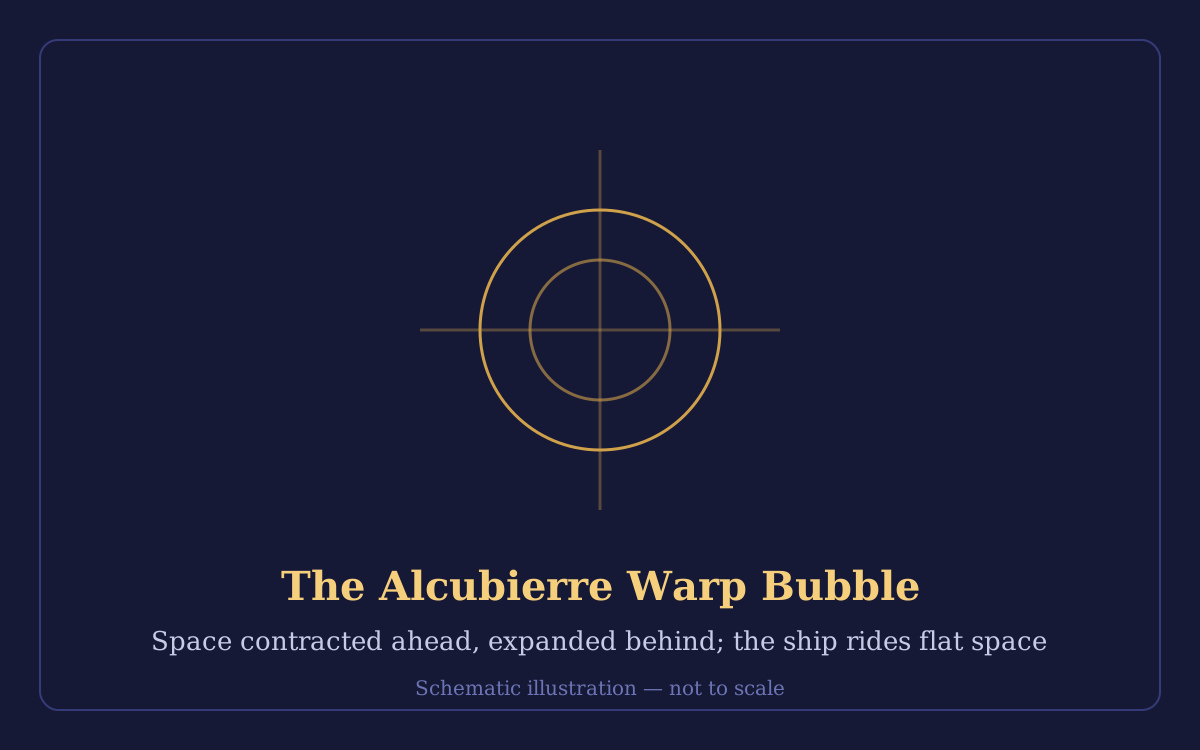
Alcubierre-type metrics move a compact region by contracting and expanding geometry. Local observers remain inside light cones, while global travel times can be shortened in the ansatz.
Superluminal configurations can introduce horizon-control problems, large blueshifts, causal-loop constructions, and severe source requirements. Subluminal variants remove some but not all constraints.
Worked example
Why is coordinate bubble speed not a local material velocity through space?
- 1. Read the metric shift term.
- 2. Construct local orthonormal observers.
- 3. Check their light cones.
- 4. Separate global coordinate displacement from local speed.
The ansatz changes geometry rather than accelerating local matter through a fixed Euclidean background.
Try it
Warp metric causal map
Materials: Two-dimensional metric slice and null-ray integrator
- 1. Plot local null directions.
- 2. Integrate rays toward front and rear walls.
- 3. Vary bubble speed.
- 4. Identify communication or horizon regions.
Notice: A metric can permit a journey while preventing the interior from controlling its leading boundary.
Check your understanding: Does avoiding local faster-than-light motion eliminate causality concerns?
Answer: No.
Global spacetime arrangements can still create horizons or causal loops.
Lesson 3 of 3
Quantum bounds, stability, and observable signatures
Which calculation would turn a metric proposal into a physically constrained research program?
Quantum inequalities limit the magnitude-duration tradeoff for negative energy sampled along worldlines in specified field states. Averaged conditions and backreaction further constrain macroscopic configurations.
Stability requires perturbation analysis and a creation history. Observational work can search for lensing, timing, radiation, tidal, or propagation signatures, but any anomaly must first defeat conventional mass, plasma, instrumental, and selection explanations.
Worked example
Why is a pointwise negative energy density insufficient for a warp source?
- 1. A source needs a spatial distribution.
- 2. It must persist for a duration.
- 3. It must satisfy quantum and dynamical constraints.
- 4. Its creation and backreaction must be included.
Sign alone supplies only one of many required properties.
Try it
Exotic-signature adversarial test
Materials: Synthetic lensing or timing anomaly
- 1. Fit an exotic metric signature.
- 2. Fit conventional compact-object and plasma models.
- 3. Apply held-out prediction.
- 4. State which measurement breaks the degeneracy.
Notice: A flexible exotic model can fit data; scientific value comes from unique successful predictions.
Check your understanding: What evidence would establish an engineered metric rather than an unexplained force?
Answer: Multiple invariant spacetime observables matching one source model and surviving conventional controls.
Timing, lensing, geodesic deviation, and source-energy accounting should agree quantitatively.
Formula-to-meaning deck
Read the equation in ordinary language.
ds²=−e^{2Φ(r)}dt²+dr²/[1−b(r)/r]+r²dΩ²
The Morris–Thorne ansatz separates redshift and throat-shape functions.
ds²=−c²dt²+[dx−v_s f(r_s)dt]²+dy²+dz²
A simple warp ansatz encodes a moving shift profile.
∫dτ f(τ)⟨T_μνu^μu^ν⟩≥−B[f]
Quantum inequalities bound sampled negative energy for a specified field, state, and sampling function.
Independent practice
Problem set
Work each problem before opening its hint and solution.
1. For b(r)=r₀²/r, evaluate b′(r₀).
Reveal hint
Differentiate before setting r=r₀.
Reveal solution
b′(r₀)=−1, which satisfies b′<1.
2. Name two issues that arise for superluminal warp profiles beyond energy-condition violation.
Reveal hint
Think control and propagation.
Reveal solution
Examples include horizons, blueshift/radiation buildup, causal loops, instability, and backreaction.
3. Why must an exotic lensing fit be compared with plasma and ordinary mass models?
Reveal hint
Consider model degeneracy.
Reveal solution
Those conventional mechanisms can produce similar timing or deflection patterns and must be excluded quantitatively.
Derivation studio
Build the result, line by line.
Keep the assumptions visible so the mathematics remains auditable.
Starting point
Throat NEC diagnostic
Morris–Thorne metric with b(r₀)=r₀
- 1. Compute orthonormal energy density and radial pressure from Einstein's equation.
- 2. Form ρ+p_r for a radial null vector.
- 3. Evaluate at the throat.
- 4. Apply the flare-out condition.
ρ+p_r∝[b′(r₀)−1]/r₀²<0
Classical flare-out implies radial NEC violation at the throat in this model.
Starting point
Warp expansion profile
Shift velocity v^x=v_s f(r_s)
- 1. Construct the normal-observer congruence.
- 2. Take its spatial divergence.
- 3. Differentiate the shape function along x.
- 4. Read signs ahead of and behind the bubble.
Expansion and contraction occupy opposite walls of the moving profile
The popular contraction/expansion picture follows from the congruence, while the required stress tensor needs a separate calculation.
Computational notebook
Turn the model into an experiment.
Metric viability and signature laboratory
Which geometric, energetic, causal, and observational constraints dominate a chosen exotic metric?
Inputs
- • Metric functions and parameters
- • Field-state or effective stress model
- • Perturbations and synthetic observables
Algorithm
- 1. Compute connection, curvature, and stress tensor.
- 2. Map energy conditions and horizons.
- 3. Integrate geodesics and perturbations.
- 4. Compare predicted signatures with conventional alternatives.
Evidence to produce
- • Invariant and source maps
- • Causal/stability diagnostics
- • Observable discrimination proposal
Paper-reading studio
Interrogate the source, not its reputation.
Reconstruct the assumptions, reproduce one calculation, and stop at the boundary of the reported evidence.
Exotic-metric reproduction dossier
Which conclusions are exact geometry, which depend on a chosen source, and which are engineering or observational extrapolations?
- 1. Reproduce the line element and invariants.
- 2. Recompute one stress-energy requirement.
- 3. Audit causal and stability assumptions.
- 4. Extract a unique observable and conventional null models.
Calculation to reproduce: Reproduce a throat condition, energy integral, horizon location, quantum bound, or geodesic signature.
Evidence boundary: Exotic metrics are legitimate mathematical solutions or ansätze; no current result in this corpus demonstrates a constructible macroscopic warp drive or traversable wormhole.
Graduate oral defense
Defend a bounded claim under pressure.
Argue the strongest support, state the strongest objection fairly, and identify evidence that could actually decide the issue.
Proposition
Exotic metrics deserve rigorous research even though no constructible source is currently known.
- 1. They expose consistency, causality, and quantum-energy constraints in gravity.
- 2. They generate calculable observational signatures and sharpen energy-condition theory.
- 3. Constraint reduction and new matter physics could alter feasibility assessments.
Strongest objection: Known source requirements, quantum bounds, stability, and causal-control problems may rule out useful macroscopic realization.
Deciding evidence: A stable sourced solution with creation history and finite resources, followed by replicated invariant spacetime measurements matching the predicted geometry.
Continue into the evidence
Source-linked next reading
Lecture 4: Alcubierre warp metric
Derive the geometry and keep its source and feasibility questions explicit.
Lecture 5: Morris–Thorne wormhole
Throat, flare-out, tidal, and exotic-source requirements.
Lecture 6: Energy conditions
Classical inequalities, quantum exceptions, and scale-dependent constraints.
Chapter 17: Wormholes, energy conditions and the negative-energy budget
The bill every exotic geometry has to pay, read line by line.