Semiclassical and induced gravity
Derive gravitational terms from quantum effective actions and ask which parts are explanation, approximation, or testable physics.
Study effective actions in curved space, heat-kernel expansions, trace anomalies, Sakharov-style induced gravity, stochastic gravity, emergent-gravity analogies, and experimental constraints on additional fields or departures from Einstein dynamics.
Interactive model
Explore before calculating
Live laboratory
Semiclassical backreaction scale estimator
Translate a declared energy-density scale into a dimensional curvature radius, compare it with a modeled region, and keep source fluctuations separate from the expectation value.
Energy density: 1.00e+10 J/m³
Dimensional Lρ: 2.19e+16 m
(R/Lρ)²: 2.08e-33
σT/|⟨T⟩|: 0.20
The dimensional curvature strength is small across this region. The declared source fluctuation is below the mean.
This uses only the magnitude estimate 1/Lρ²≈8πGρ/c⁴. It is not a metric solution and omits tensor signs, pressures, gradients, boundary data, conservation, state choice, and renormalization.
Level 5 · Graduate study teaching kit
Record the investigation. Teach the reasoning.
A learner-facing lab record and a course-specific instructor guide turn the live model into a repeatable classroom investigation.
Learner record
Semiclassical source and backreaction scale test
When can a renormalized quantum stress tensor source a classical geometry without invalidating the approximation that produced it?
Download learner recordInstructor guide
Teach for evidence, not button pushing
Learners test mean-source, fluctuation, scale-separation, and renormalization conditions before interpreting semiclassical or induced-gravity results.
Download instructor guideAdvanced assessment
Reconstruct it. Quantify it. Try to break it.
Determine when a renormalized mean source is informative and when fluctuations or curvature invalidate the semiclassical description. Three research-level challenges include explicit deliverables and scoring criteria.
Portable research dataset
Record data that another laboratory can open.
Mean-source, fluctuation, curvature, and approximation-validity records. JSON preserves schema and provenance; CSV supports ordinary analysis tools. Imports stay in this browser and are limited to 1 MB and 5,000 records.
Ready for a new research record.
| Statelabel | Curvature radiusm | Stress scaleJ/m³ | Backreaction ratiodimensionless | Fluctuation ratiodimensionless | Approximation validboolean | Record |
|---|---|---|---|---|---|---|
Schema field definitions
- State · label
- Quantum-state prescription.
- Curvature radius · m
- Background curvature radius.
- Stress scale · J/m³
- Renormalized mean stress scale.
- Backreaction ratio · dimensionless
- Mean-source validity diagnostic.
- Fluctuation ratio · dimensionless
- Stress-fluctuation diagnostic.
- Approximation valid · boolean
- Declared decision under the recorded thresholds.
Lesson 1 of 3
Effective actions, curvature expansion, and anomalies
Which gravitational terms are generated when quantum matter is integrated out?
The one-loop effective action is a functional determinant. A heat-kernel or derivative expansion organizes local terms by curvature and derivatives: vacuum, Einstein-Hilbert, and higher-curvature contributions.
Renormalization fixes divergent coefficients through measured gravitational couplings. Trace anomalies show that classical scale symmetry can fail quantum mechanically in curved spacetime.
Worked example
Which local terms appear first in a four-dimensional low-curvature expansion?
- 1. Order by mass dimension.
- 2. Begin with a volume term.
- 3. Add scalar curvature.
- 4. Then include curvature-squared invariants.
∫√−g(−Λ_eff+c_R R+c_1R²+c_2R_μνR^μν+⋯).
Try it
Operator-to-effective-action map
Materials: A scalar field operator and heat-kernel coefficient table
- 1. Identify the differential operator.
- 2. List the first local invariants.
- 3. Track regulator dependence.
- 4. State which coefficients require measurement.
Notice: Generating a term in an effective action does not predict its observed finite coefficient without a renormalization condition or microscopic completion.
Check your understanding: Does a generated Einstein-Hilbert term prove gravity has no independent microscopic degrees of freedom?
Answer: No.
It shows such a term occurs in the low-energy action, not that every aspect of gravity is exhausted by the chosen matter loops.
Lesson 2 of 3
Sakharov induction and emergent-gravity programs
Can spacetime elasticity and Newton's constant arise as collective low-energy response?
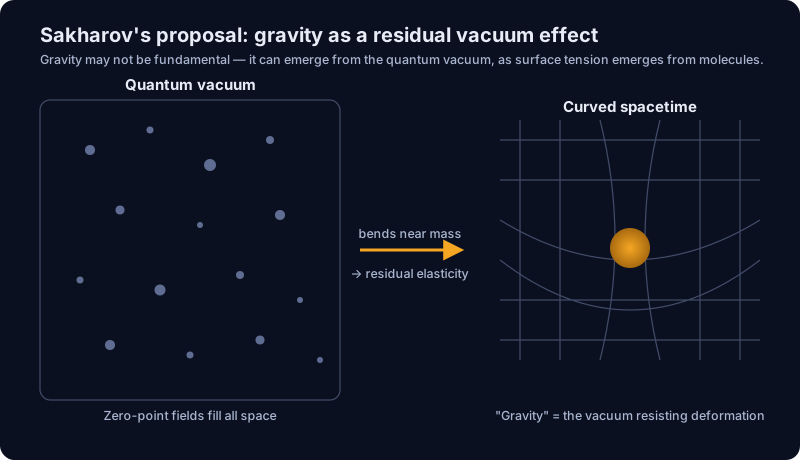
Sakharov's proposal treats curvature as perturbing quantum fields, whose vacuum response induces gravitational action terms. The resulting Newton coefficient is sensitive to spectrum and ultraviolet completion.
Broader emergent programs use entanglement, thermodynamics, condensates, or analogue media. They must recover equivalence, diffeomorphism symmetry, propagating tensor modes, and precision-tested nonlinear dynamics.
Worked example
What scale relation often appears in cutoff-based induced-gravity estimates?
- 1. The R term has mass dimension two.
- 2. A quadratic ultraviolet sensitivity supplies that dimension.
- 3. Species and couplings set a coefficient.
- 4. Relate it to inverse Newton strength.
Schematically 1/G_ind∼NΛ_UV², with model-dependent signs and coefficients.
Try it
Emergence requirement matrix
Materials: Two induced/emergent gravity proposals
- 1. Identify microscopic degrees of freedom.
- 2. Derive low-energy metric variables.
- 3. Check universal matter coupling.
- 4. List unmatched GR tests and novel predictions.
Notice: Reproducing one equation or analogy is not the same as recovering the full tested gravitational theory.
Check your understanding: Why is universal coupling a hard requirement?
Answer: Observed gravity responds nearly universally to matter and energy.
A medium-specific force or quasiparticle metric does not automatically satisfy the equivalence principle.
Lesson 3 of 3
Stochastic backreaction and experimental discriminants
When do fluctuations around the mean stress-energy become observable sources?
Stochastic gravity supplements the mean semiclassical source with a noise kernel built from stress-tensor correlations. It studies induced metric fluctuations and the regime where mean-field gravity remains valid.
Experimental relevance requires predictions distinct from conventional gravity: modified propagation, extra polarizations, equivalence violations, scale-dependent couplings, or correlated noise with a specified spectrum.
Worked example
What comparison indicates mean-field semiclassical gravity may fail?
- 1. Compute or estimate stress-energy expectation.
- 2. Estimate connected stress fluctuations.
- 3. Propagate both through gravitational response.
- 4. Compare fluctuation scale with the mean geometry.
Large induced fluctuations relative to the mean signal the need for a description beyond the expectation-value source.
Try it
Falsifiability design studio
Materials: One emergent or induced-gravity model
- 1. Extract its distinct parameter.
- 2. Map that parameter to an observable.
- 3. Identify existing bounds.
- 4. Design a measurement that improves sensitivity without model-dependent reinterpretation.
Notice: A program becomes physics when its mechanism produces a discriminating observable rather than only a new explanatory vocabulary.
Check your understanding: Can an unexplained force residual alone identify induced gravity?
Answer: No.
The residual must match a unique quantitative signature and survive ordinary force, calibration, and selection controls.
Formula-to-meaning deck
Read the equation in ordinary language.
Γ_1=½Tr ln Δ
A one-loop effective action is encoded by the determinant of the fluctuation operator.
Γ_eff=∫√−g(−Λ_eff+c_RR+c_1R²+⋯)d⁴x
Long-wavelength quantum response produces a local curvature expansion.
N_μνρσ(x,y)=½⟨{t_μν(x),t_ρσ(y)}⟩
The noise kernel measures connected stress-tensor fluctuations that can source stochastic metric response.
Independent practice
Problem set
Work each problem before opening its hint and solution.
1. Why does the coefficient of R have mass dimension two in natural units?
Reveal hint
The action is dimensionless and d⁴x has dimension −4 while R has dimension 2.
Reveal solution
Its coefficient must have dimension 2 so the integrand has dimension 4.
2. If 1/G_ind∝NΛ², how does it scale when species count doubles?
Reveal hint
Hold cutoff and per-species coefficient fixed.
Reveal solution
It doubles.
3. Name two observables that could distinguish an emergent model from GR.
Reveal hint
Think propagation and universality.
Reveal solution
Examples include extra gravitational-wave polarizations, dispersion, equivalence-principle violation, fifth forces, or scale-dependent Newton coupling.
Derivation studio
Build the result, line by line.
Keep the assumptions visible so the mathematics remains auditable.
Starting point
Induced Einstein-Hilbert scaling
Γ_1=½Tr ln Δ and a proper-time representation
- 1. Write lnΔ as an integral over proper time.
- 2. Insert the heat-kernel expansion.
- 3. Identify the coefficient multiplying R.
- 4. Integrate to the ultraviolet cutoff.
c_R∝NΛ_UV² plus finite spectrum-dependent terms
Matter fluctuations can generate gravitational stiffness, while its observed value remains completion- and renormalization-dependent.
Starting point
Einstein-Langevin structure
Split T_μν=⟨T_μν⟩+t_μν
- 1. Linearize the metric around a semiclassical solution.
- 2. Represent stress fluctuations by a stochastic source ξ_μν.
- 3. Choose its two-point function equal to the noise kernel.
- 4. Solve the linear response equation.
δG_μν=8πG(δ⟨T_μν⟩+ξ_μν)
The stochastic equation reproduces symmetrized metric correlations within its validity regime.
Computational notebook
Turn the model into an experiment.
Induced-action and constraint laboratory
Which spectra and cutoffs can reproduce a target gravitational coefficient without violating measured low-energy bounds?
Inputs
- • Matter spectrum and couplings
- • Ultraviolet scale and regulator
- • Fifth-force and propagation constraints
Algorithm
- 1. Compute leading induced coefficients.
- 2. Run sensitivity to spectrum and cutoff.
- 3. Map leftover operators to observables.
- 4. Compare with current constraints and radiative stability.
Evidence to produce
- • Coefficient hierarchy
- • Parameter-sensitivity map
- • Viability and falsifiability report
Paper-reading studio
Interrogate the source, not its reputation.
Reconstruct the assumptions, reproduce one calculation, and stop at the boundary of the reported evidence.
Induced-gravity program reconstruction
Does the work renormalize a gravitational term, derive universal dynamics, or propose an analogy?
- 1. Reproduce the effective-action expansion.
- 2. Identify microscopic spectrum and cutoff assumptions.
- 3. Check recovery of equivalence and tensor dynamics.
- 4. Extract a distinct constrained observable.
Calculation to reproduce: Reproduce one induced coefficient, anomaly term, noise kernel, or phenomenological bound.
Evidence boundary: An induced R term is a substantive theoretical result; it does not alone prove a manipulable vacuum medium or a route to engineered gravity.
Graduate oral defense
Defend a bounded claim under pressure.
Argue the strongest support, state the strongest objection fairly, and identify evidence that could actually decide the issue.
Proposition
Induced gravity is a viable low-energy organizing principle but not yet a complete demonstrated microscopic theory of gravity.
- 1. Quantum matter generically contributes covariant curvature terms.
- 2. Thermodynamic and entanglement structures provide nontrivial links between geometry and quantum information.
- 3. Effective descriptions can yield testable corrections.
Strongest objection: Cutoff dependence, universality, cosmological constant stability, and recovery of full nonlinear quantum gravity remain unresolved.
Deciding evidence: A UV-complete derivation of observed couplings and Λ together with unique, verified deviations or microscopic predictions inaccessible to GR plus ordinary QFT.
Continue into the evidence
Source-linked next reading
Chapter 3: ZPF, inertia, and gravity
Sakharov-style induction and competing inertia/gravity interpretations.
Lecture 3: General relativity
The complete tested low-energy target an emergent program must recover.
Lecture 9: Puthoff–Haisch–Rueda program
An application of vacuum response to inertia, with objections and proposed tests.