Research update · 23 November 2026
A faint glow around MH370? What the thermal video shows, and how to check it yourself
In the thermal infrared video of MH370, the plane reads cooler when the three orbs come close. The air right around it may read a little warmer at the same time. Both effects are small. Here is what we measured, what could cause it, and everything you need to check it on the same video.
The idea
Ashton Forbes reads the orbs as plasma or field devices working on the plane. One way to picture it: the orbs wrap the plane in a field or a shell of plasma, a bubble. A thermal camera sees heat, so it may catch only the edge of such a shell: a faint warming of the air, or a cooling of the plane inside it.
So we asked a simple question of the video: when the orbs are closer to the plane, does anything around the plane read differently?
What we measured
We used the thermal infrared video, one reading per distinct picture, from the stretches at 20 to 39.5 s and 44 to 53.5 s. In every picture we found the plane and the orbs, and measured how far the orbs were from the plane, in plane-widths. Slow drifts within each stretch (the camera zooming and panning) were removed first. To judge chance, we shifted the orb-distance series in time many times and asked how often a link as strong as the real one turned up by accident. Heat here is a reading of the video's rainbow palette, from blue (cool) to red (hot), not degrees.
Measured (modest)
1. The plane reads cooler when the orbs are close
Across 467 pictures, the plane's heat reading rises as the orbs move away: a rank correlation of +0.14, p = 0.003. In other words, closer orbs, cooler plane.
It holds with the plane's size on the screen and its screen position held fixed: +0.0197 per plane-width of orb distance, against a chance band of ±0.0150, p = 0.003. The plane's body cools; its hottest spots, the engines, do not follow (−0.006). This matches what Ashton points out: the plane cools before the flash.
Candidate (weak)
2. Slightly warmer air in a ring close around the plane
Across 418 distinct pictures, the air close to the plane minus the air farther out reads +0.0095 higher in the quarter of pictures where the orbs are closest than in the quarter where they are farthest. It survives blanking out 48 pixels around every orb, so it is not the orbs' own glow.
It is fragile: we tried three ways of removing the slow drift, and one of them removes it. It stays an open question.
Other fingerprints
3. Warm specks and sensor noise
Candidate: more separate small warm spots in each picture when the orbs are close, +0.43 per picture against a chance band of ±0.39, p = 0.037.
Not resolved: noise across the whole picture, p = 0.10.
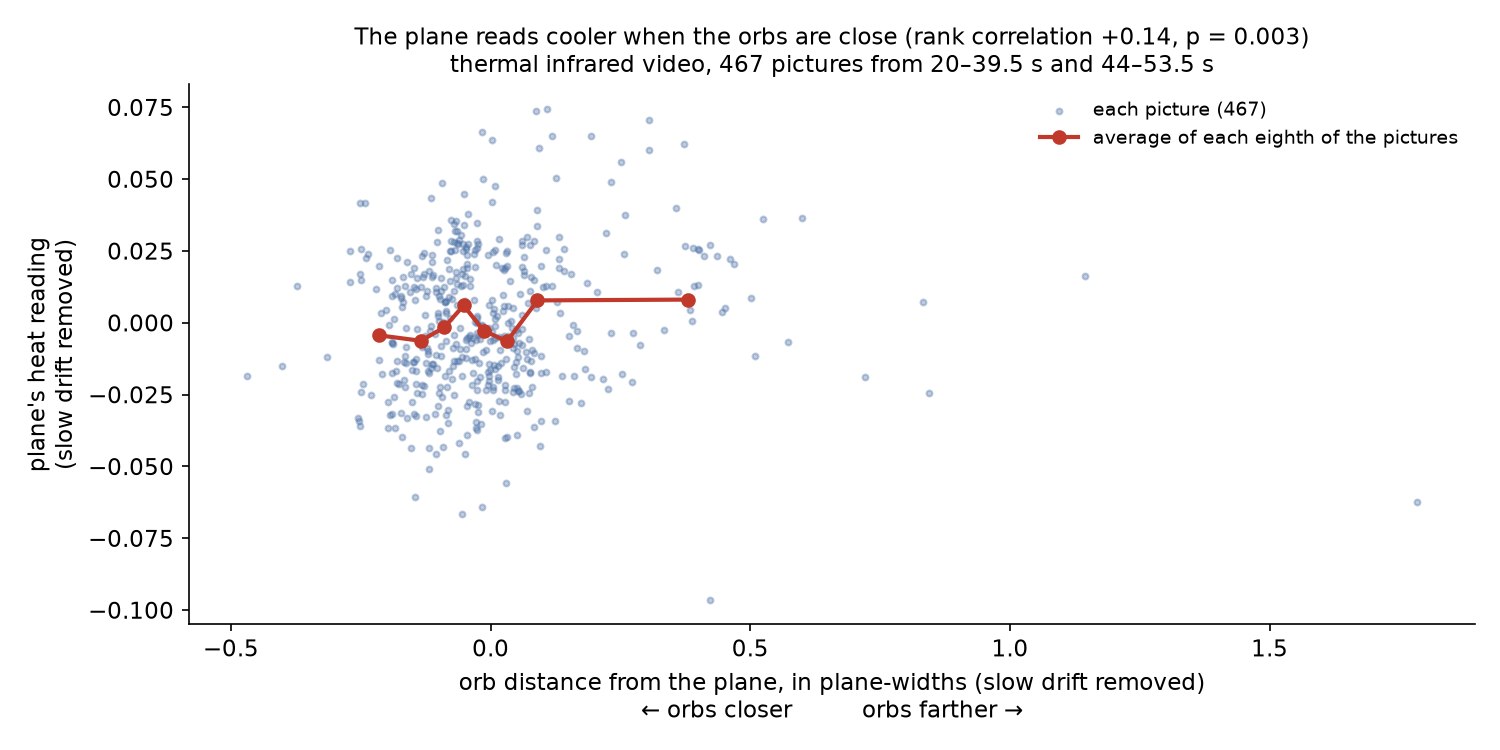
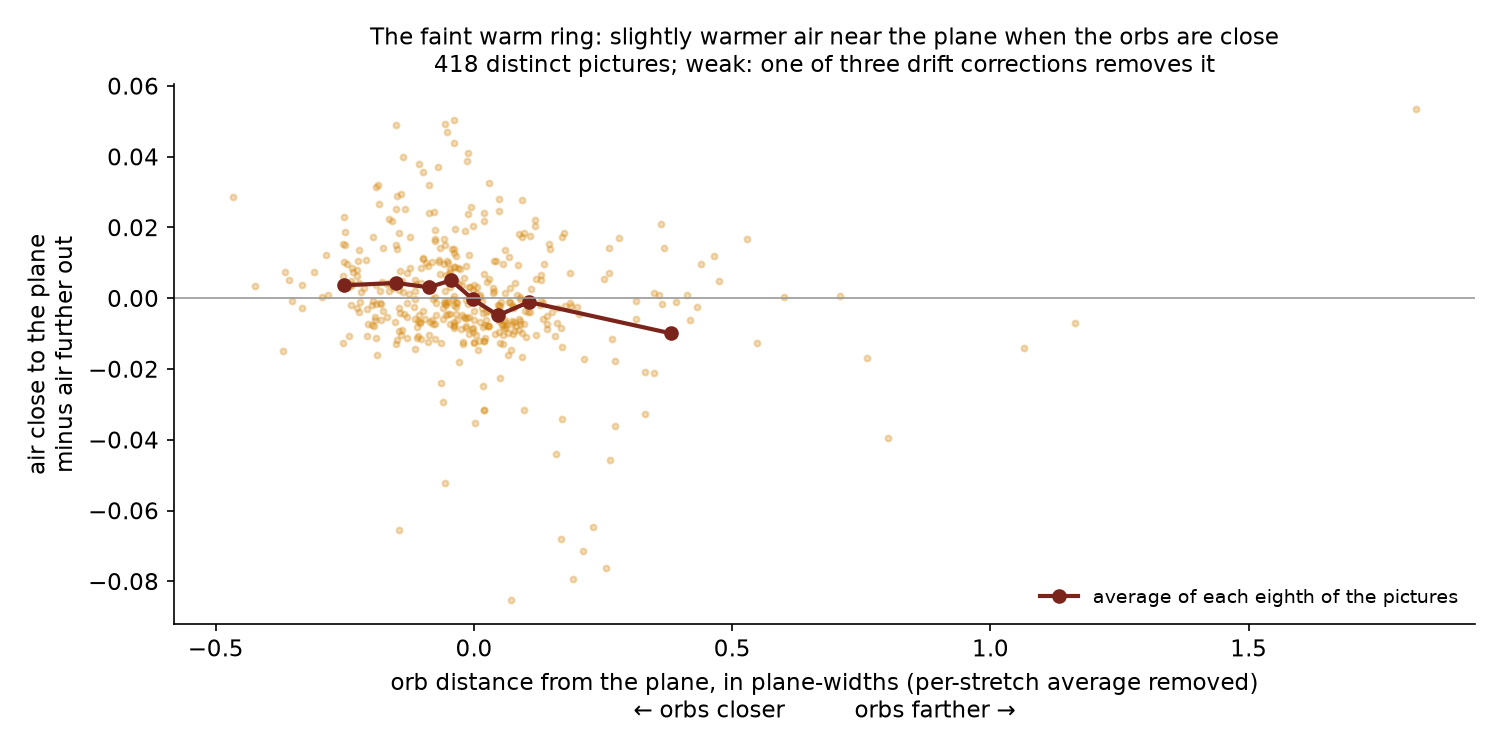
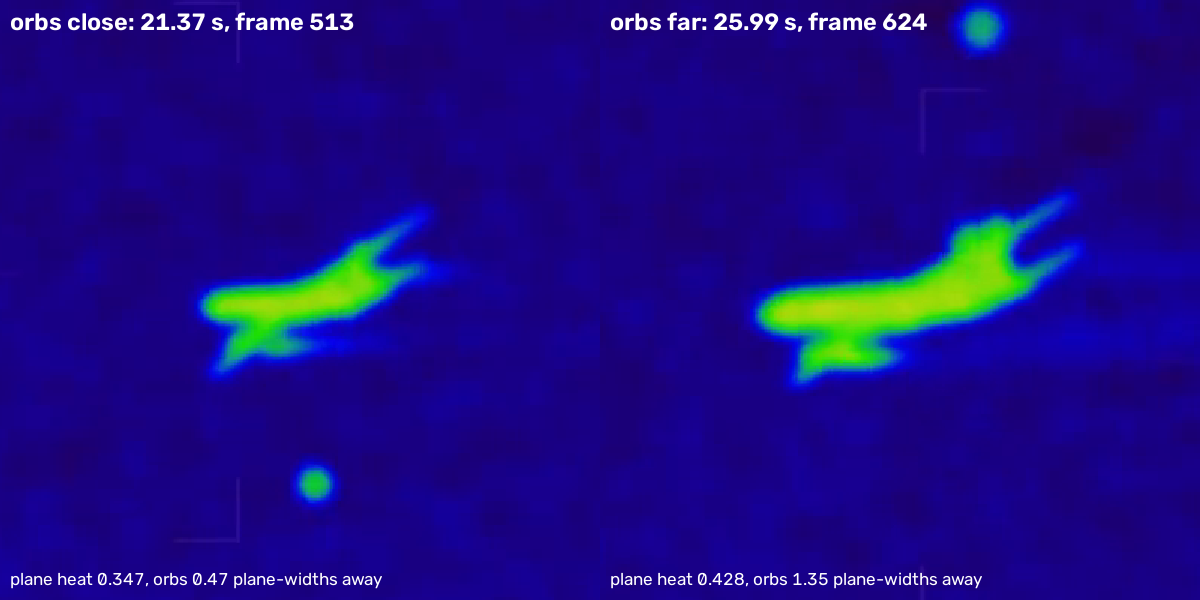
Does it wrap the whole plane?
If the orbs enclosed the plane in a shell, the effect should show all the way round. So we split the plane's body into thirds along its length, and the ring of air around it into eight directions, and ran the same closest-against-farthest test on each part (391 distinct pictures, 48-pixel blank-outs, curved drift removed, the same shifted-timing check against chance).
Candidate
The cooling sits in the middle and rear of the plane
Middle third: −0.016 (p = 0.029). Tail third: −0.015 (p = 0.016). The nose third does not change (p = 0.57). The cooling is in the middle and the rear of the plane, not the nose.
Not seen
No warm shell all the way round
Of the eight directions around the plane, only one, on the tail side, reaches p = 0.044. With eight directions tested, one result like that is what chance alone often gives. No sign of a shell all the way round; at most a hint on the tail side.
Does this look like a warp bubble?
An Alcubierre warp bubble is lopsided by design. Space contracts ahead of the craft and expands behind it, with the energy concentrated in a ring around it. So its telltale sign is that the front and the back behave differently. The site's lecture on the Alcubierre warp metric and Chapter 4 work through the geometry.
We asked the thermal infrared video the same question: do the front and the back of the plane behave differently when the orbs are close?
Measured
The tail cools relative to the nose
When the orbs are close, the plane's tail third cools relative to its nose third: −0.0175, against a chance band of ±0.0129, p = 0.010, over 391 pictures. That is a real front-to-back difference on the plane itself, with the rear of the plane acted on.
What to watch next
The air ahead and behind
The air around the plane shows no front-to-back difference at this video's sensitivity: behind minus ahead, −0.0008, p = 0.95. A warm-or-cool region of opposite sign ahead of and behind the plane, the second mark of a warp bubble, is not resolved yet. Next: the same test in the final approach, and on a sharper copy of the video.
What could cause it?
Six possible causes, each with the fingerprint it would leave in the video and the test that comes next. They are open questions; more than one could be at work.
Energy drawn out of the plane's surroundings
The orbs' field takes energy from the plane and the air around it: a cold interaction, in line with Ashton's reading of the flash as a cold event.
Fingerprint: The plane and the air next to it read cooler as the orbs close in, most strongly in the last moments.
Where it stands: The plane-cooling result fits this directly.
Radiation outside the camera's band, turned into heat in the air
Per Ashton, the orbs may give off X-rays, ultraviolet or Cherenkov light. The air would absorb it and glow faintly in heat.
Fingerprint: A broad, faint warm haze around the formation that grows as the orbs come closer; the air glows, not the plane.
Where it stands: This fits the possible warm ring.
High-energy radiation reaching the sensor directly
Radiation striking the camera's sensor itself would show as specks, not as a glow on any object.
Fingerprint: Single specks that last one picture, more of them when the orbs are close, not tied to any object.
Where it stands: This fits the extra warm spots. Next: test whether those spots are single-pixel, single-picture events.
The orbs' fields acting on the camera's electronics
A strong field could disturb the camera's electronics rather than the scene.
Fingerprint: Effects across the whole picture, such as noise bursts, stripes or jumps in brightness, timed with the orbs' approach rather than their position.
Where it stands: The noise test has not resolved this yet (p = 0.10). Next: a stripe test, row by row and column by column, in every picture.
A plasma shell around the plane and the orbs
The orbs may wrap the plane in a shell of ionised air or field: the “bubble”. The camera may catch only its edge.
Fingerprint: A closed shell around the plane and the orbs, brighter at its rim, moving with them.
Where it stands: Next: a heat profile outward from the centre of the three orbs, not from the plane's centre.
The camera adjusting its own brightness
Hot orbs in the picture could make the camera's automatic level control darken everything a little. This has to be ruled out before anything else.
Fingerprint: The whole picture shifts together, including the far sky.
Where it stands: Our near-minus-far design cancels a shift of the whole picture, and the plane result is measured against the plane's own corrected level. Next: check the far sky's level against orb distance on the original pixels.
Check it yourself
You need the same video, Python and three commands.
1. Get the same video
The thermal infrared video, YouTube ID ShapuD290K0, from the Internet Archive's Wayback Machine: download the archived copy. Save it as ShapuD290K0.mp4. This capture is YouTube's 2016 re-encode of the 2014 upload: 1280 × 720, 3,282 frames. Check that your file matches ours:
shasum -a 256 ShapuD290K0.mp4
f11499cc30c23b6ab3cc3284bf601597c16f243e828b55d93a039fbecc07d251
2. Software
Python 3.12 with numpy, opencv-python-headless and scipy (we used numpy 2.x and OpenCV 5.1).
3. Run three commands
python detect_drone.py ShapuD290K0.mp4 drone-detections.jsonl
python plane_cooling.py drone-detections.jsonl plane-cooling.json
python bubble_dose.py ShapuD290K0.mp4 drone-detections.jsonl bubble-dose.json
The first finds the plane, the orbs and their heat in every frame. The second measures plane heat against orb distance. The third measures the warm ring. As published, bubble_dose.py blanks 8 pixels around each object; our reported run used 48: change the two 8-pixel margins in its blank-out line to 48.
4. What you should get
- plane-cooling.json: 467 pictures, slope +0.0197 heat per plane-width of orb distance (cooler when the orbs are closer), chance band ±0.0150, p about 0.003.
- bubble-dose.json (48 px): about +0.0095 warmer ring near the plane in the closest quarter of pictures against the farthest; with a curved drift correction it shrinks to the edge of chance.
5. The whole-plane check
python -I glow_sectors.py ShapuD290K0.mp4 drone-detections.jsonl glow-sectors.jsonIt prints 391 pictures, then the eight directions and the three thirds of the plane's body. It prints the thirds as “one end”, “middle” and “other end”; the other end is the tail, to the right on the screen. Expect one end (the nose) unchanged (p about 0.57), the middle third at about −0.016 (p about 0.029) and the other end (the tail) at about −0.015 (p about 0.016). Among the eight directions only the first, from the tail-side axis, should reach p about 0.044; the other seven stay within chance.
For the tail-minus-nose figure, take glow-sectors.json and, for each picture, subtract the first value of body_thirds (the nose) from the third (the tail). Then run the same closest-against-farthest comparison: remove a curved drift within each stretch, compare the quarter of pictures with the orbs closest against the quarter with them farthest, and shift the orb-distance series in time to judge chance. Expect about −0.0175, chance band about ±0.0129, p about 0.010.
Download the scripts and our results
- README.md: the steps, the software and the numbers you should get
- detect_drone.py: finds the plane, the orbs and their heat in every frame
- link_tracks.py: links each orb from picture to picture
- plane_cooling.py: plane heat against orb distance
- bubble_dose.py: the warm ring against orb distance
- plane-cooling.json: our result for the plane, picture by picture
- bubble-dose-m48.json: our result for the warm ring, picture by picture (48 px blank-out)
- glow_sectors.py: the plane in thirds, and the warm ring in eight directions
- glow-sectors.json: our result for the thirds and directions, picture by picture
Compare your output with ours line by line. If you get something different, tell us.
Credits
The idea that the plane cools before the flash, and the reading of the orbs as plasma or field devices, come from Ashton Forbes's analysis. Follow his work on X at @AshtonForbes. The measurements, charts and scripts on this page are ours. More on the two videos: MH370: the two videos in 3D.