Questions and Measurements
How an idea travels from first proposal toward the textbook — and the experiment that moves it next.
The question runs through this book: what can the vacuum do, and how would we measure it? The Casimir effect, energy-conversion experiments and proposed propulsion mechanisms ask different questions. Follow each to its apparatus, calculation and original source.
A propulsion experiment must account for momentum and energy. A craft that carries no propellant still has to account for its momentum and its energy: something has to take up the momentum the craft gains, and something has to pay for the work. The proposal in this book is not that those books stop balancing. It is that the vacuum itself is the other party in them — and that is a claim which has to be measured, not asserted.
The method page explains how sources are checked.
Calibrating your judgement
Two habits skip that step. One accepts a claim because it is exciting. The other rejects a claim because it is uncomfortable. Both decide before looking. Start with the observations and how they were obtained.
Read the source, then design the test
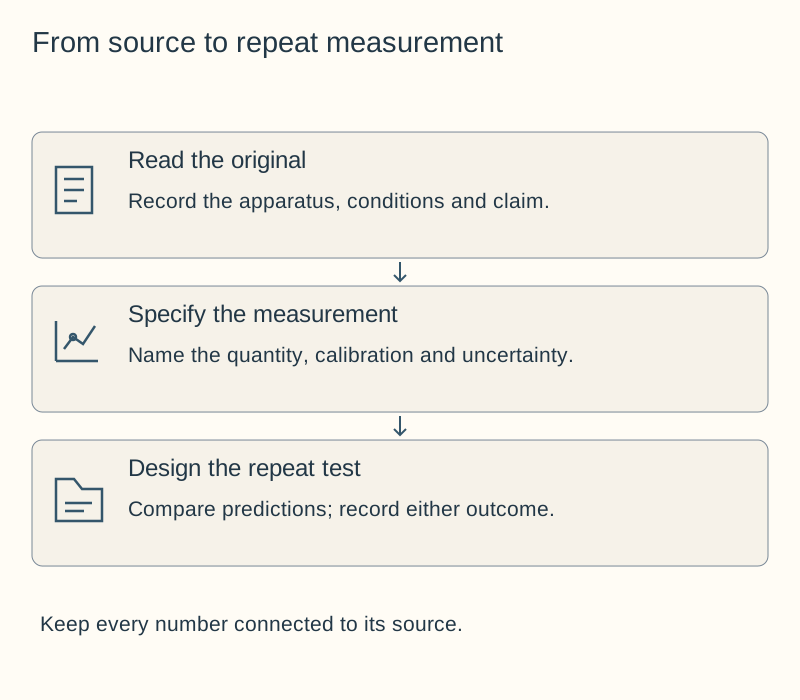
A measurement of the Casimir force reports how an instrument responds under specified conditions. Read the geometry, calibration and uncertainty before connecting the result to another device. NASA’s lattice-confinement-fusion research, superfluid-vacuum models and zero-point-energy experiments each need that same close reading.
A Pais patent records an invention and its proposed operation. To find out how a device behaves, look for its test conditions and measured output. A useful question is what observation would distinguish the proposed mechanism from another explanation.
Try it with one paper: identify the quantity measured, the comparison experiment and the reported uncertainty. Then describe a repeat measurement that another laboratory could make. Keep the paper beside your notes so every number stays attached to its source.
Naming the next experiment
For every major claim, we write down in advance the measurement that would move it. That one line turns an idea into a research programme. It tells you where to point the instrument, and it tells you what a result means before you have it.
The best work in this field does exactly that. It says ahead of time what would move it, then goes and measures. Several groups did that this season, and you meet them at the end of this chapter.
When separate lines agree
Confidence grows fastest when independent streams land on the same answer. A patent, a bench measurement, and a theoretical prediction that never knew about each other are three clues, and that pattern is the one worth hunting. Ten retellings of one claim are still one claim. So this book always walks back to the primary document: the paper, the patent, the released file.
Bayes’ rule rewards specific predictions. Suppose two laboratories obtain separate measurements: each can add information if their errors are independent. Ten articles reporting the same measurement do not create ten experiments. Shared instruments, data or assumptions can also make apparently separate results depend on one another.
Put the method to work
Choose a prediction, name the instrument and write down the expected result before testing. Include the uncertainty: a small difference may fit the instrument’s normal variation. Record what happened even when it changes your explanation. This is how a reader can follow the investigation from an interesting idea to a useful experiment.
What the field added — July to September 2026
Two months of new material gave this chapter fresh practice at the part of the method that does the real work: going back to the primary record before repeating anything. Several claims that arrived this season as a headline turned out, on inspection, to be a company's own announcement, or a preprint, or an interview — each of which is worth reading, and none of which is an independent measurement. Naming which one you are holding is not scepticism. It is the first step of the calculation above, because it is what sets P(E) honestly.
The season also showed how a good investigator updates. Teams in this field published results that did not survive their own screens, and revised in public. Revising a hypothesis as the data come in is not weakness; it is the method. And the CIA's own declassified U-2 history — sightings the agency knew were aircraft and let stand as UFOs — is the documented reminder that institutions sometimes prefer a strange public story to a classified one, which is why this chapter asks for primary documents. This season delivered several. Details in the research log, and the editorial process itself is written up on the method page.
Sources
This is a method chapter; its "sources" are the tools it borrows, all canonical.
Primary / canonical
- Bayes & Price (1763), "An Essay towards solving a Problem in the Doctrine of Chances," Phil. Trans. R. Soc. 53, 370. DOI 10.1098/rstl.1763.0053. Public domain.
- K. Popper, The Logic of Scientific Discovery (Eng. ed. 1959) - the discipline of saying in advance what would change your mind.
- E. T. Jaynes, Probability Theory: The Logic of Science (CUP, 2003) - modern Bayesian treatment.
Where the evidence bar got its phrasing
- M. Truzzi (1978), "extraordinary claims require extraordinary proof," Zetetic Scholar 1 - the modern phrasing; C. Sagan, Cosmos (1980, ep. 12) popularized it; the underlying idea is Laplace's.
Counting independent lines, made quantitative (beyond the source corpus)
- J. Ioannidis (2005), "Why Most Published Research Findings Are False," PLoS Med. 2(8):e124, open access at 10.1371/journal.pmed.0020124 - prior odds x power x bias; the arithmetic behind "one independent replication is the unit of evidence."
- "Risk and Scientific Reputation: Lessons from Cold Fusion," arXiv:2201.03776 - how a large energy claim gets judged, and how a field goes back and re-tests it (a running worked example in Ch. 12).
Where separate traditions agree: the tools above come from probability theory, philosophy of science and metascience. They were built for different jobs and land on the same discipline - the convergence this book is built to look for.