Ages 8–12 · about 6 minutes
Why Doesn't the Book Fall?
If gravity is pulling the book down, why does it just sit there?
Do this first · Try this at home
Add the force arrows
Start with your hands. The reading makes far more sense afterwards.
You need: Paper and a pencil, or someone to describe and draw the arrows with you
0 of 3 steps done
What should I notice?
Notice: The second drawing has one unit of net force upward: the book's velocity would change upward, not jump instantly. These are invented comparisons, not measurements. If drawing is difficult, describe four up versus four down, then five up versus four down, with a helper.
Now read on to find out why it happens.
The big idea
A supported object can stay still while gravity keeps pulling. Balanced forces mean no change in velocity, not no forces.
- net force
- All the forces on one object added together, including their directions.
- inertia
- An object's tendency to keep its velocity unless a net force changes it. A still object has inertia too.
- superconductor
- A material that carries direct electric current with zero electrical resistance under its required conditions.
- critical temperature
- The temperature below which a particular material can become superconducting; current and magnetic field also matter.
Earth pulls the book downward. The table supports it upward. In this simple model, the two forces on the book have equal sizes and opposite directions, so their sum is zero. Gravity still acts.
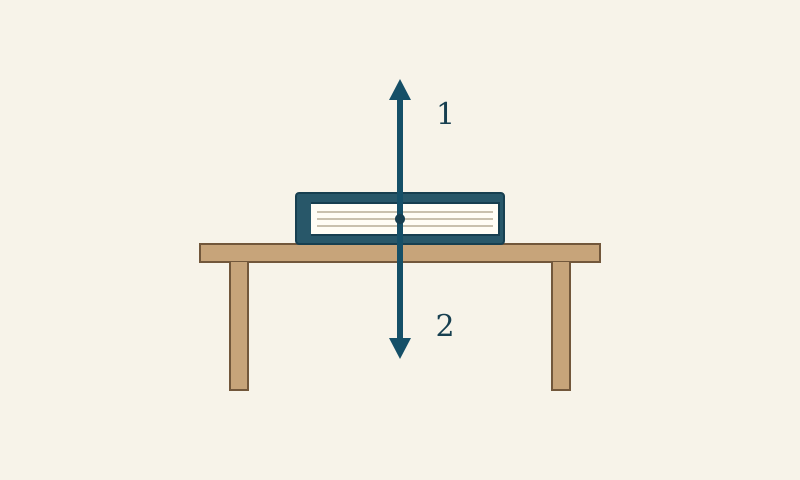
Add the forces, not just the motion
Net force means adding every force on one object, with its direction. Zero net force means no acceleration: a still object stays still, and a moving object keeps going straight at constant speed. Moving does not always mean the forces are unbalanced.
The book still has inertia: changing its velocity requires a net force. Both arrows describe forces on the book. They are not an action-and-reaction pair, because those paired forces act on different objects.
Down depends on where you stand
Near Earth's surface, its gravitational pull points approximately toward its center. People on opposite sides of Earth have opposite directions of down in space. Gravity acts all around Earth; it does not pick one downward direction for the universe. Our book diagram shows two local forces, not a dip in spacetime.
Magnetic support
Some materials become superconductors below their own critical temperature. They carry direct electric current with zero electrical resistance. Temperature is not the only condition: too much current or magnetic field can end superconductivity. Cooling just any material does not make it a superconductor.
In a suitable laboratory arrangement, magnetic forces between a magnet and a superconductor can support a hovering object. When it stays still, the upward magnetic force balances its downward weight. Gravity has not been turned off. The support is magnetic instead of a tabletop.
Not every magnet-and-superconductor arrangement holds an object steadily. These demonstrations need suitable materials and controlled conditions. The cold equipment belongs with trained people in a laboratory; our activity uses only paper and a pencil.
Imagine removing the book's support without touching it. In our two-force model, gravity would be left unbalanced and the book would accelerate downward. Its inertia and Earth's attraction were there all along.