Quantum mechanics: states, amplitudes, and measurement
Replace tiny classical particles with states, amplitudes, operators, and testable probabilities.
Build a careful introduction to superposition, interference, uncertainty, quantization, and measurement before returning to vacuum fields.
Interactive model
Explore before calculating
Live laboratory
Quantum wave-packet explorer
Localize a minimum-uncertainty packet and watch its momentum spread respond. Translating the packet changes its mean position, not the uncertainty product.
Δx: 0.50 nm
Minimum Δp: 1.05e-25 kg·m/s
ΔxΔp: 0.50 ħ
Electron velocity spread: 1.16e+5 m/s
This is a Gaussian minimum-uncertainty model, not a hidden classical trajectory. Narrower position preparation requires a broader distribution of possible momenta.
Level 2 · Secondary physics teaching kit
Record the investigation. Teach the reasoning.
A learner-facing lab record and a course-specific instructor guide turn the live model into a repeatable classroom investigation.
Learner record
Wave-packet width and uncertainty record
How does narrowing a wave packet in position change its momentum spread and later evolution?
Download learner recordInstructor guide
Teach for evidence, not button pushing
Learners connect localization with momentum spread without treating a wavefunction as a literal material wave or hidden classical path.
Download instructor guideLesson 1 of 3
States, amplitudes, and probabilities
Why do quantum alternatives interfere before a measurement outcome is recorded?
A quantum state encodes probability amplitudes for possible measurement outcomes. Amplitudes can carry phase and must be added before their squared magnitude gives probability.
This is why two-path experiments show interference even when detections occur one at a time.
Worked example
Two equal path amplitudes arrive in phase. What happens qualitatively?
- 1. Add the amplitudes.
- 2. The total amplitude doubles.
- 3. Probability depends on squared magnitude.
The probability can become four times one-path probability at that location, balanced by destructive regions elsewhere.
Try it
Amplitude arrow addition
Materials: Paper arrows or a phasor simulation.
- 1. Draw two equal arrows aligned.
- 2. Add head to tail.
- 3. Repeat with opposite arrows.
- 4. Compare squared resultant lengths.
Notice: Phase changes probabilities through amplitude addition, not by adding ordinary probabilities first.
Check your understanding: In a two-path quantum experiment, what is added before probability is calculated?
Answer: Probability amplitudes.
Their phases create constructive and destructive interference.
Lesson 2 of 3
Observables and uncertainty
What does it mean for a physical quantity to be represented by an operator?
An observable is associated with an operator whose eigenvalues are possible measurement outcomes. A state may be sharp for one observable and spread across outcomes for another.
Position and momentum uncertainty is structural, not merely poor instruments. It follows from the noncommuting operations that represent them.
Worked example
A wave packet is squeezed into a narrower position range. What happens to momentum spread?
- 1. A narrow packet requires more wavelength components.
- 2. Different wavelengths correspond to different momenta.
- 3. Momentum distribution broadens.
Improving position localization increases momentum uncertainty.
Try it
Wave-packet construction
Materials: A wave-superposition simulation.
- 1. Combine a few nearby wavelengths.
- 2. Observe the broad packet.
- 3. Add a wider range of wavelengths.
- 4. Compare localization and component spread.
Notice: Localization is built from a broad spectrum, visually linking Fourier structure to uncertainty.
Check your understanding: Is Heisenberg uncertainty only caused by disturbing a particle with a measurement device?
Answer: No.
Measurement disturbance can matter, but the uncertainty relation is a property of quantum states and noncommuting observables.
Lesson 3 of 3
Quantized energy and the ground state
Why can an oscillator lose thermal energy yet retain zero-point energy?
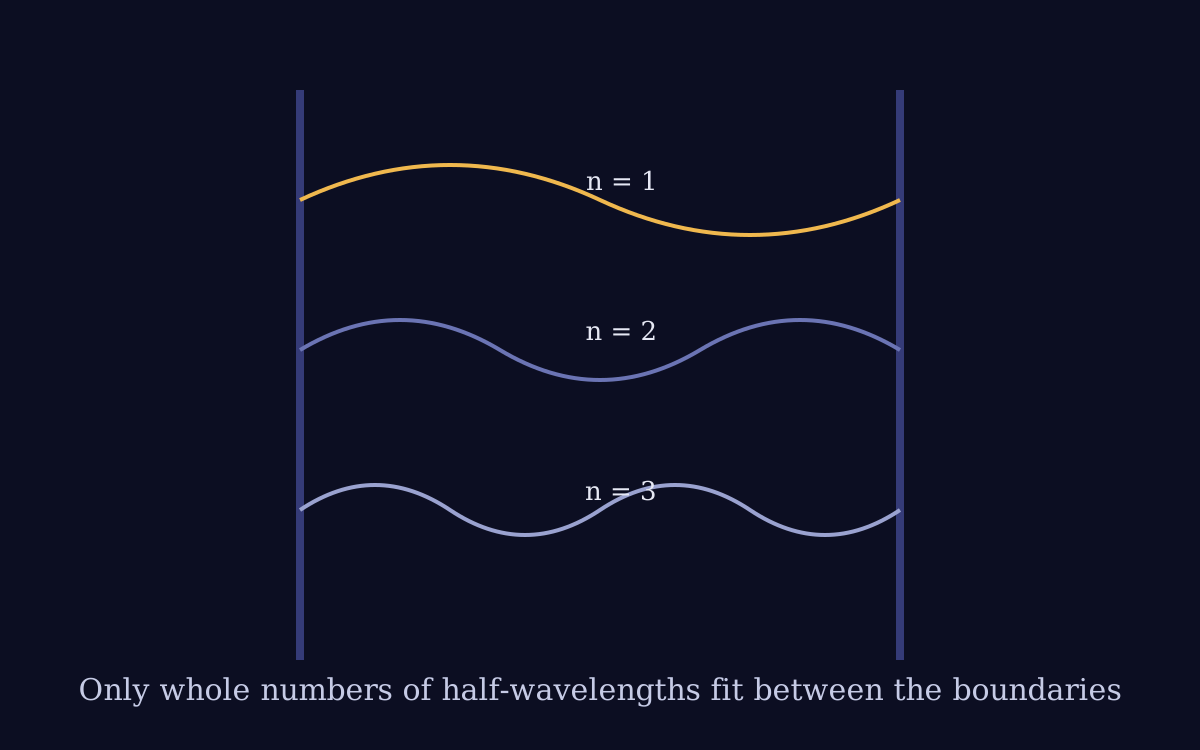
Bound quantum systems often allow discrete energy levels. Transitions exchange energy in quanta fixed by level differences.
For the harmonic oscillator, the lowest energy is ½ℏω. It is not an unlimited accessible reservoir: the ground state is already the minimum state for that Hamiltonian.
Worked example
An oscillator frequency doubles. How does its ground-state energy change?
- 1. Use E₀ = ½ℏω.
- 2. Ground-state energy is proportional to angular frequency.
- 3. Double ω.
The ground-state energy doubles, while extracting cyclic work still requires changing the system and paying those control costs.
Try it
Energy-level spectroscopy
Materials: A simulated atom with selectable photon energy.
- 1. Send photons below a level gap.
- 2. Increase to the exact gap.
- 3. Record absorption.
- 4. Try larger nonmatching and matching gaps.
Notice: Discrete absorption reveals allowed energy differences rather than arbitrary classical energies.
Check your understanding: Why is a ground state not automatically a fuel tank?
Answer: Because it is already the lowest energy state of the specified system.
Useful work requires a transition to a lower accessible state or an externally changed Hamiltonian and complete cycle.
Formula-to-meaning deck
Read the equation in ordinary language.
P = |ψ|²
Outcome probability density is the squared magnitude of the state amplitude.
Units: context dependent
ΔxΔp ≥ ℏ/2
Position and momentum spreads cannot both be arbitrarily small.
Units: J·s
E_n = ℏω(n + ½)
The quantum harmonic oscillator has discrete levels and nonzero ground energy.
Units: J
Independent practice
Problem set
Work each problem before opening its hint and solution.
1. Two real amplitudes +0.4 and +0.3 reach one outcome. Find the unnormalized probability weight.
Reveal hint
Add amplitudes, then square.
Reveal solution
|0.7|² = 0.49.
2. The same amplitudes arrive with opposite signs. Find the weight.
Reveal hint
Add +0.4 and −0.3 first.
Reveal solution
|0.1|² = 0.01.
3. Find the gap E₂−E₁ for a harmonic oscillator.
Reveal hint
Subtract ℏω(2.5) − ℏω(1.5).
Reveal solution
ℏω.
Continue into the evidence