Dissertation and synthesis colloquium
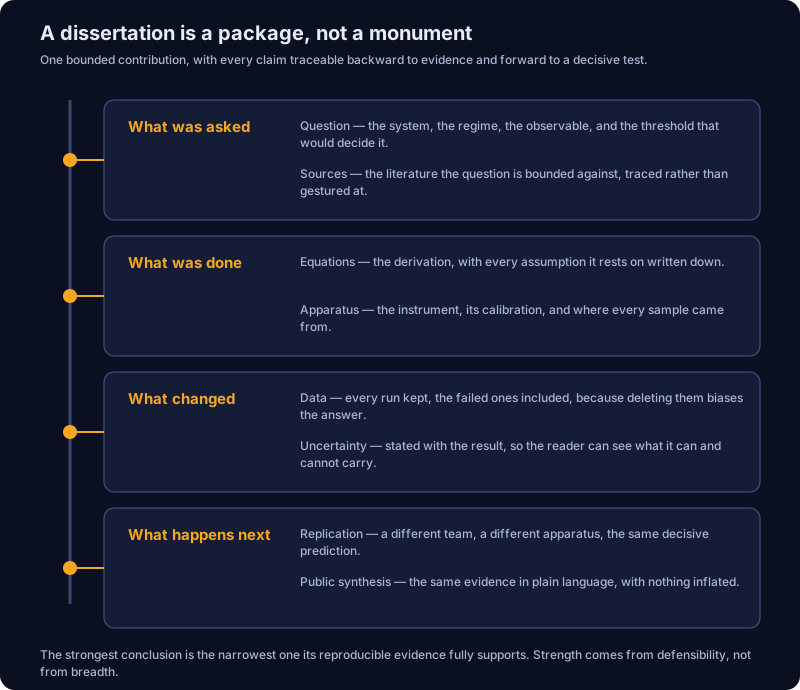
Defend one original, reproducible contribution that states exactly what is known, unknown, and experimentally decisive.
Integrate question formation, literature synthesis, theory and methods, preregistration, research execution, uncertainty, negative results, reproducibility, committee review, public communication, and a defensible dissertation package spanning the site's physics and evidence standards.
Interactive model
Explore before calculating
Live laboratory
Dissertation dependency and release compiler
Compile claim tracing, executable outputs, negative runs, robustness, independent reproduction, committee closure, and public translation into one sequential release decision.
Sequential gates passed: 1/6
Next dependency: Executable audit trail
Independent reproductions: 0
Release decision: hold
Hold at gate 2: Executable audit trail. Later completeness cannot bypass this dependency.
This compiler records declared artifact readiness; it does not award a degree or establish a thesis claim. The committee must inspect the actual sources, data, code, environments, uncertainty, deviations, negative results, authorship, ethics, and public evidence language.
Level 6 · Research preparation teaching kit
Record the investigation. Teach the reasoning.
A learner-facing lab record and a course-specific instructor guide turn the live model into a repeatable classroom investigation.
Learner record
Dissertation evidence-package compiler
Does the dissertation contribution remain defensible when claims, executable outputs, nulls, robustness, reproduction, committee objections, and public language are compiled in order?
Download learner recordInstructor guide
Teach for evidence, not button pushing
Researchers compile a bounded, reproducible contribution whose claims survive null preservation, robustness checks, independent reproduction, and adversarial defense.
Download instructor guideAdvanced assessment
Reconstruct it. Quantify it. Try to break it.
Compile a dissertation as a network of bounded claims, reproducible artifacts, adversarial tests, and honest residual limitations. Three research-level challenges include explicit deliverables and scoring criteria.
Portable research dataset
Record data that another laboratory can open.
Claim, artifact, adversarial test, limitation, and sequential readiness records. JSON preserves schema and provenance; CSV supports ordinary analysis tools. Imports stay in this browser and are limited to 1 MB and 5,000 records.
Ready for a new research record.
| Compiler gatelabel | Bounded claimstatement | Evidence artifactreference | Adversarial teststatement | Passedboolean | Residual limitationstatement | Record |
|---|---|---|---|---|---|---|
Schema field definitions
- Compiler gate · label
- Sequential evidence-package gate.
- Bounded claim · statement
- Claim evaluated at this gate.
- Evidence artifact · reference
- Stable evidence-package reference.
- Adversarial test · statement
- Strongest relevant challenge.
- Passed · boolean
- Gate decision.
- Residual limitation · statement
- Limitation retained in technical and public conclusions.
Lesson 1 of 3
Research question, contribution, and committee contract
What precise uncertainty will the dissertation reduce, and how will the committee know?
A defensible question names the system, regime, comparison, observable, and decision threshold. Originality can be a new derivation, measurement, bound, dataset, method, replication, or synthesis.
The contribution matrix separates required claims from optional interpretations. Committee membership should cover theory, experiment/computation, statistics, and an adjacent field that can test the assumptions.
Worked example
Narrow 'Can vacuum energy power propulsion?' into a dissertation question.
- 1. Choose one mechanism and parameter regime.
- 2. Define a measurable output and all inputs.
- 3. Specify best conventional comparator.
- 4. Set a threshold that would exclude or support the model.
A bounded question might test whether a driven cavity's calibrated momentum transfer exceeds electromagnetic, thermal, and pump-momentum predictions across preregistered reversals.
Try it
Contribution matrix defense
Materials: One-page proposal
- 1. Write primary contribution.
- 2. List dependent claims.
- 3. Assign evidence and failure criteria.
- 4. Invite committee members to remove or narrow unsupported claims.
Notice: A smaller contribution with decisive evidence is stronger than a sweeping thesis assembled from suggestive pieces.
Check your understanding: Can a null result be an original dissertation contribution?
Answer: Yes.
A strong null can exclude important parameter space, validate methods, or settle a precise research question.
Lesson 2 of 3
Execution, audit trails, and negative-result integrity
Can every change from proposal to conclusion be reconstructed and justified?
Preregistration freezes confirmatory choices while a change log records justified deviations. Exploratory work remains valuable when labeled and followed by new confirmation.
Versioned data, code, notebooks, apparatus/sample provenance, calibration, failed runs, and decision logs create an audit trail. Uncertainty and model checking accompany every headline result.
Worked example
A primary analysis fails but a new filter produces significance. How should it appear?
- 1. Report the preregistered null first.
- 2. Label the new filter exploratory.
- 3. Explain why it was tried.
- 4. Validate it on held-out or new data before confirmatory claims.
The exploratory pattern becomes a future hypothesis, not a replacement for the failed primary test.
Try it
Reproducibility freeze
Materials: Current research repository and clean environment
- 1. Tag data and code release candidate.
- 2. Rebuild all figures from raw inputs.
- 3. Verify hashes and dependencies.
- 4. Have an uninvolved reviewer execute the package.
Notice: A dissertation is not reproducible until a different person can regenerate its key results.
Check your understanding: Why preserve failed runs?
Answer: They reveal selection, apparatus reliability, boundary conditions, and the true rate of null or anomalous outcomes.
Deleting them biases both effect and uncertainty estimates.
Lesson 3 of 3
Defense, synthesis, and public translation
Which conclusions survive the strongest fair objection, and how should they be taught publicly?
The defense tests assumptions, derivations, methods, statistics, alternatives, and scope. A committee should be able to distinguish thesis-critical weaknesses from future work.
Public synthesis translates equations and evidence without inflating certainty. Established results, measurements, active research, proposed interpretations, and speculation remain visibly separated even when the narrative is ambitious.
Worked example
How should a dissertation with one replicated effect but unresolved mechanism conclude?
- 1. State the replicated observation precisely.
- 2. Report models excluded and remaining.
- 3. Do not name an unproven mechanism as fact.
- 4. Specify the smallest deciding experiment.
The observation can be established while mechanism remains active research.
Try it
Three-audience colloquium
Materials: Same result for specialist, graduate, and public audiences
- 1. Present technical derivation.
- 2. Present graduate-level evidence chain.
- 3. Present public explanation with no jargon leakage.
- 4. Check that evidence wording remains identical.
Notice: Accessibility should simplify language, not alter the evidence presented.
Check your understanding: What is the strongest dissertation conclusion?
Answer: The narrowest conclusion fully supported by reproducible evidence and explicit assumptions.
Strength comes from defensibility, not breadth.
Formula-to-meaning deck
Read the equation in ordinary language.
Contribution=claim+method+evidence+boundary
A durable contribution pairs a bounded proposition with how it was established and where it stops.
Decision: advance if P(data|model)/P(data|null)>K and robustness gates pass
A decision rule combines quantitative discrimination with prespecified methodological gates.
Reproducibility=inputs+versions+commands+expected outputs+checksums
A package is reproducible when another person can regenerate defined outputs from frozen inputs.
Independent practice
Problem set
Work each problem before opening its hint and solution.
1. Rewrite 'the aether is real' as a falsifiable dissertation claim.
Reveal hint
Specify model, coupling, observable, and comparator.
Reveal solution
Example: 'Model A predicts a sidereal phase modulation of amplitude X under configuration Y that standard electromagnetic and thermal models keep below Z; a blinded year-long test will estimate or bound X.'
2. Why is a robustness gate needed in addition to a likelihood threshold?
Reveal hint
Consider artifacts and analysis dependence.
Reveal solution
A model can win statistically while relying on failed calibration, unstable preprocessing, or one unreplicated condition; robustness gates enforce methodological validity.
3. What files must regenerate a dissertation figure?
Reveal hint
Trace from raw input to pixels.
Reveal solution
Raw or referenced immutable data, metadata, code/notebook, locked dependencies, exact command, configuration, and expected checksum or numerical assertions.
Derivation studio
Build the result, line by line.
Keep the assumptions visible so the mathematics remains auditable.
Starting point
Bounded claim decision rule
Define target model M₁, null M₀, and prespecified robustness gates G
- 1. Compute predictive likelihood or a declared test statistic.
- 2. Calibrate threshold under M₀.
- 3. Evaluate sensitivity and alternative specifications.
- 4. Require G before changing claim status.
Advance claim only when statistical threshold and every critical robustness gate pass
Evidence status is a compound scientific decision, not a p-value or Bayes factor alone.
Starting point
Reproducibility dependency closure
Each result R depends on data D, code C, environment E, and parameters P
- 1. Represent dependencies as a directed acyclic graph.
- 2. Hash every immutable leaf.
- 3. Record commands that transform parents to children.
- 4. Verify final outputs and tests from a clean root.
R=f(D,C,E,P) with every dependency versioned and auditable
Dependency closure turns a narrative claim into an executable scholarly object.
Computational notebook
Turn the model into an experiment.
Dissertation evidence compiler
Can every thesis claim be regenerated, source-traced, uncertainty-checked, and assigned an evidence boundary?
Inputs
- • Claim register and literature graph
- • Versioned data, code, and notebooks
- • Committee criteria and deviation log
Algorithm
- 1. Build claim-to-evidence dependency graph.
- 2. Execute all reproductions from clean environments.
- 3. Run uncertainty and robustness gates.
- 4. Generate technical and public evidence summaries.
Evidence to produce
- • Executable dissertation compendium
- • Claim-status and limitation matrix
- • Committee audit and public teaching module
Paper-reading studio
Interrogate the source, not its reputation.
Reconstruct the assumptions, reproduce one calculation, and stop at the boundary of the reported evidence.
Dissertation synthesis dossier
Which original contribution survives complete reproduction, adversarial review, and the strongest conventional alternative?
- 1. Trace every thesis claim to source or data.
- 2. Reproduce all critical derivations and figures.
- 3. Audit deviations, negative results, and uncertainty.
- 4. Separate contribution from interpretation and future work.
Calculation to reproduce: Reproduce the dissertation's central result and its strongest alternative-model comparison from frozen inputs.
Evidence boundary: A dissertation establishes only its bounded, reproducible contribution; broader implications remain separately graded research questions.
Graduate oral defense
Defend a bounded claim under pressure.
Argue the strongest support, state the strongest objection fairly, and identify evidence that could actually decide the issue.
Proposition
A scientifically ambitious dissertation is strongest when it makes its uncertainty and failure conditions impossible to miss.
- 1. Explicit boundaries prevent one result from carrying unsupported implications.
- 2. Negative results and deviations reveal the actual research process.
- 3. Reproducibility enables cumulative correction and extension.
Strongest objection: Excessive gating and caution can suppress unconventional synthesis and exploratory discovery.
Deciding evidence: A portfolio showing that bounded preregistered claims coexist with clearly labeled exploration that generates successful independent predictions.
Research practicum
Make the work inspectable before making it impressive.
Pre-register the decisive test, package every dependency, and pass explicit milestone gates before interpretation expands.
Complete the dissertation release gate
Is the contribution ready for committee approval, public teaching, and independent reuse?
Preregister
- • Freeze thesis-critical claims and committee criteria.
- • Define reproduction and robustness gates.
- • Precommit public evidence language and limitations.
Reproducibility package
- • Dissertation source and citation graph
- • Immutable data and sample/apparatus provenance
- • Containerized code, notebooks, and tests
- • All-result manifest, deviation log, and public module
Milestone gates
- 1. Proposal and contribution approval
- 2. Independent reproduction of central result
- 3. Adversarial pre-defense and corrections
- 4. Committee defense, archival release, and public translation
Continue into the evidence
Source-linked next reading
Full curriculum
Trace every prerequisite and return completed research to the teaching pathway.
Disciplinary spine
Demonstrate integration across theory, experiment, computation, and systems.
Knowledge graph
Publish the claim, source, and dependency network supporting the dissertation.
Chapter 13: The unified picture and an honest ledger
Every claim on one map, with the next measurement named for each row.